Boots on the ground as first Australian rescue team arrives in Nepal
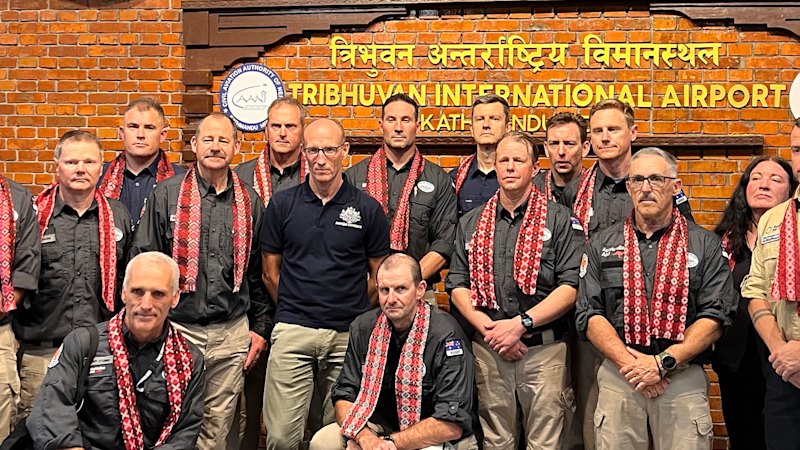
Kathmandu: A team of specialist drone operators from NSW and Queensland has arrived in Nepal, the first Australian rescue workers to reach the disaster-stricken nation since a deadly tidal wave tore through the country last week.
The team, including 10 Fire and Rescue NSW personnel, landed in the capital, Kathmandu, late on Friday night (Saturday AEST) following a plea for help from the Nepalese government.
They are part of the federal government’s $11 million humanitarian support package, and will be joined by disaster victim identification officers from the Australian Federal Police on Saturday.
Chief superintendent Jeremy Stubbs, from Fire and Rescue NSW, said the unit, which included personnel who had experience in the 2011 Christchurch earthquake and Japanese tsunami, would meet with their Nepalese counterparts on Saturday before being deployed to help the rescue effort.
“It’s humbling to have our offer of this type of capability accepted,” he said, as Nepal’s search and rescue effort enters its 10th day.
“I think it demonstrates the relationship that Nepal has with Australia, and also the respect that the Australian community has had for Nepal seeing them go through this type of disaster.”
The Nepalese government has confirmed 1294 deaths, with more than 5000 people still missing, including 583 foreign nationals. The Chinese government has reported 31 confirmed deaths and 531 missing – including 261 foreign nationals – on the Tibet side of the border.
Families of some of the 36 Australians still unaccounted for have expressed angst at the lack of new information from the Department of Foreign Affairs and Trade. Two Australians were removed from the list of those unaccounted for on Friday, sparking hope for some families, but DFAT declined to publicly provide their names or specific locations.
Speaking outside the Tribhuvan International Airport in Kathmandu late on Friday night, Australia’s ambassador to Nepal, Simon Ernst, defended the Department of Foreign Affairs and Trade’s policy of not releasing details. He said privacy laws limited the agency’s ability to disclose people’s identities.
“We can’t do anything differently,” he said. “We can’t talk about them. We can’t disclose their names. We can’t disclose any details that would make them identifiable.”
“They’re quite at liberty to talk to you if they wish to. But we, I can’t do that.
“We generally communicate with the next of kin. Now there are times when people don’t want people, even in their immediate circle, to know where they are.”
While the expectation of finding survivors may be fading, there are still glimmers of hope. Nepalese authorities revealed two people had been rescued alive from a hydropower tunnel on Friday, nine days after the floods hit.
Asked whether authorities still had hope of finding the missing Australians alive, Ernst said: “We do.”
But Ernst said no decision would be made about where the Australian experts would be dispatched until meeting with Nepalese authorities on Saturday.
“They will contribute to the overall Nepali operation, but they’re not a standalone outfit,” he said.
“This is part of Australia assisting Nepal, and there’ll be discussions tomorrow about where they deploy and the focus.”
Of the missing Australians, about 15 were part of a tour group undertaking a Hindu pilgrimage up Mount Kailash near the border between Nepal and Tibet when the floods hit. Some of their families have travelled to Nepal and have asked for rescue efforts to be directed to areas where phone pings were detected after the floods.
Ernst said Australia had “specifically asked” Nepalese authorities to search those locations.
“I think we’re getting to the point now where individual areas, pieces of ground have now been searched multiple times,” he said.
While he did not believe authorities had struggled to obtain information from telecommunications companies, it was a question of “whether the data actually helps take forward the investigation or not, or the search or not”.
“In some cases, it does. In some cases, it’s inconclusive,” he said.
“But it’s a pretty obvious question, and we can be confident we’ll be, you know, making that particular, our particular interest in that location known, as we already have.”
Other Australian help has arrived since the glacial collapse near the border with Tibet sent an inland tidal wave tearing through the country last week, including aid supplies aboard Royal Australian Air Force plane on Wednesday.
However, the drone specialists are the first dedicated rescue team to arrive. While there have been questions over why Australians had not deployed sooner Ernst said it was a response to requests from the Nepalese government.
“They don’t need more boots on the ground, so to speak,” he said. “They need technology and expertise and that’s part of what our team is.
“Access has been very difficult, so pouring more people into it doesn’t necessarily help with the issue.”
The team has arrived with two sets of drones. One, Stubbs said, was small enough to fit in the palm of a hand, and could be used to fly inside damaged homes and tunnels.
“The benefit of that is we have a structural engineer with us. That structural engineer will do an assessment of what they can see and determine whether it’s safe for us to go in, but the imagery is fantastic as well,” he said.
The larger drone conducts what he called a “broad area assessment” which can quickly provide mapping to the Nepalese government and emergency workers.
Get a note directly from our foreign correspondents on what’s making headlines around the world. Sign up for our weekly What in the World newsletter.
KioskNews shows a cleaned-up reading view extracted from the publisher’s page — the original always lives on their site, not ours.