A cornered Trump is a more volatile Trump
Insecure, alone and a poor strategic thinker, Donald Trump poses an unpredictable threat following his party’s staggering election losses
By Timothy L. O’Brien / Bloomberg Opinion


“Nobody knows the system better than me, which is why I alone can fix it” then-presidential candidate Donald Trump said at the 2016 Republican National Convention. Trump has always been a loner, in politics, business and life. His inherent distrust of others, belief that every contest is a zero-sum game, inherited wealth, detachment from reality and abiding self-regard all play into this. He harbors a long-standing fascination with swift, bold and unilateral solutions to complex challenges — whether that involves prosecuting a perilous war in Iran, launching inflationary trade battles or jumping headlong into this week’s bruising midterm election.
Trump’s preference for piloting solo encourages him to double down when he fails, with little regard for consequences. The bruising losses the president and Republicans endured in the midterms — with Democrats handily winning control of both chambers of Congress — formally ushers Trump into the lame-duck chapter of his second White House term. That might recommend compromise and collaboration, in the interest of responding to an epic electoral implosion by considering and meeting voters’ needs.
Trump certainly gestured in that direction once the magnitude of his defeat became apparent.
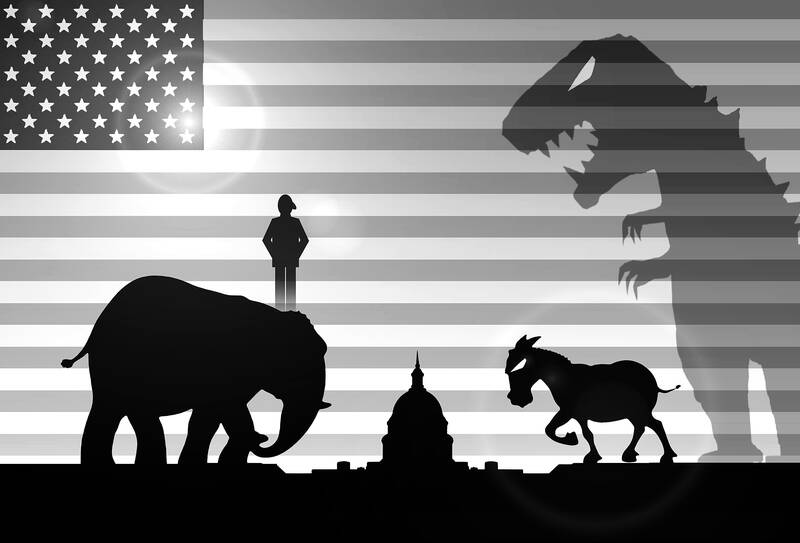
Illustration: Yusha
“I think I can work with everything,” he told Fox News in the early hours of Wednesday morning when asked if he planned to cooperate with Democrats. He congratulated his opponents and did not question the bona fides of their victory.
He could have left it at that, but, of course, he did not.
“They’re in control, but they’re really not in control,” he said, telling the Fox crew and its audience that he still has the power to veto Democratic legislation he does not like.
That sounds much more like the Trump who rarely concedes or collaborates; the same Trump who defiantly plowed through careers as a real estate developer, casino operator, serial bankruptcy artist and reality TV curiosity before becoming president. A Trump cornered in his previous incarnations was usually a Trump who lashed out, and it is likely that is the president the world is going to live with for the next two years.
It would be a welcome surprise if a more evolved Trump emerged on the other side of his electoral defeat, but his history and histrionics teach otherwise. Introspection has not been his strong suit. He dismissed the idea of seeing a therapist when asked.
“I have found I am not a disbeliever in it,” he said. “But I look at reports that psychiatrists have by far the highest rate of suicide than anybody — that means they’re pretty fucked up, and I don’t have the time for it.”
When asked about public figures he admired, he cited Orson Welles, the legendary film director.
“He was like this great genius that after twenty-six, never ever did it. He became totally impossible,” Trump said. “He thought everybody was a moron, everybody was this, everybody was that; if he had a budget, he’d exceed it by 20 times and destroy everything. He became impossible. I loved that.”
This passes for self-awareness from a man who thinks he is surrounded by morons and does not blink at being impossible or destructive — especially when he inhabits an empowering venue such as the White House.
James Talarico, the Democrat who just secured a lopsided Senate victory in Texas, told his supporters he looked forward to instilling bipartisan civility and a “politics of love” in his work. Togetherness is not Trump’s go-to melody. The politics of retribution, financial grifting, monument-building and authoritarian flexes are his comfort zones.
What should the US and its observers around the globe expect from Trump between now and 2028?
The president has grown used to an acquiescent Congress, courtesy of Republicans who ceded their institutional powers and prerogatives because of shared ambitions, realpolitik and fear. Trump went on to tax, spend, manage and mismanage the federal government, send armed, masked immigration agents onto US streets, fire off tariff salvos, run roughshod over the law and go to war in the Middle East as he saw fit. He dismissed the social, geopolitical and economic malaise that sprang from this as little more than hoaxes.
Congressional Democrats are going to be more assertive than their Republican counterparts in monitoring the executive branch, and Trump’s tolerance of that independence might be, at best, short-lived. He would certainly exercise his veto powers. Democrats would try to leverage legislative majorities to override his vetoes — or settle for scoring political points. Tech and AI regulation, healthcare, affordability initiatives and immigration would likely be among the primary policy battlegrounds. Gridlock could prevail.
Democratic investigations, including exploring the contours of White House corruption and the conduct of the Iran war, are being teed up. If the Democrats can force a winding down of the war and an end to Trump’s tariff follies, they could snap up quick economic and geopolitical victories. However, Trump would probably come out fighting against probes he would inevitably, relentlessly brand as witch hunts and policy reversals he would personalize and would not stomach.
Presidents of both parties, especially second-term ones, have historically tended to venture overseas when they have found themselves stymied domestically. The Constitution and an uncertain world offer latitude and freedom from congressional control many presidents have prized. For a loner, the draw is even more potent.
Trump’s wanderings, fundamentally bellicose and strategically haywire, have mired him in Iran and found him essentially abandoning Ukraine in its war with Russia. He has engaged in meandering but muted fisticuffs with China. He did not bother learning until after the fact that an Iran under siege could tie up oil flows through the Strait of Hormuz and a China threatened with potentially suffocating tariffs could withhold rare-earth metals from global supply chains.
Even so, expect Trump to choose overseas theaters when he wants to fly solo. Will he either offer Taiwan as a sacrificial lamb to China or, to keep the world off balance and everyone guessing, engage in a more pointed economic or military smackdown with China? Will he try batting Europe around some more and continue leaving Ukraine to dangle? Will he escalate in Iran rather than embrace a diplomatic resolution? I do not know, and I suspect the president is not sure himself just yet.
Trump thinks about the world and himself cinematically, not strategically, and how he dominates center stage drives his decisions as much as anything else. He loves and needs an audience, even when he is hoodwinking them.
“I could say the stupidest things, and you’d clap,” Trump told a gathering of his political supporters last month. “It’s true.”
They laughed and clapped.
A comeuppance and reckoning arrived with this week’s midterms, leaving Trump, for the time being, isolated and constrained. It could be a very long and caustic two years.
Timothy L. O’Brien is senior executive editor of Bloomberg Opinion. A former editor and reporter for the New York Times, he is author of TrumpNation: The Art of Being the Donald. This column reflects the personal views of the author and does not necessarily reflect the opinion of the editorial board or Bloomberg LP and its owners.
KioskNews shows a cleaned-up reading view extracted from the publisher’s page — the original always lives on their site, not ours.