Stitching our warped reality together: a cartoonist and art critic take different approaches to the Bayeux tapestry
Our journalists often draw connections between seemingly disparate issues or events to give people a fuller grasp of how things interrelate. But not every story can convey the scope and complexity of today’s algorithmically warped reality.
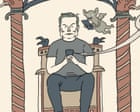
One of the Guardian’s regular cartoonists has managed this feat by drawing inspiration from a medieval embroidery made almost 1,000 years ago. Edith Pritchett was asked by her editors on the Guardian’s Saturday magazine to draw a modern-day version of the Bayeux tapestry, the 11th-century artwork that has been capturing imaginations this month as it goes on public display in the UK for the first time since its creation. Her updated version was included as a pullout poster in the print edition of the Guardian last weekend and also published as a special scrollable digital feature.
Whereas the original Bayeux tapestry tells the story of the events leading up to the Norman conquest of England in 1066, Edith’s take on it depicts today’s battles with online trolls, social media addiction, the manosphere, AI agents and a natural world ravaged by fossil fuels. But her version is more than just a topical reimagining: it gives the viewer a genuine feel for how the different components of today’s dystopia amplify each other.
“I decided on the main topics such as techno-feudalism, the climate crisis, the super-rich, Elon Musk, the online swirling vortex of hatred,” says Edith, “then I tried to work out how to piece it together into a kind of flowing narrative.”
Unlike Edith, the Guardian art critic Jonathan Jones tried to avoid thinking about the Bayeux tapestry in contemporary terms when he encountered the actual artwork at the British Museum for his review of the landmark exhibition. “I’m always against grafting contemporary issues on to [historic] works of art,” he says. “Yet when I saw it, my genuine visceral response was to see some of those parallels. There is real horror in it – the horror of war – and it really did strike me very freshly.”
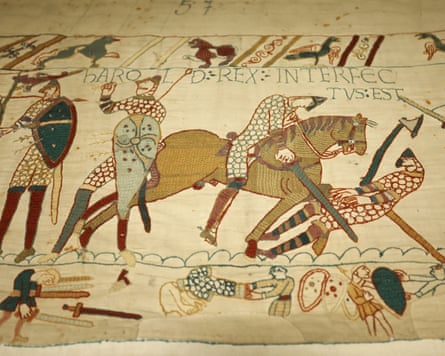
While the Bayeux tapestry might be made of frail linen, it’s hard to overstate its weight as a treasured artwork, historical document and, more latterly, an instrument of Franco-British diplomatic goodwill. Edith was understandably unnerved by the prospect of trying to update it: “I depressed myself by looking at the tapestry online and thinking about how beautiful and amazing it is. I thought, ‘Oh no, I’m going to do this cheap rip-off of it’.”
But she also felt inspired by the challenge. “I knew I was going to be wading into the big questions of today’s age,” she says. “I had an initial jumble of ideas and then picked out things that could be represented in an immediate visual language.” For instance, AI agents are depicted as retro-looking robots. However, she had to ditch some aspects of today’s tech-dominated world. “I would have loved to have included something about datacentres, but how do you draw a datacentre in a way that’s visually engaging? It would have looked rubbish.”
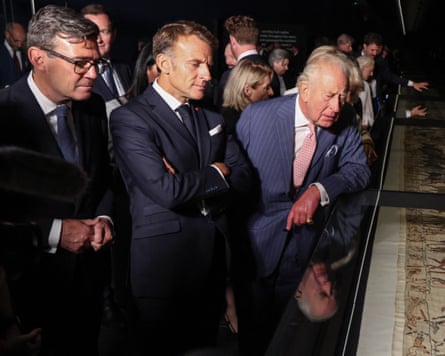
The prominent role of tech titans proved prescient: last week, the Guardian revealed that the tech billionaire Peter Thiel had been granted a private viewing of the Bayeux tapestry at the British Museum ahead of the British and French heads of state.
Given the tapestry’s political significance and history, how did Jonathan avoid approaching it with preconceptions? “I have a fairly visual mind and when I go to an exhibition I avoid reading captions and text as much as possible. I don’t read catalogues until years afterwards,” he explains. “If you focus on the visual experience, what you see is fresh and raw – you’re not seeing it through other people’s words. One of the problems I have as a critic is that, for perfectly good reasons, curators want to talk to you in a show, and I have to politely ask them to leave me alone. It needs to be about what’s directly in front of my eyes. That physical, visceral experience in a direct, unmediated way so that you just open yourself to the images.”
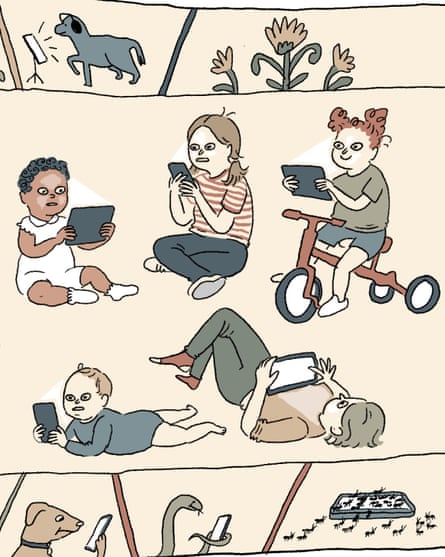
The original artwork stretches to 68.3 metres long. Jonathan describes the experience of viewing it as almost cinematic. But as well as being swept along, his eyes were drawn to the intricate borders above and below the main narrative. These famously feature images of animals and symbolic portents that either mirror the story’s actions and emotions or provide a kind of ambiguous commentary. “So this felt like a whole multifaceted world that aspires to take in the whole of creation,” says Jonathan.
In today’s speak, you could say the borders reveal the vibes. Re-creating them gave Edith further scope to show how some of today’s dystopian tendencies work in tandem. “For instance, I drew an incel narrative along the bottom border,” she says, pointing to images of red and blue pills beneath a scene about the manosphere. Other details include a bitcoin symbol beneath a superyacht; wall-mounted mirrors that literally reflect the social media-induced misery of teenagers; dead animals above an oil rig, while other animals succumb to phone addiction and grapple with four-legged AI robots.
Edith refrained from illustrating some of the more horrifying consequences of today’s dynamics, such as droughts, wildfires and armed conflict, because she didn’t want to be reductive. “As an illustrator, you want to have a visual shorthand for things you’re trying to represent, but you also want to give them dignity. So there are certain things that, if you try to draw them, you would skip all nuance.”
Despite the horrors depicted in the original tapestry, Jonathan was surprised by the levity of some of the panels. “The surreal and comedy aspects were surprising. It felt more contemporary than I thought it would be. It was more raw and shocking as well as funnier.”
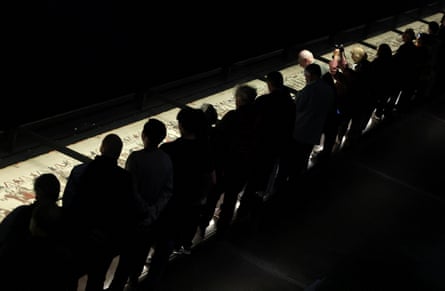
Did the tapestry also seem contemporary in terms of its format and the ways in which people consume narrative content today? “You could say its time has come because we’re more visual,” he agrees. “We don’t read as much, and here’s this raw masterpiece of visual storytelling.”
That said, building a digital version of Edith’s illustration presented unique challenges for our design team. “How do you show readers details in wide images when we’re all looking at these little vertical screens without chopping them up or pinching and zooming?” explains Tara Herman, the Guardian’s executive editor for design. The team’s solution was an interactive format that combines the act of scrolling vertically with the experience of viewing things unfold horizontally – almost as if you’re swiping instead of scrolling. “Our interactive format is an attempt to emulate the experience of being in a gallery where you’re taking your turn looking at a picture and pausing to take in different details.”
This article is taken from the Guardian’s weekly email for supporters, sent on Tuesdays. To support the Guardian’s work, please click here.
KioskNews shows a cleaned-up reading view extracted from the publisher’s page — the original always lives on their site, not ours.