But first, café con pan: 5 Mexican sweet breads worth traveling for
Few things are as important to Mexicans as family and food. One thing that brings both elements together is pan dulce, or sweet bread. Unlike a side to your everyday meal, pan dulce is what you eat while drinking your evening cafecito at home, enjoying a slow breakfast with your extended family, or bring to a dinner when you’re told to bring nothing.
In the same way dishes are completely different from one end of the country to the other, there’s a wide variety of sweet breads depending on which state you are visiting. That’s why we’ve made a list of some of the most iconic pieces of pancito you definitely have to try.
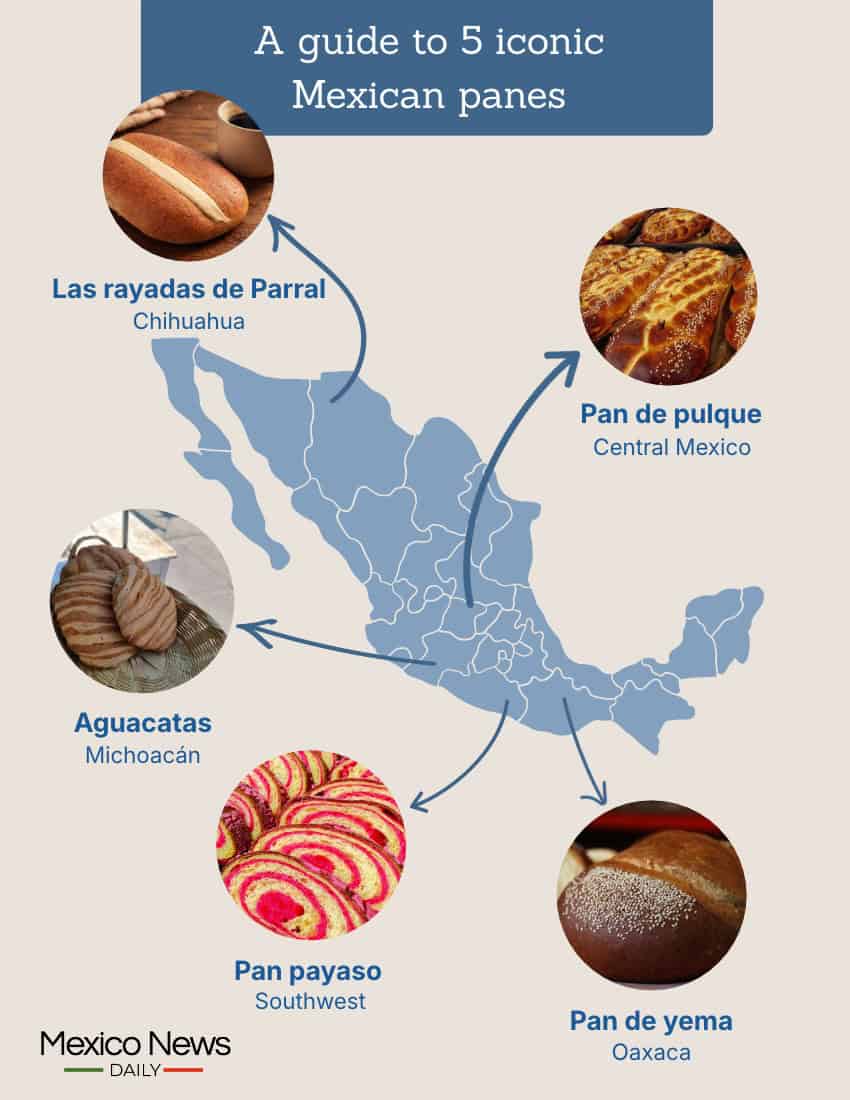
Michoacán: Aguacatas
Round, cakey and sweet, aguacatas are a type of sweet bread you’ll only be able to find in Michoacán and, more specifically, Tingüindín and Uruapan. Similar in shape and size to a tortilla, aguacatas are usually sweetened with piloncillo (whole cane sugar), including small pieces left inside.
Thanks to their shape and mild taste, this type of bread is usually paired or stuffed with sweet chilacayota (sweet pumpkin) and ate (a thick, jelly-like dessert made from the pulp of different fruits). Although they are difficult to find throughout the country, if you happen to be in Michoacán, you should definitely give them a try.

Oaxaca: Pan de yema
Oaxaca is one of the richest states in Mexico, food-wise. From all types of moles to all kinds of fruits, if you are a foodie and have not been to Oaxaca, you should book your trip right away. Just as it is across Mexico, sweet bread also has a great presence in Oaxacan cuisine with the traditional pan de yema.
As its name suggests, the core ingredient for pan de yema is egg yolk, giving it not only its yellowish shade, but also a rich taste and consistency. Unlike other sweet breads, pan de yema is not very sweet, but rather buttery, and so delicious that it transcended its traditional presence during Día de Muertos to be available all year long.
Chihuahua: Las rayadas de Parral
With a 100-year history, las rayadas de Parral has established itself as one of Northern Mexico’s most iconic sweet delights. A piece of this bread is typically simple: an oval shape with a line in the middle — which is where the name “rayadas” comes from.
But besides its unassuming appearance, the legends behind its creation reveal a historic origin.
It is said that rayadas de Parral was invented during the Mexican Revolution to feed Pancho Villa’s troops when they arrived in Parral. Their simplicity comes from the lack of other ingredients brought about by the war. According to legend, not just the local baker, but tailors and even musicians joined in to create this thick, flavorful bread.
Although there are no documents to prove or disprove the myth, there’s a short story by iconic Revolution-era writer Nellie Campobello that chronicles this bread: “They brought the flour and the sweets. Cherna arrived running. We lit the abandoned ovens. We rolled up our sleeves, and there we are, playing the part of bakers.”
Central Mexico: Pan de pulque
No matter the type of bread, they all have one thing in common: they need to rise in order to be soft. Whether with yeast or beer, fermentation is a key part of the bread-making process around the globe.
When Spaniards arrived in Mexico, bringing yeast from Europe was too expensive. But bread needed to be made, so local bakers found a unique, local ingredient that has a yeasty effect: pulque.
Unlike other sweet breads that are synonymous with specific localities, pan de pulque can be found throughout Central Mexico, as states like Hidalgo, Tlaxcala and Estado de México are known for pulque production. With a strong taste and different kinds of fillings and toppings, it has also earned the name of pan de feria or pan de fiesta, as it can be found at almost every local fair.
Southwest Mexico: Pan payaso
Originating in Southwest Mexico, pan payaso is a soft, vibrant delight that catches your eye right away. Present in Guerrero, Oaxaca, Chiapas, Michoacán and even Morelos, the sweet bread’s name — clown sweet bread — comes from its distinctive bright pink swirl. People have also bestowed upon it a slightly less family-friendly moniker, pan borracho, or drunk sweet bread.
Pan payaso’s shape is akin to that of a baguette, covered with sugar and then sliced to let its bright inside be seen. Cloudy and sweet, it is one of the most searched “how tos” when it comes to Mexican sweet bread — and when you taste it, you’ll know why.
Every region in Mexico tells its own story through flour, sugar and tradition. So next time you are visiting any of these states, be sure to turn an everyday bakery visit into a small cultural journey, because there is always a new regional favorite waiting to be shared over a warm cup of coffee.
Lydia Leija is a linguist, journalist and visual storyteller. She has directed three feature films, and her audiovisual work has been featured in national and international media. She’s been part of National Geographic, Muy Interesante and Cosmopolitan.
KioskNews shows a cleaned-up reading view extracted from the publisher’s page — the original always lives on their site, not ours.