‘It’s glottophobia’: Brazilians in Portugal battle for linguistic recognition

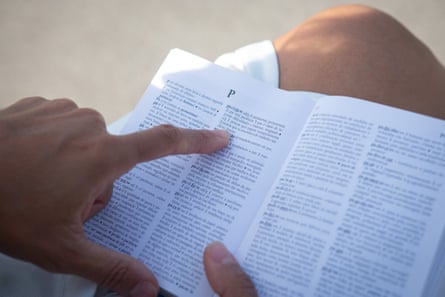
Not long after she started studying to become a nurse in Portugal, Iracema Ferreira began bringing a dictionary to her classes as a retort to accusations she was speaking Brazilian, not Portuguese. “It was to show that those words are in the Portuguese language dictionary,” she said.
A Brazilian speech therapist, Ferreira moved to Portugal in 2020 and later heard from several colleagues from her home country that the process of getting a licence to work in the European country was a dead end. The 45-year-old soon abandoned the idea of continuing the career she had practised for a decade and switched to nursing instead.
The speech therapists’ struggle for recognition underlines what Brazilians say is a wider strand of prejudice still embedded into Portuguese society against the language variant of its former colony. “It’s glottophobia,” said Tanise Anhaia, president of the Brazilian Speech Therapists Association in Portugal (AFBP), using a term to mean linguistic discrimination.
Barely any Brazilians have been awarded a licence to practise as a speech therapist in Portugal since 2019, according to the AFBP, which was set up last year. One of the two exceptions is a woman whose lawyer argued his client’s rejection was “totally incomprehensible, illegal and unconstitutional” and got it overturned.
For many Brazilians in Portugal the struggle will not come as a surprise. People from the Latin American giant make up by far the largest migrant group, numbering more than 480,000, according to the Portuguese migration agency, AIMA. (According to the Brazilian foreign ministry, the population is larger, at 628,000 in 2025.)
However, as the size of the group increases, so do the reports of xenophobia. In 2022, the commission for equality and against racial discrimination reported that “Brazilian nationality” was the most common basis of discrimination in the complaints they received, forming 34% of all complaints.
In 2023 Statistics Portugal reported that 55% of Brazilians said that they had suffered discrimination, the biggest proportion in terms of nationality.
Last year a Portuguese man was arrested after posting a video in which he offered 500 euros for each “Brazilian head” delivered to him.
A Brazilian woman who lives in the Lisbon district, who asked to remain anonymous, told the Guardian she had seen her then eight-year-old being punched by another child and told: “That’s for Brazilians to learn that they have to go back to their land.” Earlier, at a school meeting, she remembered a teacher saying “the kids were speaking too ‘Brazilianised’” and that they would themselves receive speech therapy.
The popularity of Brazilian YouTubers is leading to more young people emulating the speech of their favourite stars, say parents and linguists. In the 1980s there was a similar panic in Portugal over the popularity of Brazilian soap operas, said Afrânio Barbosa, dean of the Centre for Letters and Arts at Brazil’s federal university of Rio de Janeiro.
“Every time a Brazilian cultural product spreads in Portugal there is such a reaction. And you hear the same sentences: ‘They are worsening the Portuguese language’,” said Barbosa. “These are social reactions due to a colonial symbolic projection of the language, as if its legitimacy lay in its geographical origin and not in the historical demographic identity of its speakers.”
Brazil and Portugal are part of the Community of Portuguese Speaking Countries, which has the “diffusion of the Portuguese language” as one of its goals. Yet the question of whether the variants in practice are different languages or not splits linguists. “It’s a very complex discussion,” said Renato Basso, a professor of linguistics at the federal university of São Carlos who studies the history of the Portuguese language.
“The Brazilian Portuguese spoken by people with a university degree from the urban centres and the European standard are relatively similar.”
In schools it’s important that everyone has access to a “standard norm”, added Basso. However, linguists point out that even within Brazil and Portugal, people end up speaking differently depending on where they live and their social circle.
“If you get stuck with the idea that there is only one version of a language, everything gets too complicated,” said Basso.
That seems to be exactly what speech therapists are being told, however. When Anhaia sat the test to get a licence in 2021, there was no linguist present, just a speech therapist, she recalled. At the end, the examiner told her: “I won’t approve you because you don’t speak European Portuguese.” Anhaia will sit the test again this year.
Margarita Correia, a Portuguese linguist, said the requirement was “absurd”. The body responsible for the licences, ACSS, said that some candidates lacked the knowledge to assess the Portuguese population and that their university degrees were not equivalent.
The ACSS declined to comment. The Portuguese Association of Speech Therapists said its members did not have the authority to comment.
Álvaro Filho, a Brazilian journalist and writer who has lived in Lisbon since 2016, assembled chronicles of life as a migrant for his new book Eu Não Falo Brasileiro (I Don’t Speak Brazilian). One of them is about his son, whose teacher said that “he would just pass the class if he spoke Portuguese”.
“It’s implicit that when they say you speak Brazilian it’s because they don’t recognise this Portuguese variant as an equal. It’s worse,” he said. “It might become an autonomous version, but it has to be our decision, from Brazil.”
KioskNews shows a cleaned-up reading view extracted from the publisher’s page — the original always lives on their site, not ours.