Did Beijing and Washington agree on a crisis prevention deal, or not?
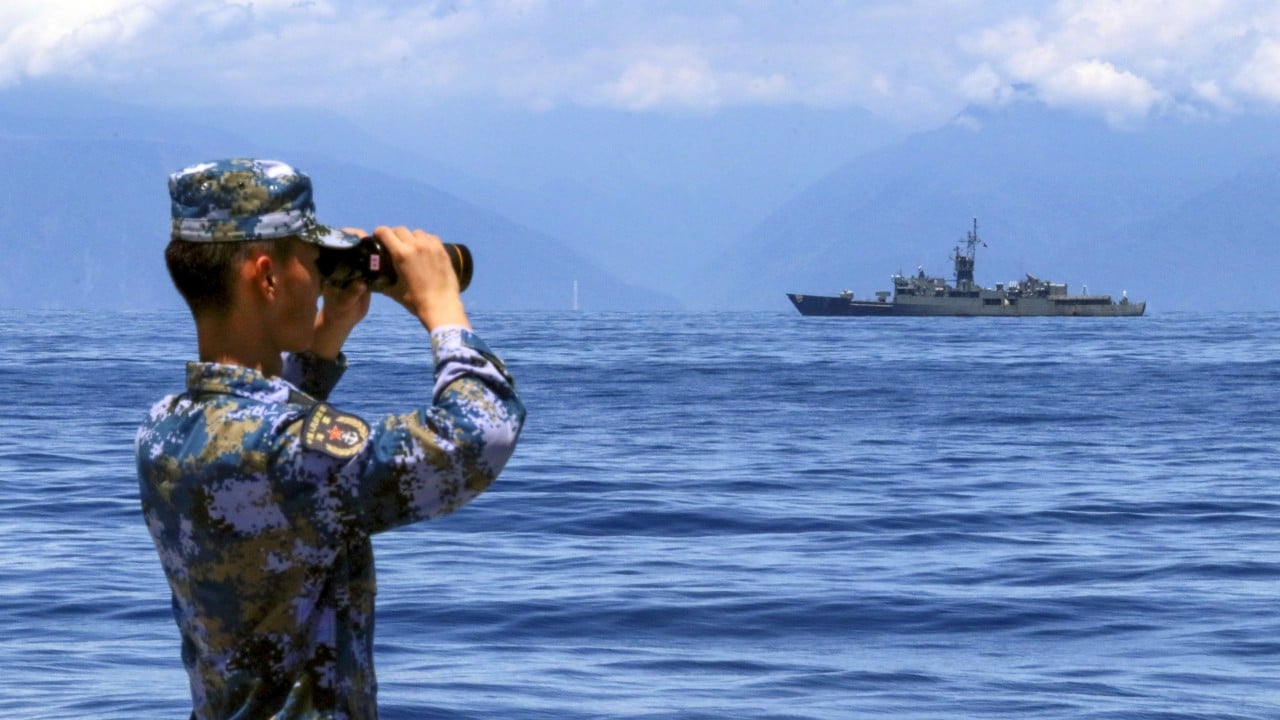
Disagreement over how to prevent conflicts could account for differences in how Chinese and US accounts have characterised discussion on the topic during last week’s summit, analysts said.
Speaking at a White House arrival ceremony, Chinese President Xi Jinping said the two militaries should maintain regular dialogue and “improve mechanisms for crisis communication and prevention.”
China’s foreign ministry said in a statement issued after the summit that the countries’ militaries had agreed “to conclude a memorandum of understanding (MOU) on crisis communication and prevention as soon as possible.”
The MOU was listed separately from the eight “deliverables and understandings” reached at the summit that were also included in the ministry’s statement, which did not specify when or where the two militaries reached this agreement.
Neither the White House nor President Donald Trump himself has made any public comment on the proposed crisis communication and prevention mechanisms or the MOU.
China’s defence ministry did not respond to a request for comment.
China’s Minister of National Defence Dong Jun did not travel with Xi on the US trip last week, nor was any other senior military official included in the Chinese delegation.
“This is not accurate and was not even discussed,” an unnamed US official told the Financial Times, referring to China’s claim about the MOU on crisis communication.
Trump rejects working with China on AI despite Xi’s recent visit
Chinese experts said that Beijing’s remarks could be targeted at building concrete mechanisms after the two countries agreed to a broader framework earlier this year.
Hu Bo, director of the South China Sea Strategic Situation Probing Initiative, a Beijing-based think tank, said Xi’s call for stronger crisis communication and prevention mechanisms could have been aimed at advancing the two countries’ vision of building “a constructive relationship of strategic stability.”
“If you are going to talk about strategic stability, you need to have some measures in place. Otherwise, if something happens, you will not be able to maintain stability,” he said.
Hu said the MOU could address broader understandings between the two militaries on avoiding conflict. Efforts to strengthen military-to-military communication and manage risks had been carried out in recent years through several existing mechanisms, he added.
They included the establishment of a crisis communication working group between the US Office of the Secretary of Defense and China’s Office for International Military Cooperation, with the inaugural meeting held by video conference in October 2020. No subsequent meetings have been held.
Zhou Bo, a retired People’s Liberation Army senior colonel, wrote last year that the 2020 meeting marked the first time crisis management was “officially mentioned” in China-US military discussions. He described it as “a bold step in the right direction”.
Additionally, the two militaries already have rules governing the safety of air and maritime encounters under a 2014 bilateral memorandum. The working group which reviews these rules last met in Hawaii in May to assess their implementation and discuss measures to improve military maritime safety.
04:52
‘New joint arrangement’ on trade as Xi meets Trump at White House
There have also been signs of renewed military-to-military contact since Xi and Trump met in Beijing in May. China and the US ended a two-year hiatus in command-level contact with a meeting in Canada between Chinese General Yang Zhibin, commander of the Eastern Theatre Command, and US Admiral Samuel Paparo at the Indo-Pacific Chiefs of Defence Conference in late August.
Hu added that the discussions on crisis management could have been held before the summit.
But other analysts said the discrepancy may reflect deeper differences over what crisis prevention should entail.
A Beijing-based analyst, who requested anonymity, said the two sides had “major differences over how a crisis should be prevented.”
“The most important measure for preventing crises is for you [the US] to reduce, and ultimately stop, activities around China that threaten China and China’s national interests. The Americans certainly cannot accept that at present,” he said.
The analyst said crisis prevention could include measures such as establishing rules of behaviour and setting guidelines for maintaining safe distances during military encounters at sea, but said such measures were insufficient.
The analyst said the most important measure would be reducing US military activities on China’s “doorstep,” including surveillance operations in the South China Sea, which he said could prompt Chinese aircraft to respond and “inevitably cause friction and manoeuvring between the two sides.”
He also cited former US House Speaker Nancy Pelosi’s 2022 visit to Taiwan as an example.
“You triggered a crisis, and then after triggering a crisis, you call us and ask how to avoid one. Our view is, if you do not come in the first place, there wouldn’t be a crisis to begin with,” he said.
Shi Yinhong, an international relations professor at Beijing’s Renmin University, said if the US side did not discuss or emphasise the need for crisis prevention at the summit, “it may have something to do with the situation in the South China Sea.”
“Perhaps the US side believes that China has done too much militarisation in the South China Sea. It may not be able to accept both China’s militarisation of the area and an agreement to avoid conflict,” he said.
KioskNews shows a cleaned-up reading view extracted from the publisher’s page — the original always lives on their site, not ours.