‘Worse things across the border’: Got Indian citizenship, Pak migrants look for the future
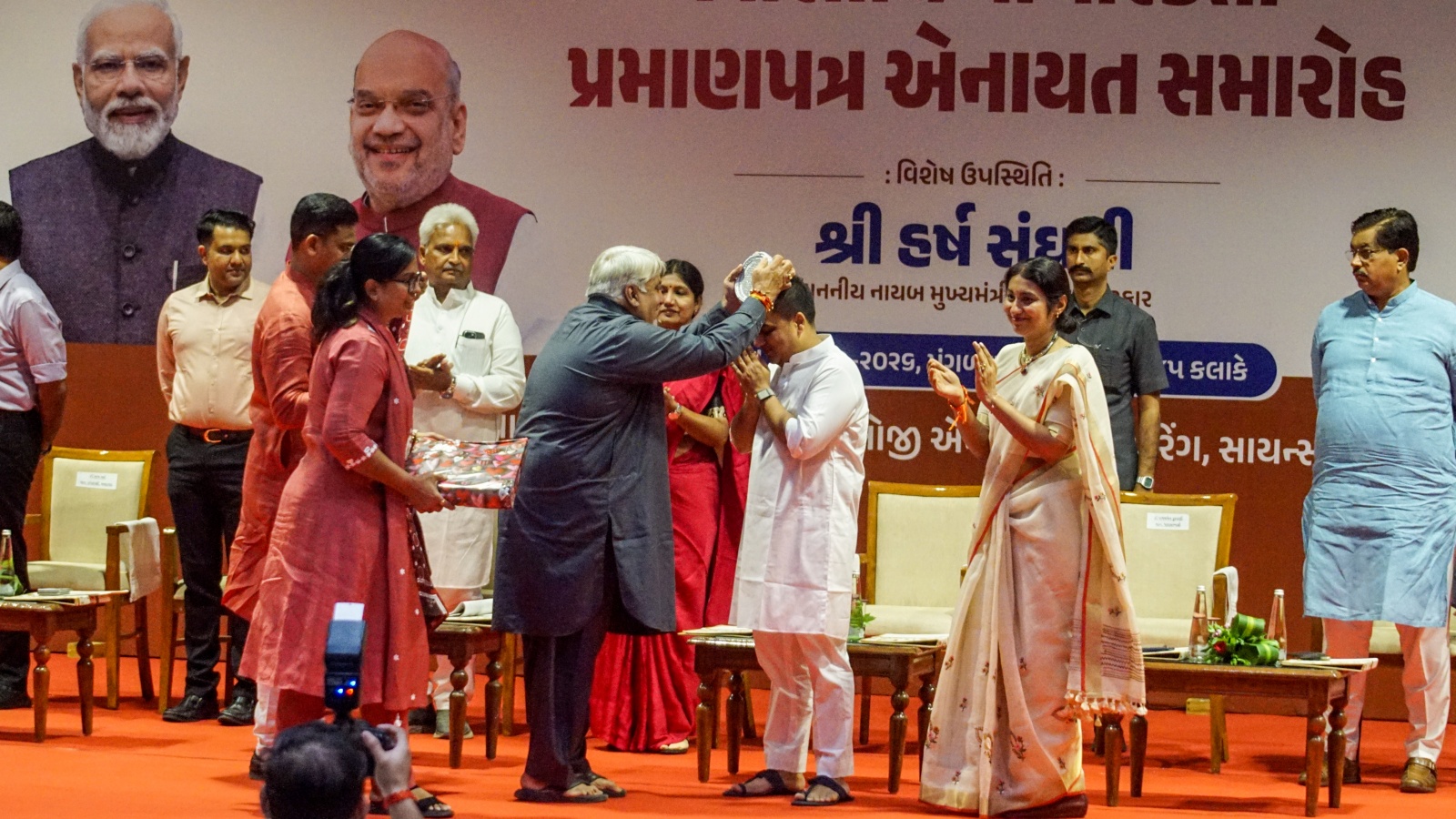
“People used to look upon us with suspicion. They say we have come from Pakistan and could be terrorists. Nobody would rent us a house and we spent many rainy days without a roof over our heads,” said 31-year-old Rajnandini alias Saavi, a single mother of three children, who came to India in 2008 in a group of 50-60 people from Karachi, Pakistan.
Rajnandini not only got her citizenship certificate on Tuesday but also a shoutout from Gujarat Deputy CM Harsh Sanghavi from the stage during an event in Ahmedabad where 158 refugees were given citizenship certificates. Those who received the certificates comprised 126 beneficiaries under the Citizenship (Amendment) Act (CAA) and 32 registered through the district collector’s office, an official release said. An amendment in the CAA empowered collectors to grant citizenship in seven states and Union Territories.
Rajnandini said that after her husband Rajendra alias Babur died of COVID-19 during the pandemic, many people advised her to return to Pakistan because she has no other relatives in India. Her parents, eight sisters and three brothers live in the Chanesar Goth locality of East Karachi in Sindh province. But she refused, continued to raise her children while working as a seamstress and has now received Indian citizenship.
“I never thought of going back to Pakistan. Because however bad things appear to be here, there are worse things across the border… I don’t want to ruin the lives of my children by going back to Karachi,” she said.
Another woman, 35-year-old Poonam Gihara, sat in the auditorium in Ahmedabad, flanked by her 22-year-old daughter Kesar and son-in-law Rohan, hoping that she will get her Indian citizenship, finally.
Originally residents of Kali road, which has since been renamed Hali road, in Hyderabad of Pakistan’s Sindh province, where there is sizable Hindu enclave, Poonam said she came to India in a group of 70 people, mostly her extended family members, in 2013, after some of her relatives immigrated in 2008.
Poonam came to India by Thar Express, the second cross-border train after Samjhauta Express, that was operational between India and Pakistan from 2006 to 2019. It ran between Bhagat Ki Kothi railway station in Jodhpur, Rajasthan, and Karachi Cantonment railway station in Pakistan’s Sindh province.
Story continues below this ad
“We crossed the zero point and then reached Munabao (Rajasthan). From there we went to Jodhpur, then stayed at a Gurudwara in Delhi for a week before settling down in Ahmedabad.”
Poonam said she had faced taunts ever since she immigrated from Pakistan. “We faced a lot of taunts and still do, even today. Even children have no qualms in calling us Pakistani on our faces. We try to avoid it, instead of fighting over it.”
Asked if Indian citizenship might change the attitude of people towards them, she said, “We don’t need to prove anything. Dogs will keep barking, we cannot be perturbed by it.”
Child brides
In Ahmedabad, Rajnandini is inseparable from her best friend Saraswati alias Kanwal, 31, the sister of her deceased husband. In fact, they have grown up together. Saraswati lived in Saddar town, about 6 km away from Rajnandini’s house. Unlike Rajnandini, Saraswati’s entire family is in India and her husband Dayalu (38) works in the garment sector.
Story continues below this ad
They belong to Gihara Rajput, a nomadic clan from Rajasthan (Many people from the community have settled in the Sindh province after partition).
The best friends have many things in common, including trauma about their restricted childhood and both were already married when they came to India in 2008 at the age of 13.
“Families believe it is best to have the daughters married before anyone notices them when they come of age,” they said.
Rajnandini said that she was married at 12, and her eldest daughter is now 17 years old, making the mother-daughter age gap just 14 years. Similarly, Saraswati’s eldest child, a son, is 14.
Story continues below this ad
Poonam, too, got married at the age of 15. She has four children – three sons and a daughter.
Gang violence back home
Rajnandini said several Hindu women have faced constant harassment in their area in Pakistan.
“Chanesar (a neigbourhood in Karachi) used to witness rapes and abduction of women. There were gangs who used to put people at gunpoint. Gang violence and teargas shelling by police were a routine affair there,” Rajnandini said.
Saraswati added, “Back in Karachi, we had to cover our faces before going out. We used to be locked in a room when any workmen came, like the plumber or electrician, and were let out only after they were gone. We were never allowed to go to school due to fear of abductions. Those who could afford it, arranged private tuition for their daughters.”
Story continues below this ad
Notably, almost everyone in their circle has a Hindu name and a Muslim sounding name, which, they said, “was to avoid discrimination.”
Poonam’s daughter, Kesar, has studied only till Class 5 and eventually dropped out of school. “I had put her in a nursery institute in Pakistan. And she went to school as well. But there she used to be bullied because of her Hindu faith. And then the whole immigration process and moving around disrupted her studies. We admitted her to a school in Ahmedabad, but she was already 9 years old at the time. But she could not keep up with others and eventually dropped out.”
‘Drank tea in the open’
Asked about the differences in life in Karachi and Ahmedabad, they said that they live a completely different lifestyle to that in Pakistan.
“I felt suffocated there, even as a child. We couldn’t go out by ourselves, relying on our father or brothers to get things done for us. But here, in Ahmedabad, it was all so different. We were so carefree. We used to run behind cows and dance in the rain, go to a roadside shop and drink tea in the open. Just eating noodles in a wayside shop used to feel so novel for us. People used to wonder what was wrong with us but they would never understand the sense of freedom we felt.”
Story continues below this ad
Asked what happens when she tells her sisters back in Pakistan about her life in India, Rajnandini said they also want to come, but the difficulty in getting a visa even after paying money, and lack of means prevent them from applying.
Hope for future
Hariram Kachchhi’s wife Baghan was six months pregnant when the couple boarded the Thar Express along with 25 others from Sangar in Sindh to India in March 2013. After their son Omesh Hari, Baghan had suffered two miscarriages and they were very careful this time. However, a month after reaching Gopalpura village in Gujarat’s Anand, Baghan went into labour at seven-and-a-half months.
When Dharasindhu was born, she weighed just 830 grams. “She stayed in the Neonatal Intensive Care Unit (NICU) for 21 days. Doctors had given up and asked us to take her home. Fortunately, my elder brother, who came to India in 2011, who is a pediatrician, helped us look after her,” said Kachchhi.
But even though she survived infancy, Dharasindhu had multiple disabilities. She could not walk, she could not see and could not hear. However, once she turned five, her eyesight improved, she began walking, but her hearing issues persisted. She has 70% hearing loss on the left side and 56% on the right side. She overcame these shortfalls and played table tennis at the state level.
Story continues below this ad
Her proud father said, “Now, she plays junior floor hockey but since she has reached the national level and hopes to be inducted into the Gujarat team, she needs a domicile certificate, for which she needs citizenship. We have high hopes for her.”
Hariram Kachchh’s family is among the 158 refugees who received citizenship certificates on Tuesday. He has a dream now: one day his daughter will play floor hockey for her country – India.
KioskNews shows a cleaned-up reading view extracted from the publisher’s page — the original always lives on their site, not ours.