Live: 'Coordinated mortgage fraud' uncovered by financial crimes watchdog
The Australian share market is likely to fall in morning trade, following another weak session on Wall Street.
It comes as several governments' borrowing costs, including the US, Japan and Germany, surge to their highest level in decades on concerns about ballooning debt and rampant spending.
See how the trading day unfolds on our blog.
Disclaimer: this blog is not intended as investment advice.
Filter Posts
All
4
Key Events
3
Market snapshot
1
Key Event
Australian government's borrowing costs at their highest level in years
By David Chau
By David Chau
Concerns about the US-Iran war dragging on, expensive oil prices, high inflation and ballooning government debt are clearly on the minds of Australian investors.
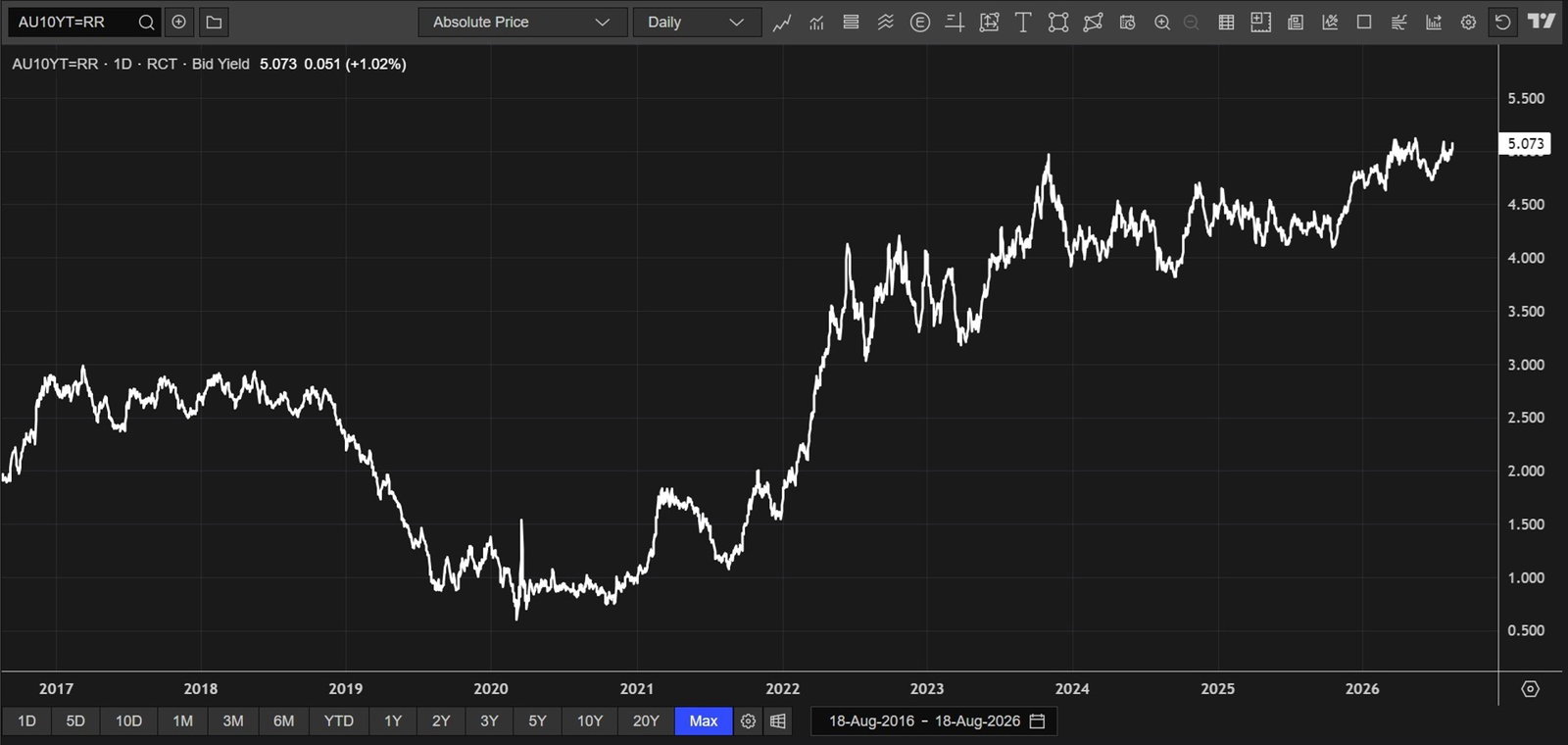
The Australian government's 10-year bond yield is currently sitting at 5.07%, around its highest level in many years.
Like many overseas governments, its long-term borrowing costs have also surged as lenders are demanding more compensation — for what they see as higher risks over the next decade.
Key Event
US, Japan and Germany bond yields surge to multi-decade highs on 'problematic' government spending
By David Chau
By David Chau
Share markets in the US and Europe fell overnight due, in part, to concerns about elevated oil prices and persistently high inflation across the world.
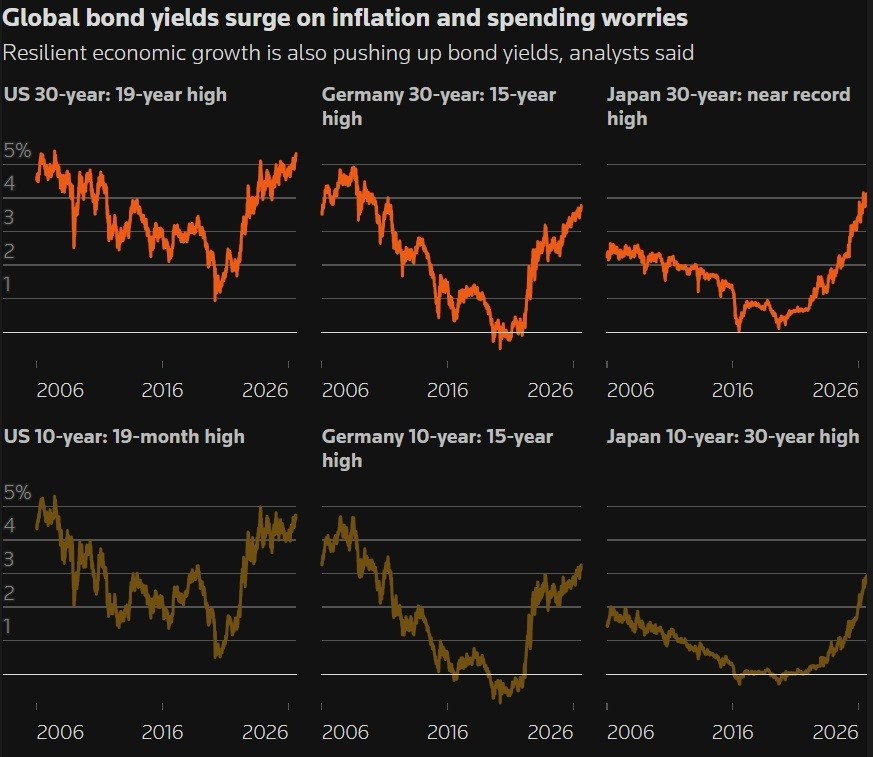
That, in turn, led to several governments' long-term borrowing costs rising to their highest levels in decades:
- United States: 30-year Treasury yield rose above 5%, its highest level since 2007, during the global financial crisis.
- Japan: 10-year bond yield climbed to its highest in three decades, at just under 3%.
- Germany: 30-year bond yield hit its highest since 2011.
- France: 30-year bond yield is now at its highest point since 2008.
There is growing concern about ballooning government debt and geopolitics.
When it costs more for governments to borrow money through the bond market, that also leads to higher interest repayments for businesses and households.
And generally, when it becomes more expensive to borrow, the investors' tolerance for risk falls — along with risky investments, like shares.
'Problematic' spending by politicians
Bond markets are entering an era where the inflation and interest rate outlook is more uncertain as US President Donald Trump's policies — from tariffs to war — upend the global order.
Debt levels in developed countries are reaching thresholds that look increasingly unsustainable, with the US debt pile nearing $US40 trillion.
The war in Iran is dragging on, pushing oil prices above $US90 per barrel — pushing inflation higher and hurting global economic growth.
In addition, massive borrowing by technology companies to fund a buildout of artificial intelligence infrastructure is competing with demand for government bonds.
Bond yields' recent surge "suggests investors are losing patience with fiscal profligacy," said Jonas Goltermann, chief markets economist at Capital Economics.
But he noted that it's "entirely unsurprising: the fiscal outlook in several major economies is problematic, and politicians have shown little appetite for addressing the issue".
- with Reuters
Key Event
ASX to fall for sixth straight day, oil price hits three-week high
By David Chau
By David Chau
Good morning, and welcome to the ABC's finance blog! I'll be guiding you through the latest market action for the next few hours.
The local share market is on track to fall for its sixth trading day in a row.
ASX futures, which are a rough indicator of how the market may open, have slipped by about 0.2%.
The Australian dollar is also a little weaker at 70.8 US cents.
It follows another downbeat session on Wall Street with its benchmark index, the S&P 500, dropping for its third straight day.
Oil prices have risen to their highest level in more than three weeks on fading hopes of a resolution to the US-Iran war any time soon.
That's after Iran said it would adopt a more offensive stance and the Strait of Hormuz would remain closed, while the United States has ruled out extending their ceasefire.
Brent crude futures rose 0.5% to $US91.35 per barrel.
US West Texas Intermediate crude futures jumped 1% to $US85.33 a barrel.
Both oil contracts are trading at their most expensive level since July 24.
Anyway, please grab a coffee, tea or whatever you normally have in the morning, and I'll have more updates for you shortly!
Market snapshot
By David Chau
By David Chau
- ASX futures: -0.2% to 8,893 points
- ASX 200 (Tuesday close): -0.04% at 9,070 points
- Australian dollar: -0.3% to 70.8 US cents
- Wall Street: Dow Jones: (-0.2%), S&P 500 (-0,7%) , Nasdaq Composite (-1.3%)
- Europe: FTSE (+0.1%), DAX (-0.8%), Stoxx 600 (-0.7%)
- Spot gold: -1.8% to $US4,338/ounce
- Oil (Brent futures): +0.2% to $US91.07/barrel
- Iron ore: +0.2% to $US95.75/tonne
- Bitcoin: +0.4% to $US64,617
KioskNews shows a cleaned-up reading view extracted from the publisher’s page — the original always lives on their site, not ours.