India's 2026 Monsoon Journey: A Decade's Lowest Rainfall And A Strengthening El Nino

India's 2026 monsoon began with a rainfall crisis that July's recovery could not make up for. Rainfall improved to normal levels in July, but the deficit returned in August and continued through September.
According to the India Meteorological Department (IMD), India received 759.4 mm of rainfall between June and September, against an LPA of 868.6 mm. The season's rainfall was 87 per cent of the LPA, making 2026 the fourth-lowest monsoon rainfall year since 2001 and the 13th lowest since 1901. It was also the lowest seasonal monsoon rainfall in a decade, since 2015.
The season ended with rainfall 12.6 per cent below LPA, as El Nino strengthened in the Pacific Ocean. Rainfall deficit crossed the rainfall-deficiency threshold used in the definition of an all-India drought year.
How Was The Monsoon In 2026
June recorded 106.8 mm of rainfall, just 65 per cent of its LPA of 165.3 mm. July brought a recovery, with 283.3 mm, or 101 per cent of normal. However, rainfall fell to 213.3 mm in August, 84 per cent of the LPA, before reaching 155.1 mm in September, 92 per cent of normal. The July recovery was not enough to offset the shortfall in the other three months.
The deficit varied across regions. Northwest India received 94 per cent of its LPA, while central India received 97 per cent. The south peninsula received 76 per cent, and east and northeast India received 74 per cent.
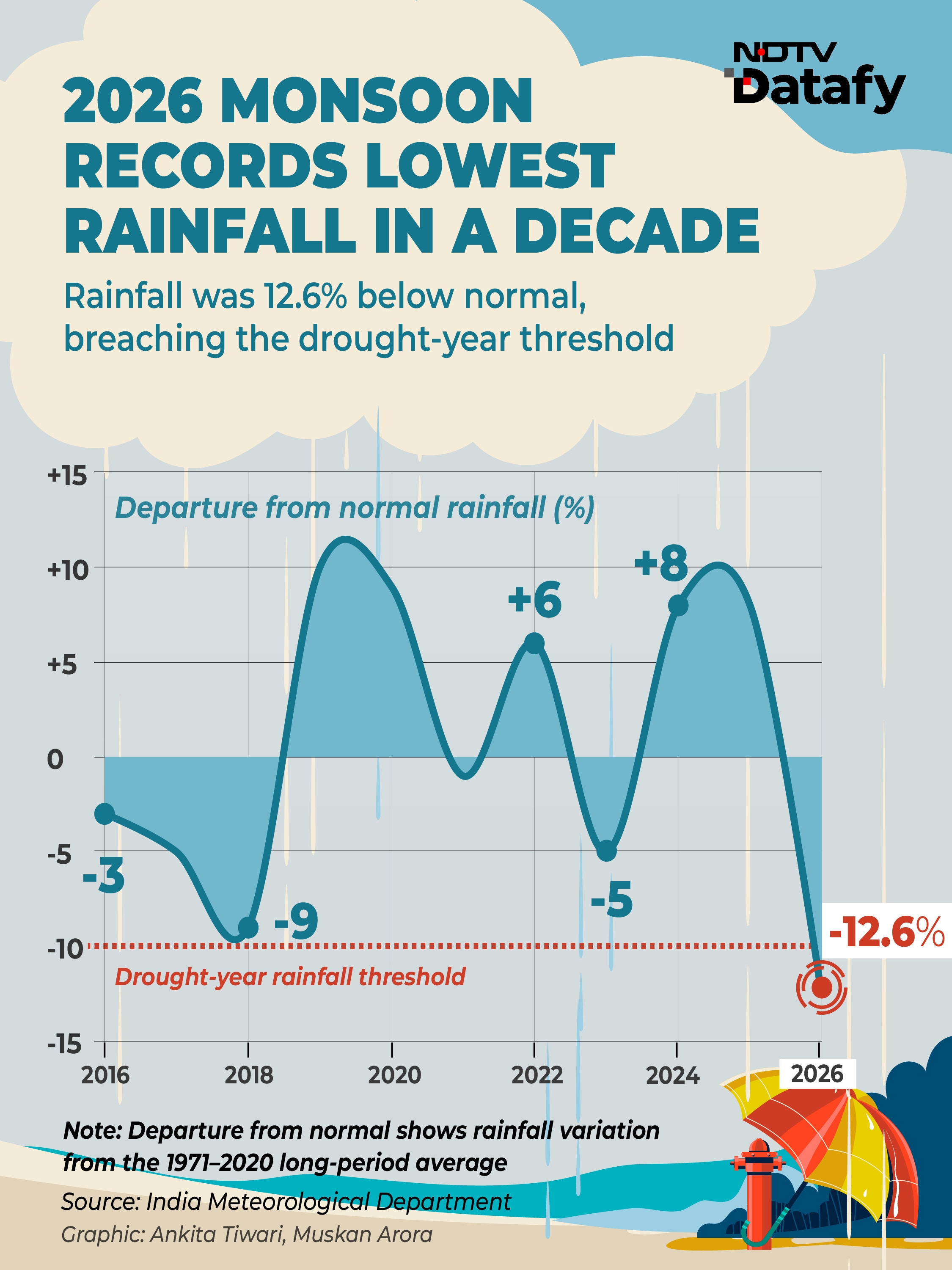
East and northeast India recorded 1,016.3 mm, its lowest seasonal rainfall since 1901. The south peninsula received 542 mm, its fourth-lowest seasonal rainfall since 1901. Of the country's 36 meteorological subdivisions, 17 recorded deficient rainfall, 18 received normal rainfall and Odisha recorded excess rainfall.
El Nino And The Monsoon Deficit
The rainfall shortfall coincided with the development and strengthening of El Nino, a climate pattern associated with warming in the central and eastern equatorial Pacific Ocean.
IMD reported that weak El Nino conditions developed in June and strengthened through the monsoon season, reaching strong intensity by the end of September.
The Indian Ocean Dipole (IOD) remained neutral throughout the season, despite forecasts of a possible positive IOD phase towards the end of the monsoon.
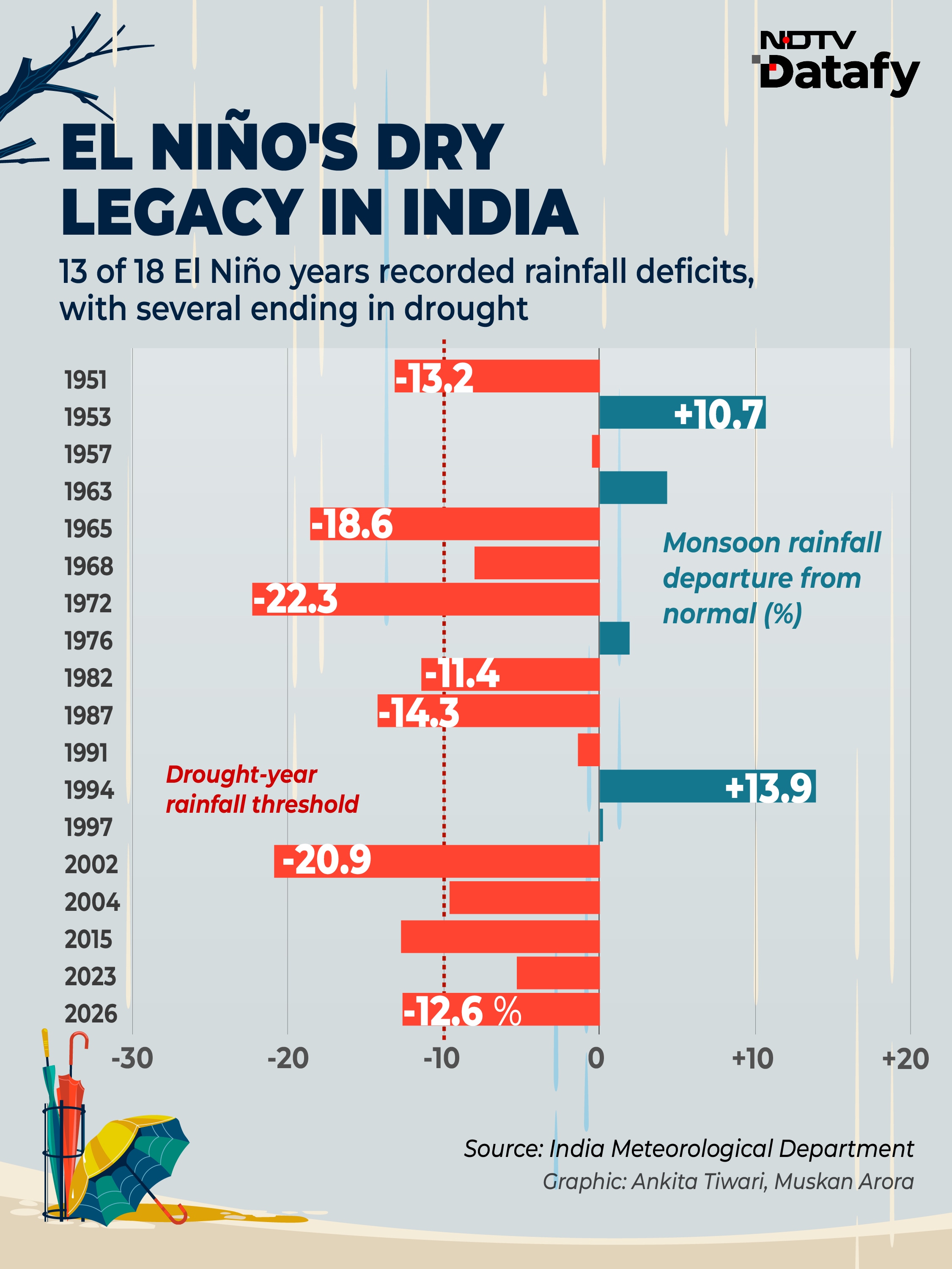
The 2026 season therefore saw a strengthening El Nino alongside a neutral IOD. Historical figures in the data show that several El Nino years also recorded monsoon rainfall deficits.
India received 22.3 per cent below-normal rainfall in 1972, 20.9 per cent below normal in 2002 and 12.7 per cent below normal in 2015. In 2023, the deficit was 5.3 per cent. IOD was positive in 1972 and 2015, while in 2023 it developed from August. In 2002, the IOD shifted from negative readings earlier in the monsoon to positive in September.
The IOD can influence how El Nino affects India's monsoon. A positive IOD, with warmer waters in the western Indian Ocean relative to the east, can support moisture flow towards India and partly offset El Nino's influence on rainfall.
A negative IOD can create less favourable conditions for monsoon rainfall, while a neutral IOD provides no strong east-west temperature contrast.
However, the historical figures show that a positive IOD does not guarantee normal rainfall: India recorded deficits in both 1972 and 2015 despite positive IOD conditions.
KioskNews shows a cleaned-up reading view extracted from the publisher’s page — the original always lives on their site, not ours.