Wall Street on edge after $1.4 trillion wipeout
For nearly four years, Wall Street has been happy to underwrite the boom in artificial intelligence spending, writing blank cheques without asking too many hard questions. Now, it seems, investors have become uneasy about the massive spending spree they have helped ignite.
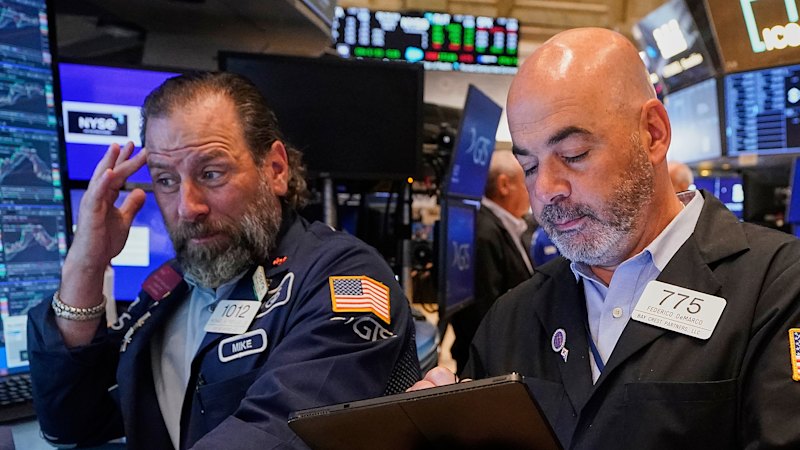
Late last week, as a collective, the biggest tech companies lost almost $US1 trillion ($1.4 trillion) of market value, headed by a 13 per cent, or $US500 billion, plunge in the value of Google’s parent, Alphabet.
Shares in the four big hyperscalers – Alphabet, Microsoft, Meta and Amazon – all fell heavily after issuing third-quarter results that showed capital expenditures soaring and, for all but Microsoft, revenue growth from their core business weakening.
Concerns about the rate of spending by the hyperscalers – as a group, probably the most profitable and valuable companies in history – have risen even as their investments in AI have accelerated.
In the latest quarter they invested more than $US200 billion, compared with $US113 billion in the same quarter of last year. They expect to spend at least $US230 billion in the December quarter.
Increasingly, that spending is outstripping even the vast cash flows they generate from their legacy businesses.
Of the four biggest hyperscalers, only Microsoft is generating positive free cash flows. It had $US18.6 billion of free cash flow in the quarter, whereas Alphabet (minus $US9.1 billion), Amazon (minus $U33.5 billion) and Meta (minus $US2.1 billion) racked up nearly $US45 billion of net cash outflows between them. In the same quarter last year they had positive net cashflows of more than $US36 billion.
They’re all reporting record levels of capex and have foreshadowed higher levels of spending in the fourth quarter and into next year. They’ll spend around $US750 billion between them this year and, from their guidance, more than $US1 trillion in 2027.
With their spending outstripping cash generation they’ve had to raise new equity and, increasingly, borrow.
Alphabet and Meta have, between them, raised almost $US90 billion of new equity since June and have programs that could raise a further $US100 billion. All the hyperscalers are issuing debt to fund their AI spending.
There are cracks, however, appearing in Wall Street’s previous enthusiastic willingness to fund anything AI-related.
Last week S&P Global Ratings lowered the outlook for Meta’s AA- credit rating to negative, citing the increased spending on AI, its increasing leverage and its negative free cashflows.
Also last week, Blackstone, which is the key investor in a consortium financing Anthropic’s $US63 billion purchases of semiconductors from Google, told its investors that the leading frontier lab may not gain an investment grade rating.
If Anthropic – about to try to raise $US100 billion of equity in an initial public offering valuing it at up to $US2 trillion – were to issue bonds with a junk bond rating, it would diminish the pool of potential investors and increase the cost of the funding. It would also sound a warning bell for other, lesser, participants in the AI ecosystem.
It’s not just access to debt and the cost of gaining that access that is becoming an issue for even the biggest and best of the AI aspirants. Access to equity – and its cost – is becoming tighter and more expensive.
The company that started the AI frenzy, OpenAI, deferred its planned $US1.5 trillion-plus float this year into 2027, but is still trying to raise $US30 billion of new equity at a valuation of $US1.4 trillion – or was trying to raise that amount on those terms.
The Financial Times is reporting that the amount it is seeking this week has been cut to $US20 billion and the valuation to $US1.25 trillion as the turmoil in the market for tech shares has caused demand for its shares to weaken.
Like most of the standalone AI companies, OpenAI has been able to raise vast amounts of capital at valuations that have increased at a mind-boggling rate. It was valued at “only” $US852 billion in March, a month after Anthropic raised $US30 billion at a valuation of $US380 billion.
If those valuations were ever to reverse, those AI companies without legacy revenues would lose their access to capital and die a near-instant death. Their lifeblood is continuing access to capital at ever-increasing valuations.
Even for the hyperscalers, their ability to raise capital easily and cheaply is being threatened by the more rigorous scrutiny from investors who previously signed blank cheques. Those investors are not just more focused on the risks AI investment, but its concentration and vulnerability.
Those risks, unique to AI, were highlighted again last week when Nvidia and fellow chip-makers AMD and Broadcom committed to taking up $US5 billion of Meta’s $US25 billion equity raising. Meta is, of course, a major customer of the companies and therefore they are helping to fund the purchases of their own products.
That’s a typical AI transaction – a circular finance transaction – where the chipmakers with cash, Nvidia in particular – have provided vendor financing to the frontier labs, hyperscalers and data centre operators to support demand for their chips.
The entire sector is financially interconnected and interdependent and vulnerable to any significant disruptive external event. Shifts in access to external funding, or its cost, could generate implosions across the sector.
The crash in Alphabet shares showed even hyperscalers aren’t immune, although the issue that drove its shares to their biggest loss in its history wasn’t the risk of a loss of access to funding markets, but the impact of AI on what had appeared to be a financial fortress.
Google, Meta and Amazon have been so dominant, and the “moats” that have protected their massively profitable businesses so deep and wide, that it was almost unthinkable that their defences could be breached and their massive margins and returns on capital threatened.
The entire sector is financially interconnected and interdependent and vulnerable to any significant disruptive external event. Shifts in access to external funding, or its cost, could generate implosions across the sector.
Google’s dominant search business generates more than half its revenues, with the advertising revenue it generates very high margin. It’s third-quarter report, however, showed that its search revenues were less than analysts predicted and their growth rate of 12 per cent significantly lower than the 17 per cent generated in the second quarter and 19 per cent in the first.
Google is getting strong growth from “AI Mode” queries using its Gemini AI platform – but that growth is in revenues that are much lower-yielding than those high-margin revenues from advertising.
Google is doing what most incumbents failed to do in response to the horde of online start-up that challenged and decimated traditional media in the late 190s and early 2000s.
It is cannibalising itself. In the process, however, it is also showing that its moat – its absolute dominance of search – is no defence against the AI platforms now being routinely used by companies and consumers in preference to its search engine.
Other AI applications (including Meta’s) are using their AI agents to search retail sites for products and arrange purchases, bypassing Amazon’s website and the advertising that product sponsors have paid for.
What’s happening within heavyweights like Google and Amazon is as important in the longer term as what’s happening outside them in funding markets, given that it is the cashflows from their legacy businesses that provide them with far better access to capital, on far better terms, than their challengers.
The initial impacts of AI-driven competition to the tech titans, adds new layers of complexity and risk to the evaluations investors are now being asked to make of AI and, as last week’s market turbulence demonstrated, not positive ones.
The Market Recap newsletter is a wrap of the day’s trading. Get it each weekday afternoon.
More:
KioskNews shows a cleaned-up reading view extracted from the publisher’s page — the original always lives on their site, not ours.