Business groups back Taipower, CPC subsidies; scholars dissent
Business groups yesterday backed government subsidies for state-run utility Taiwan Power Co (Taipower, 台電) and state-run oil company CPC Corp, Taiwan (CPC, 台灣中油), while some scholars argued that taxpayers should not bear the cost of subsidies.
Speaking at a public hearing of the Legislative Yuan’s Economics Committee, Vice Minister of Economic Affairs Lai Chien-hsin (賴建信) said government support was needed because both companies were required by the government to absorb surging international oil, natural gas and coal costs since 2020 instead of passing them on to consumers.
Lai said many governments had increased financial support to cushion the impact of surging international energy prices and prevent sharp increases in consumer prices.
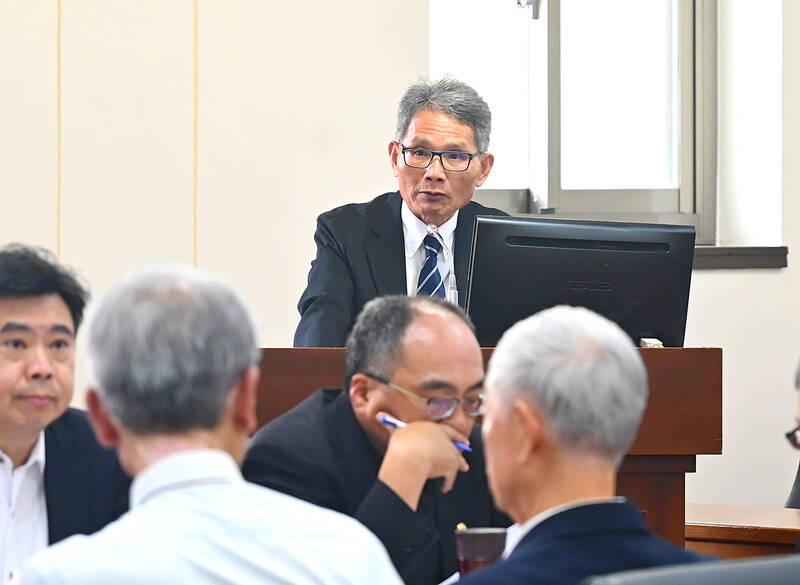
Vice Minister of Economic Affairs Lai Chien-hsin, back row, attends a public hearing of the Legislative Yuan’s Economics Committee in Taipei yesterday.
Photo: Wang Yi-sung, Taipei Times
Since 2020, CPC has absorbed NT$674 billion (US$20.76 billion) in oil and gas costs that it could not pass on to consumers, with accumulated losses reaching NT$91 billion as of the end of last month, more than half of its paid-in capital, company data showed.
Taipower has suffered even higher losses from absorbing higher natural gas and coal costs to avoid increasing electricity costs.
This year alone, its natural gas expenses had risen by more than NT$70 billion as of the end of August compared to before the US-Israel war against Iran began in February, resulting in losses of NT$20.3 billion this year and accumulated losses of NT$371.2 billion since 2020, he said.
Under the Administrative Act of State-Owned Enterprises (國營事業管理法), the government may compensate state-owned enterprises for policy-related losses, Lai said.
Lai was seeking legislative support for the NT$71.1 billion supplementary budget to subsidize Taipower approved by the Executive Yuan.
Liu Shou-jen (劉守仁), secretary-general of the General Chamber of Commerce of the Republic of China, said the losses were caused by war-driven increases in global energy and raw material prices rather than mismanagement and should be subsidized to avoid higher electricity rates.
Leu Jang-hwa (呂正華), secretary-general of the Chinese National Federation of Industries, also supported government subsidies and capital injections but said only losses caused by international energy price fluctuations should qualify for compensation under a transparent and accountable review mechanism.
Opposition lawmakers have rebuffed attempts by the government to subsidize the losses of the two state-run companies, and some scholars agreed with that stance.
Huang Yao-hui (黃耀輝), a professor at National Taipei University of Business, argued that Taipower’s losses were primarily the result of Taiwan’s flawed nuclear-free energy policy, which had increased power generation costs.
Yeh Tsung-kuang (葉宗洸), dean of the College of Nuclear Science at National Tsing Hua University, also opposed the subsidies, saying Taipower and CPC should instead strengthen their finances through capital injections and that the public should not bear the cost of past energy policy mistakes.
The different viewpoints center around the overall energy policy of the Democratic Progressive Party (DPP), which has been in power since 2016.
The DPP’s plan to phase out nuclear power also increased reliance on natural gas from 30.6 percent of the electricity mix in 2015 to 50 percent last year, and lower coal use, from 45.4 percent of the mix in 2015 to 30 percent last year.
That plan and the slower-than-expected rollout of renewable energy have resulted in surging imports of natural gas, from 17.05 million TOE (tonne of oil equivalent) in 2015 to 26.86 million TOE last year, according to Energy Administration figures.
As imports have risen, so have prices, driven by renewed global demand post-COVID 19 in 2021, Russia’s invasion of Ukraine in 2022, and the war against Iran this year.
Imported natural gas prices soared to US$575 per tonne in 2021 and US$989 in 2022 after Russia invaded Ukraine, and averaged US$716 in the first eight months of this year, Energy Administration figures showed.
Those who oppose the subsidies for Taipower argue in part that continuing the use of nuclear power would have left Taiwan less vulnerable to volatility in global fossil fuel prices.
KioskNews shows a cleaned-up reading view extracted from the publisher’s page — the original always lives on their site, not ours.