Trump to take up to 60 days to weigh sanctions
CENTRAL ASIA: Rubio was to arrive in Uzbekistan to meet C5+1 leaders, fitting a pattern in which the US’ top diplomat visits regions not at the center of the news cycle
The day after waiving sanctions and tariffs related to Russian exports, US President Donald Trump on Saturday said he has yet to announce a final decision on the matter as Secretary of State Marco Rubio said officials want more time to evaluate the situation.
Rubio said that the president would use up to 60 days to assess the economic impact of Russia-related sanctions and tariffs that he waived a day earlier.
“A lot of you don’t know what my decision is yet, but we’ll figure it out, and you’ll figure it out,” Trump told reporters at his Mar-a-Lago club in Palm Beach, Florida.
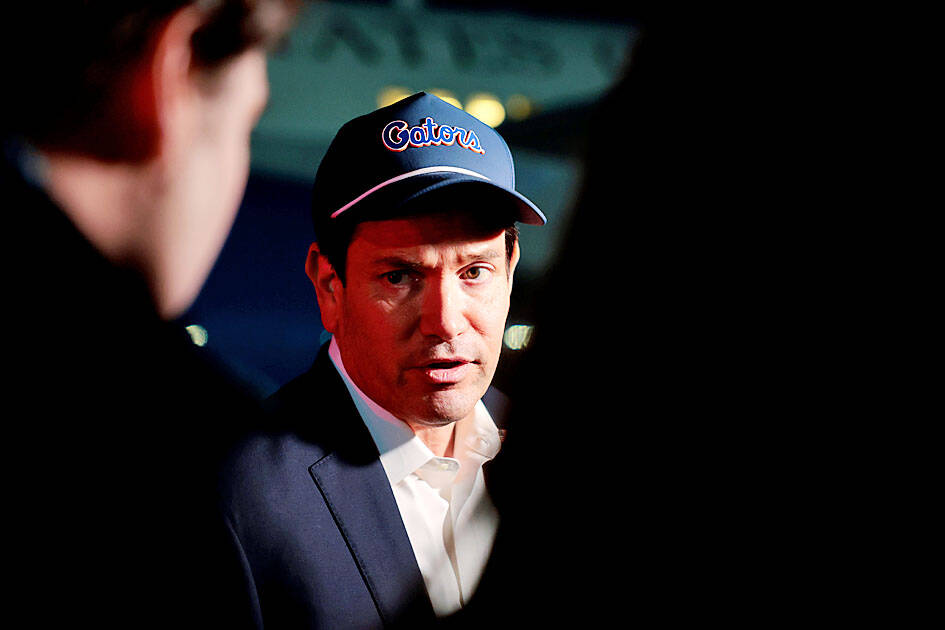
US Secretary of State Marco Rubio speaks with members of the media before boarding a plane to Uzbekistan at Joint Base Andrews in Maryland on Saturday.Photo: AP
Photo: AP
The waiver came just weeks before November’s midterm elections, with Trump under pressure over high energy prices as war with Iran disrupts global oil supplies.
Trump signed an executive order on Friday waiving key sanctions and tariffs under the law known as the Graham Act, which he signed last month at the urging of lawmakers who want to pressure Moscow over its war in Ukraine.
The measures, including tariffs on Russian goods and penalties on countries buying Russian oil and gas, were due to take effect next week. Friday’s order did not specify how long the waiver would last, but Rubio said Trump opted for a 60-day review.
“I think the president wants to take the 60-day period of time to sort of analyze what imposing both sanctions and tariffs will mean to the global economy and even to the US economy,” Rubio told reporters before boarding a plane for a trip to Uzbekistan.
Complicating matters is the Graham Act’s call not only for sanctions on Russia, but also for tariffs on goods from countries that import Russian energy supplies.
Rubio pointed to India, an important US partner that has diversified its energy supplies but remains heavily dependent on Russian oil.
Friday’s executive order drew criticism from Ukrainian President Volodymyr Zelenskiy, who warned it would embolden Russian President Vladimir Putin and prolong the war.
Meanwhile, Rubio was scheduled to land in Samarkand yesterday to meet with leaders from the C5+1, a grouping that brings together the US and the Muslim-majority post-Soviet states of Uzbekistan, Kazakhstan, Kyrgyzstan, Tajikistan and Turkmenistan.
US officials have portrayed resource-rich Central Asia — the region between China, Russia and Iran — as worthy of more attention than it received from Trump’s predecessors.
The trip fits an emerging pattern in which Rubio visits regions not at the center of the news cycle, while leaving some more fraught foreign-policy portfolios to other Trump aides, including special envoys Steve Witkoff and Jared Kushner and US Vice President J.D. Vance.
Rubio has not visited Kyiv or Moscow since becoming secretary of state. He was not present for talks between US and Ukrainian officials in Florida earlier this month, when US officials pressed Ukraine to stop hitting Russian refineries. Vance, not Rubio, represented the US in Pakistan during peace talks with Iran in April.
Rubio’s previous foreign trip, earlier this month, took him to Greece, Portugal and Iceland.
Trump administration officials have typically rejected any suggestion that Cabinet-level officials should focus their travels on geopolitical capitals and hot spots.
US Deputy Secretary of State Christopher Landau last week wrote on X last week that the idea only certain destinations were worthy of visits from secretaries of state “perfectly encapsulates the decadence and degeneracy of the contemporary US foreign policy establishment.”
One Central Asian diplomat, speaking on the condition of anonymity, said officials in the region are wondering to what extent the US would continue targeting Russian sanctions evasion.
All C5 states, while drawing closer to the US, have deep historical ties with Moscow, and the region has facilitated Russian imports and exports that violate US and EU sanctions, Western officials say.
India, which Rubio will visit after Uzbekistan, remains the world’s No. 2 Russian crude importer after China, despite Trump saying in February that India had agreed to stop buying oil from Russia.
KioskNews shows a cleaned-up reading view extracted from the publisher’s page — the original always lives on their site, not ours.