As peso lingers at record-low P62, what does it mean for Filipinos?
Already have Rappler+?
to listen to groundbreaking journalism.

The Philippine peso has never been this weak. Here's how that could affect everything from fuel prices to remittances.
AT A GLANCE
- The Philippine peso has reached record lows against the US dollar, sinking past P62 for the first time, which raises concerns about inflation and economic growth.
- Despite the peso's weakness benefiting overseas Filipino workers by increasing their remittances in pesos, the overall economic impact is negative due to rising costs of living and potential higher interest rates.
This is AI-generated. Read the article for full context. Report any errors.
The Philippine peso has pushed deeper into territory it had never entered before.
For the first time in history, the currency sank past P62 to the US dollar on August 28, closing at a then-record low of P62.265. The peso then touched an unprecedented P62.775 intraday on Monday, September 7, before closing slightly stronger at P62.586.
On Tuesday, September 8, it weakened again to a fresh record-low closing rate of P62.625 to $1.
The peso’s slide began in March 2026, when it sank to an all-time low of P60 to the dollar. A month later, it sank to an all-time low again, breaking past P61. Now, it has sunk to an all-time low yet again, this time beyond P62.
So what does a peso sinking deeper into record-low territory actually mean for the economy?
A weaker peso can make its way to fuel pump prices and grocery checkouts, raise costs for businesses, complicate the central bank’s fight against inflation, and weigh on the Philippines’ economic growth.
For OFW families, a weaker peso might provide some relief since they get more pesos for every dollar sent home. But that gain is partly eroded if the same currency weakness pushes up the cost of fuel, food, transport, and other everyday expenses anyway.
Currency depreciation hits the Philippines particularly hard because it is a country of imports – bringing in large amounts of fuel, food, machinery, raw materials, and other goods all priced and paid for in dollars.
As the peso weakens, Philippine importers have to spend more pesos to pay for exactly the same dollar-priced shipment. Companies can absorb some of that increase through lower profit margins, but they’re more likely to pass the cost on to consumers.
More expensive fuel
Fuel is one of the clearest examples of how quickly the exchange rate can ripple through the economy.
At the Department of Energy’s September 7 briefing, Energy Secretary Sharon Garin said the peso’s depreciation was adding pressure to domestic pump prices because petroleum products are bought in dollars.
DOE officials said the peso weakened by around 68 centavos during the latest pricing period, compounding an increase of roughly $9 to $10 per barrel in petroleum import costs caused by renewed Middle East tensions.
In other words, Filipinos are being hit twice because global oil prices are rising at the same time as the peso is falling. The fuel itself becomes more expensive in dollars, while each dollar needed to buy it also costs more pesos.
The impact goes beyond just motorists having to pay more for their trips. Diesel powers trucks moving food and merchandise around the country too, while businesses depend on imported machinery, fertilizers, ingredients, and other inputs. As those costs rise, companies may eventually pass on at least some of them through higher prices.
![[In This Economy] The Philippine economy is stuck in a rut](https://www.rappler.com/tachyon/2026/08/ph-economy-corruption-aug-12-2026.jpg?fit=449%2C449)
Inflation, and the BSP’s reserves
BPI lead economist Emilio Neri Jr. warned that the recent peso depreciation could fuel further inflation through higher import costs, with headline inflation in August already at a worrying 6.1%. That’s why peso weakness is also becoming a headache for the Bangko Sentral ng Pilipinas (BSP) as it tries to bring inflation back within its 2% to 4% target range.
The BSP will not, however, defend the currency at a particular level. At an August 27 Senate budget hearing, BSP Governor Eli Remolona Jr. said the central bank can smooth out sharp movements in, but trying to fix the peso at a particular rate would burn through the country’s dollar reserves.
Nevertheless, BSP data show that ammunition remains substantial.
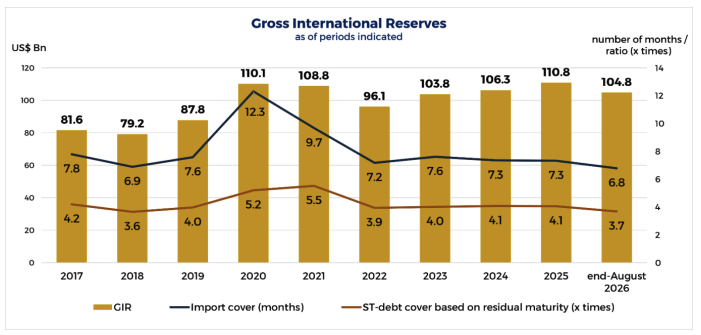
The country’s gross international reserves rose to $104.8 billion at end-August, from $103.3 billion in July, largely because higher gold prices boosted the value of the BSP’s holdings and because of income from its overseas investments. The increase was partly offset by government withdrawals of foreign currency to service external debt.
Still, the buffer has thinned from $110.8 billion at the end of 2025. At its August level, reserves could cover about 6.8 months of imports and around 3.7 times the country’s short-term external debt.
“These provide sufficient foreign currency to meet the country’s import needs, service its external debt obligations, and serve as a buffer against external economic shocks,” the BSP said in a statement on Monday.
If depreciation keeps inflation elevated, the BSP may instead have to keep interest rates high for longer or tighten further. Higher borrowing costs can then weigh on household spending, business expansion, housing, and investment, creating another drag on an economy already struggling with slower growth. – Rappler.com
KioskNews shows a cleaned-up reading view extracted from the publisher’s page — the original always lives on their site, not ours.