‘We will smash you’: Allan warned CFMEU takeover would cause $400m blowout
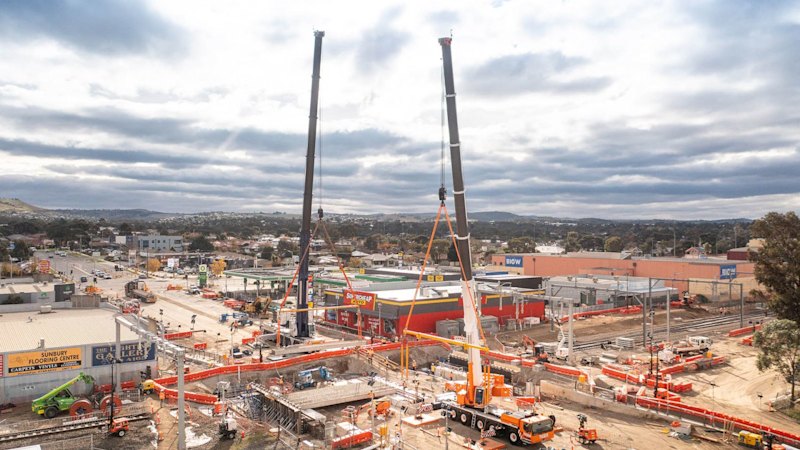
Jacinta Allan’s own department repeatedly sought to warn her that an aggressive construction union campaign to take over traffic control on Victoria’s major projects could alone inflate costs on the Big Build by more than $400 million.
The royal commission into the state’s building industry on Monday heard warning briefings were prepared for Allan, who was in 2022 and 2023 the minister responsible for transport infrastructure, from around the time the Construction, Forestry and Manufacturing Employees Union (CFMEU) seized control of a level crossing removal project in Sunbury, north-west of Melbourne.
The CFMEU had disrupted work and insisted the consortium on the Gap Road level crossing removal project employ the union’s preferred labour hire company, despite the consortium’s warnings to the government that costs would blow out.
During the first day of a 10-day block of hearings, evidence including phone calls, emails, internal company memorandums and ministerial briefs detailed how the CFMEU wrested industrial control of the $110 million project by unlawfully shutting it down, while the rail alliance’s urgent pleas for intervention from Victoria Police and statutory body WorkSafe had no effect.
The hearing was told that in June 2022, union officials pushed past security and shut down the project for 36 hours during a critical phase, and also threatened workers they would “smash” them if they did not down tools.
The commission heard building company John Holland, the contractors at Gap Road, already believed the CFMEU had “unprecedented access” to ministers and deep influence within the Andrews government when it submitted in 2022 to the union’s demand to seize control of the project.
John Holland prepared a series of memorandums for senior management and its board between 2017 and 2021, detailing its view that the CFMEU was powerfully influential within the then-Andrews government, that this influence was unlikely to diminish, and that the company’s engagement with the union “should be seen as part of a broader strategy to better position our business with the state government”.
“The premier [Daniel Andrews] is factionally aligned with the socialist left, and the CFMEU is the key industrial organisation involved in that faction,” one memo read. “We also understand the CFMEU has unprecedented access to ministers and other key Victorian government stakeholders.”
The construction company said in a separate but related memorandum that a CFMEU regional agreement on projects “means all projects are forever forced to change the way they work”.
“It impacts everything from current and future tenders to our day-to-day operations. It would forgo management prerogative on matters such as, but not limited to, employment and subcontractor selection,” the memo said.
The CFMEU’s takeover of traffic management at Gap Road set off public service warnings about the implications if that were repeated across the Big Build.
According to briefings prepared by the former major transport infrastructure authority for Allan in 2022 and 2023, when she was the minister who oversaw transport infrastructure, that cost would stretch beyond $400 million. Allan succeeded Andrews as premier in September 2023.
The cost to the taxpayer of the CFMEU’s conduct has been highly politically contentious after corruption-busting barrister Geoffrey Watson, SC, this year estimated the lawlessness had inflated the Big Build’s pricetag by $15 billion. Allan had also repeatedly claimed she was not aware of widespread issues within the Big Build before this masthead’s investigation with 60 Minutes was first published in 2024.
One briefing stated rates for traffic controllers under the CFMEU’s alternative agreement were “70-90 per cent higher than the current rates”.
“The cumulative high-level impact for projects converting current traffic management industry rates to CFMEU terms and conditions is estimated to be well in excess of $400 million,” the briefing said.
Four days after the CFMEU’s takeover of Gap Road, the rail alliance building the project awarded a traffic management package to a company named CCL, without a competitive tender, for just over $2 million. CCL’s hourly rates were “roughly double” those of the company it replaced, the royal commission heard.
The commission was established following this masthead’s Building Bad investigative series which revealed criminal infiltration of the CFMEU and widespread misconduct on government projects.
The inquiry’s first block of hearings will focus on the Gap Road project in Sunbury, and a two-day work stoppage in June 2022 during which the CFMEU wrested control of the project from the Australian Workers’ Union (AWU), following a meeting at the CFMEU Melbourne headquarters.
Gap Road was built by an alliance that included John Holland and CPB Contractors, who, the commission heard, agreed at the June 7, 2022 meeting to give the CFMEU control of the site and to employ the union’s preferred labour hire company.
Chris Young, KC, the counsel assisting the royal commission, noted that while work on Gap Road resumed at 6pm on June 7, 2022, immediately following a meeting at CFMEU headquarters between four rail alliance representatives and two union officials, no record of what was said or agreed has been found.
“There are no minutes. There’s no file notes. There’s no letter recording what was agreed,” he said.
Tendered correspondence reveals the rail alliance appealed to Victoria Police and WorkSafe during the two-day work stoppage and that workers on site were allegedly warned not to work or face repercussions.
Notes from a rail alliance meeting at the time say: “Two union officials left and went straight through the security guards and pushed through them ... There’s been no productive work done. We’ve lost time, and the unions are now on to the light towers.
“We spoke to WorkSafe. WorkSafe has asked for a set of dot points. CFMEU are putting pressure … not to work tonight. They said you guys better not turn up tonight, otherwise we will smash you during the day.”
Appeals to Victoria Police to intervene did not help, according to notes from a Microsoft Teams meeting held by members of the rail alliance.
“We’ve called the police twice in the last two weeks without luck,” the rail alliance notes state. “They asked for our security to intervene and escort them off-site. We feel that without intervention from WorkSafe, police believe it’s a health and safety matter and don’t want to intervene.”
The commission heard workers’ health and safety rights were used as “industrial leverage” on the Big Build, with rights of entry on worksites exploited to stop critical works and secure demands that inflated costs.
The inquiry heard volatility in Victorian industrial relations was defined by a struggle between the CFMEU and the AWU, in which the CFMEU was trying to dislodge the AWU as the preferred union on the largest civil construction projects, “with mixed success”.
Contractors delivering the state government’s rail and road projects were left to manage industrial disruption by themselves, and “often did so by buying peace”, the royal commission heard.
Commissioner Chris Kourakis was told the hearings would examine the way labour hire companies were said to employ health and safety representatives on CFMEU-controlled projects who were non-working and in some cases, had little or no experience on civil and infrastructure construction.
Young said the commission would examine the state’s response to complaints amid claims from contractors that the state did not intervene.
“Contractors say they reported conduct through formal notices … Some say they gave many formal notices over several years and can identify no response from the state to many of them,” Young said.
Lawyers for former premiers Daniel Andrews and Jacinta Allan were present at the hearing on Monday, as were lawyers for the CFMEU, contractors and government agencies.
The commission has already received or obtained more than 110,000 documents and issued more than 200 notices in evidence gathering.
They include information and evidence of the involvement of organised crime in the construction industry, Young said.
“The commission has received information and evidence suggesting that apparently legitimate businesses made large payments to people associated with organised crime. The services they paid for appear to have involved little more than intimidation and menace,” he said.
The counsel assisting said part of the royal commission’s role would be to recommend reforms to remove organised crime from the construction sector.
“The commission will have failed Victorians if it doesn’t recommend a system that, if implemented, finally rids the construction industry of the influence of organised crime,” he said.
The commission is due to deliver its final report by August 20, 2027. Hearings will continue during the current state election campaign and into the next term of government.
The first witnesses will appear on Tuesday. Andrews and Allan are not expected to be called as witnesses during this block of hearings.
Start the day with a summary of the day’s most important and interesting stories, analysis and insights. Sign up for our Morning Edition newsletter.
KioskNews shows a cleaned-up reading view extracted from the publisher’s page — the original always lives on their site, not ours.