Yayoi Kusama, groundbreaking artist known for her signature polka dots, dies at 97
Japanese artist Yayoi Kusama, who splashed her signature polka dots on paintings, sculptures and museum installations around the world, has died, her studio said Thursday. She was 97.
Kusama died Aug. 14 at a hospital in Tokyo, Yayoi Kusama Studio said.
"She continued to paint until her final days, never setting aside her brush, and continued exploration of forever love and eternal soul," the studio's statement said. "We will carry forward Kusama's wishes and, through art, continue to bring hope and strength for the future to people around the world."
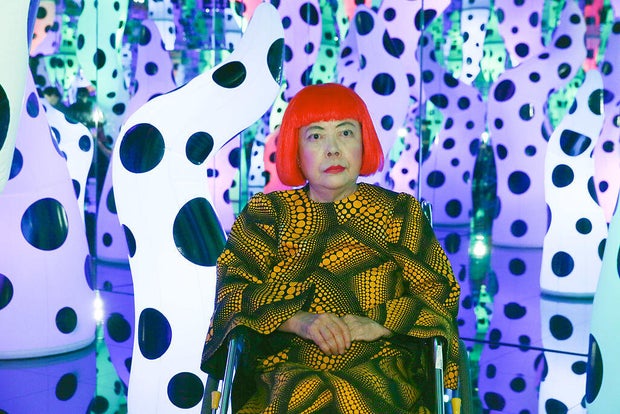
Kusama, one of Japan's most respected contemporary artists, was widely exhibited around the world, including the Museum of Modern Art and the Whitney Museum of American Art in New York.
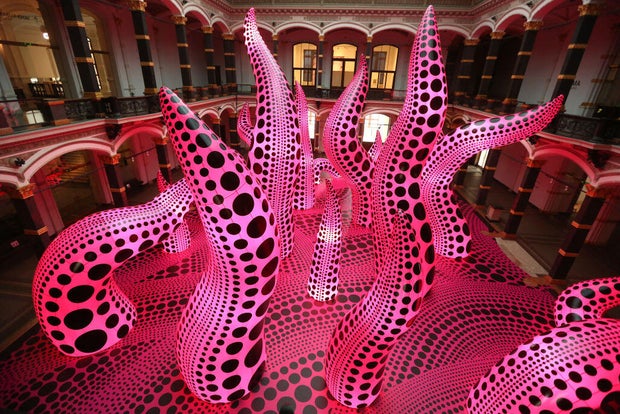
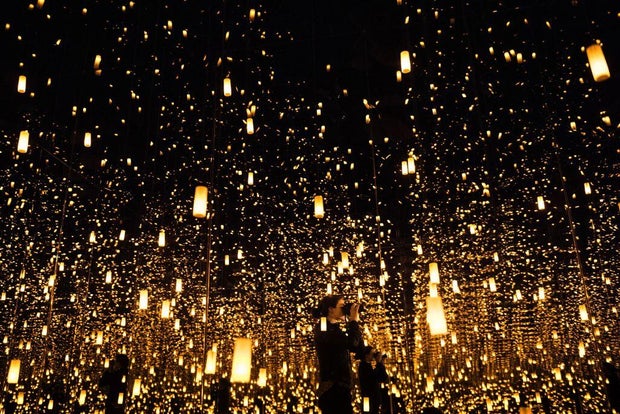
Repetitive motifs were her trademark, in various shapes, resembling netting, swirls or worms, but most often dots, dancing proudly on her canvases, or as sparkling balls or dots of light in her installations, in all their vibrant psychedelic glory.
"Polka dots are fabulous," Kusama said in a 2012 interview with The Associated Press, appearing in her signature orange bobcut wig and polka dot-covered attire.
"I want to create a thousand paintings, maybe two thousand paintings, as many as I can draw," she said in her childlike but matter-of-fact tone. "I will keep painting until I die."
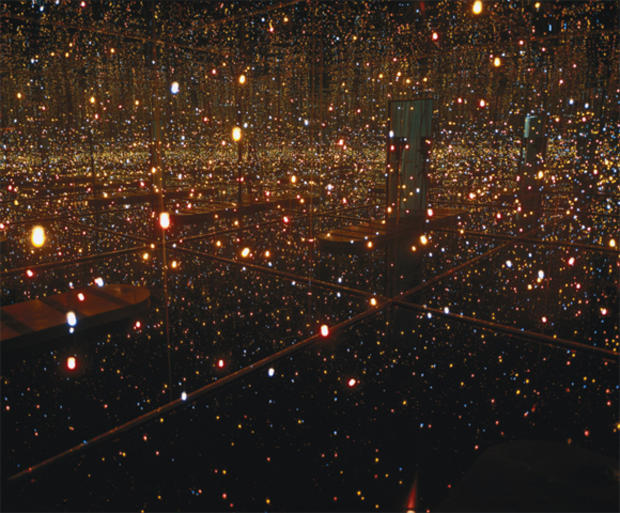
Kusama insisted she drew the way she saw the world — covered with spots, part of the hallucinations she said she had from childhood. She was in and out of psychiatric institutions for decades, although her sickness did not hold her back as she was one of the first Japanese women to go to New York to pursue her art, in 1957.
Although soft-spoken and shy in her mannerisms, she was always unabashedly bold in the assertion of her dotty vision, not only in sticking to the style for decades but also in making it accessible to the masses.
In her later years, as the times caught up with her art, she enjoyed fame. She signed on with fashion brands like Louis Vuitton as well as other licensed products like teacups, T-shirts and key chains with her illustrations, including replicas of her likeness that were used in show windows and other marketing.
In 2008, Christie's auctioned her work for $5.8 million. In 2016, she won the most prestigious award Japan gives its artists, the Order of Culture.
Upon receiving the award, she told reporters she was more determined than ever to pursue her art, stressing that the sincerity and devotion she had demonstrated in her personal life were crucial parts of her artistic legacy.
"I feel there is little left in my life, but I am now still fighting to the death for my art," she said. "I am giving all I have so that many people will continue to be interested in my art, even after I am dead."
Kusama was called pop, avant-garde, feminist, just to name some of the categories thrown at her, most of which Kusama brushed off as not quite representative of her art.
She was born in a middle-class family but felt misunderstood, as her parents wanted her to simply get married. They wanted to buy her kimono, not paints and brushes. She knew she had to get away. She chose America.
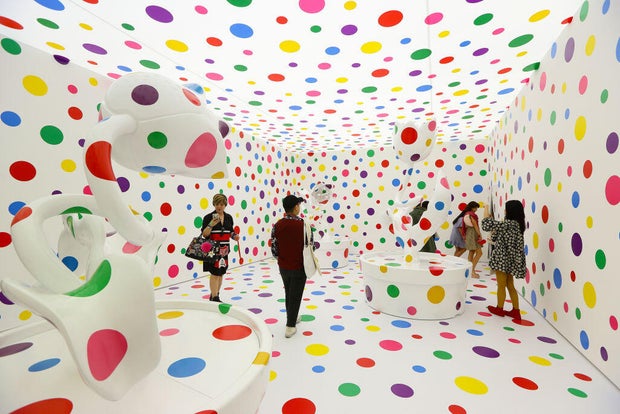
When she arrived in New York, the fad was "action painting," characterized by dribbles, swooshes and smears, not dots. She suffered years of poverty and obscurity. But she kept painting dots.
She put circles of paper on people's bodies, and once a horse, in "happening" anti-war performances in the late 1960s, which got some people arrested for obscenity but helped get media attention for her art. While in New York, she befriended artists like Andy Warhol, Georgia O'Keeffe and Joseph Cornell, who praised her innovative style.
Over the years, Kusama made quirky but stunningly celebratory works like "Macaroni Girl," a female figure plastered with macaroni, which expresses the fear of food; "The Visionary Flowers," giant sculptures of twisting tulips, and "Mirrored Corridor," a room with mirrors that delivers an illusion of a field of phallic protrusions speckled with dots.
Kusama, who also made films and published several novels, said she wasn't sure where she got her ideas. She just picked up her brush and started drawing. The process was so mysterious sometimes she surprised herself, she told AP.
"I think, 'Oh, I drew that? I was thinking that,'" she said.
But she appeared happy to have her art be the focus of media attention and praise, reading one of her poems to a reporter or tackling her artworks with gusto for photos.
But she was also a charmingly disarming mix of vulnerability and defiance — at one moment, declaring herself "an artistic revolutionary," and then the next, mumbling: "I am so afraid, all the time, of everything."
KioskNews shows a cleaned-up reading view extracted from the publisher’s page — the original always lives on their site, not ours.