In Kutch, a forest officer finds a snake species last seen 150 years ago
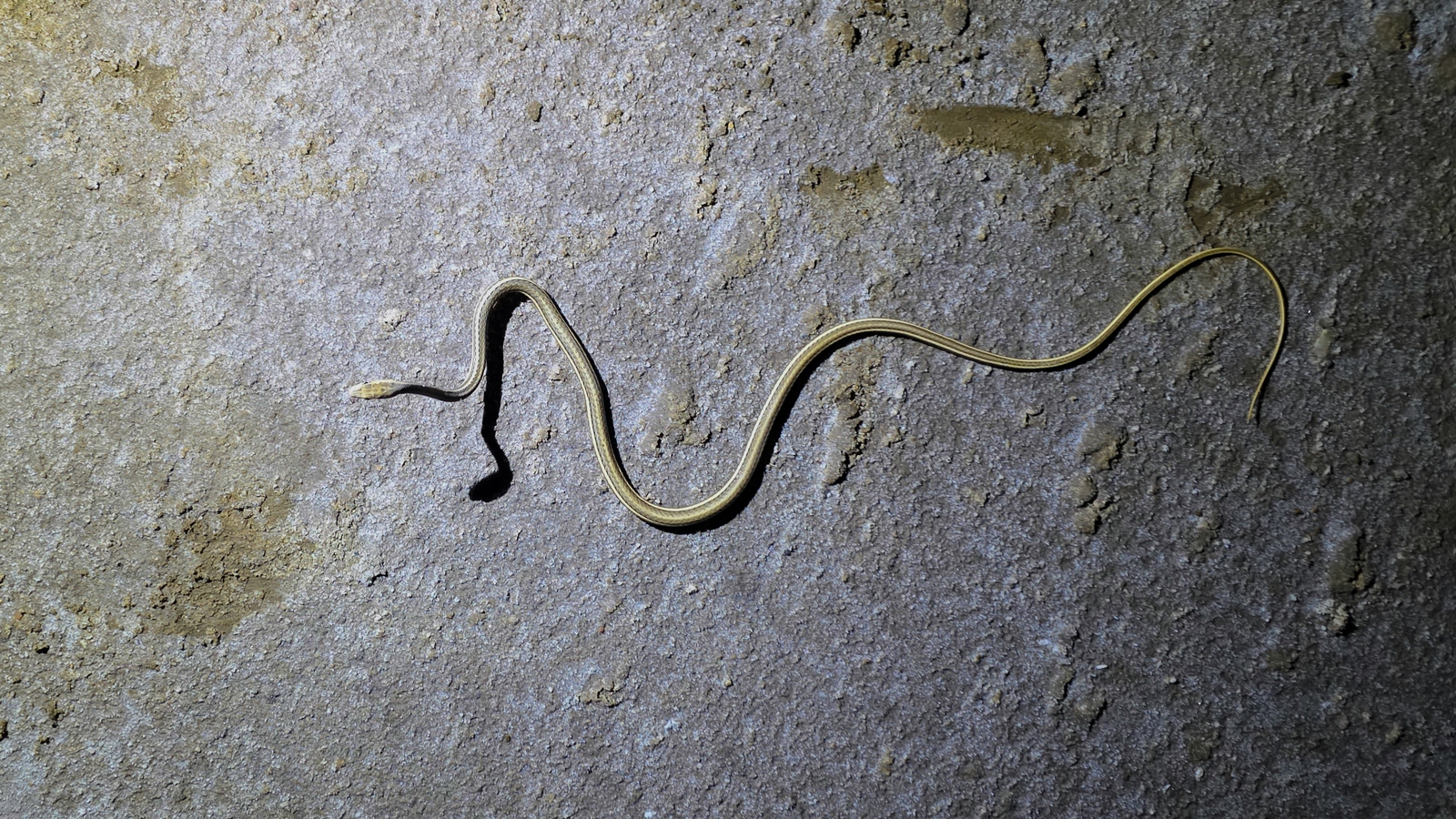
Earlier this month, a young forest officer returning from patrol near Kala Dungar, the highest point in a hilly, semi-arid part of Kutch not far from Bhuj, came across an unexpected creature.
In the gloom of the gathering dusk, the officer saw, slithering on the road in front of his vehicle, a type of snake that he had never seen before.
The officer, who had been recently transferred from Panchmahals in Eastern Gujarat to Kutch, was intrigued. He took photos and made a video of the snake, and sent them to a range of experts asking them to identify it.
The experts returned a unanimous opinion – the creature was an Afro-Asian sand snake, a fast, slender reptile that lives in arid habitats stretching from Gujarat to coastal West Africa, and spanning large parts of West Asia and coastal North and East Africa.
The last confirmed sighting of the snake, Psammophis schokari, in Kutch was more than 150 years ago. The presence of the species in the district was recorded by the great Czech palaeontologist Ferdinand Stoliczka in 1872.
Jayesh Dumadiya, the 32-year-old Range Forest Officer (RFO) of the Gujarat Forest Department’s Bhuj North Range, described how the individual of this species had suddenly appeared before his team as they were trying to tackle a different snake that had entered their vehicle.
“It happened around 7.30 pm on September 6, when I was returning from patrolling duty,” Dumadiya told The Indian Express. “A black-headed royal snake passed in front of our vehicle. Out of curiosity, we stopped and I got off and tried to capture the snake in a photo and video,” he said.
Story continues below this ad
The black-headed royal snake (Spalerosophis atriceps), also called Fischer’s royal snake, is a large, non-venomous snake that is fairly common across desert, scrub forest, and rocky habitats in the South Asian region.
With the forest staff around it, the snake went into defensive mode and climbed into their vehicle, Dumadiya said. Then, as they were trying to coax it out, a second snake appeared on the scene, he said.
“This snake, which appeared on the road, was new to me. So I took its photos and a video, and sent it to experts, snake rescuers, and scientists. They confirmed it was an Afro-asian sand snake,” Dumadiya said.
The Afro-Asian sand snake, the officer said, is different from the common sand snake or sand boa (Eryx conicus), which is a smaller, also non-venomous species of indigenous snake. “The last record of the Afro-Asian sand snake is from 1872. There have been two or three instances of its sighting since then, but they have not been confirmed,” Dumadiya said.
Story continues below this ad
The Afro-Asian sand snake is a semi-venomous reptile that hunts small animals like lizards, rodents, and small birds mainly during the day. It is usually not harmful to humans.
Stoliczka, the naturalist who identified the snake species in Kutch, was a Moravian palaeontologist, geologist, herpetologist, and ornithologist, who joined the Geological Survey of India in Calcutta in 1862, and over the next dozen years, travelled all over the subcontinent, Burma, Malaya, the Himalayas, and the Andaman and Nicobar Islands.
Dheeraj Mittal, the Conservator of Forests (Kutch Circle), said Stoliczka undertook a survey of the Kutch region of Gujarat between October 1871 and March 1872, and collected numerous zoological specimens including reptiles. Stoliczka published his observations and taxonomic findings in 1872 in the Journal of the Asiatic Society of Bengal. His papers constitute important early historical records of the reptile fauna of Gujarat, and the Afro-Asian sand snake was among the reptiles he recorded in the region, Mittal said.
“The presence of this snake species has been reported in Gujarat and Rajasthan. But the last recorded sighting was in 1872, when that scientist (Stoliczka) took that sample. Since then nobody has been able to record a sighting,” Mittal said.
Story continues below this ad
Mittal said Dumadiya’s discovery was significant because it validated a recording that was made more than a century and a half ago. “It’s a rare sighting and a kind of second record after that (1872) record. One of our RFOs has sighted the snake and recorded it on photo and video, and that is a great feat,” Mittal said.
“I will write to the editors of some scientific and environmental journals about this. There are historical records, but we have been able to see and record the reptile after so many years. The snake is endemic to landscapes like Kutch but the sighting is a sort of rediscovery,” Mittal said.
Kutch, Mittal said, is a vast and biodiverse area, certain aspects of which remain unexplored. “To physically verify in 2026 a recording made in 1872 as part of a survey is a big deal,” he added.
Dumadiya said that Kutch is a dry and arid zone, but “this rare sighting suggests that unlike the popular perception, it is full of biodiversity that requires protection and study”.
KioskNews shows a cleaned-up reading view extracted from the publisher’s page — the original always lives on their site, not ours.