Why RBI is bringing its gold reserves back to India

Starting October 2022, the Reserve Bank of India (RBI) has continuously increased the share of its gold it keeps in India. Data released Wednesday showed that the central bank maintained this practice in the first half of 2026-27 amid an increasing preference among central banks globally to store their gold domestically.
As per the RBI’s half-yearly report on the management of foreign exchange reserves, the gold held in India by the central bank increased to 740.13 metric tonnes (mt) as at the end of September, up from 680.05 mt at the end of March.
As a result, the RBI now holds 84% of the 880.52 mt of its gold in India itself, more than double the 39% held just four years ago.
In 2025-26, the RBI brought 168.06 mt of gold to India, up from 107.21 mt in 2023-24 and 103.68 mt in 2024-25.
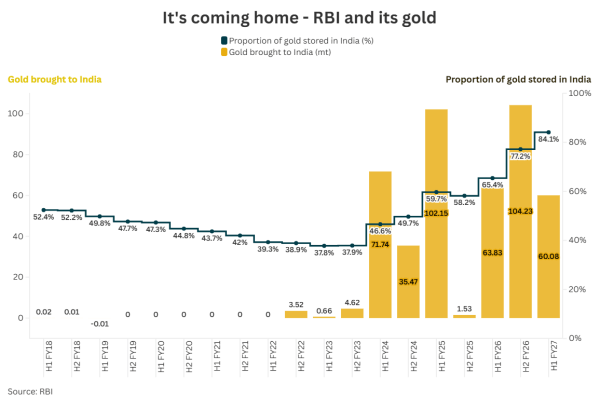 It’s coming home – RBI is bringing back its gold to India
Weaponisation of forex reserves
Ever since Russia attacked Ukraine in February 2022, the RBI has, without fail, shifted more and more of its gold holdings to India. Why?
Russia’s invasion led to the US freezing Russia’s dollar-denominated foreign exchange reserves, which sparked a move by central banks around the world towards holding more non-dollar-denominated foreign currency assets.
Story continues below this ad
This is clearly visible in data from the International Monetary Fund, which shows that the share of US dollar assets in official foreign exchange reserves declined from 57.18% in the first three months of 2026 to 56.7% in April-June. In July–September 2022, the figure was 60.43%.
But buying non-dollar assets is just one aspect of ensuring a central bank’s forex reserves are not held hostage by another country — keeping these non-dollar assets, such as gold, in the home country provides greater control too.
Rise of gold in FX reserves
Gold forms a crucial and significant portion of central banks’ foreign exchange reserves. In the case of the RBI, the precious metal as a percentage of the RBI’s forex reserves has steadily increased from 6% prior to the Covid pandemic to a peak of 19.02% at the end of January 2026 as gold prices skyrocketed.
With prices falling sharply since then, this figure fell to 16.7% by the end of March and further to 14.38% by September — all while there was no change in the quantity of gold the RBI held.
Story continues below this ad
As per latest data for November 13, the RBI’s gold holdings were worth $98.61 billion and accounted for 13.98% of the entire forex reserves of $705.34 billion.
Rising domestic storage
For central banks around the world, the Bank of England is the most popular place to keep gold. As per the June edition of the World Gold Council’s Central Bank Gold Reserves Survey, more than half (57%) of the surveyed central banks kept some of their gold with the Bank of England.
However, the World Gold Council’s latest survey found a notable change in gold ‘vaulting’ locations: 9% said they have increased domestic storage and 10% said they have diversified overseas storage locations in the past 12 months. These figures are up from 5% and 2%, respectively, from last year.
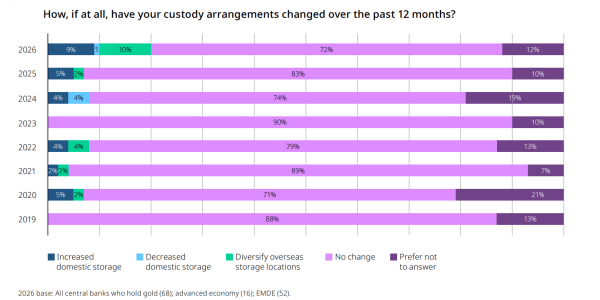 Gold storage locations.
“The trend is also observed in future plans for vaulting, with 7% saying they plan to increase domestic storage and 9% saying they plan to diversify overseas storage locations in the coming 12 months,” the World Gold Council said.
RBI not adding to gold
Story continues below this ad
Unlike some of its global counterparts, the RBI has not been aggressively buying gold; in fact, it has bought less than 1 mt of gold since March 2025.
According to latest World Gold Council data, the central banks bought 61 tonnes of gold in September — the highest monthly purchase in 2026 — with Poland and China leading the charge.
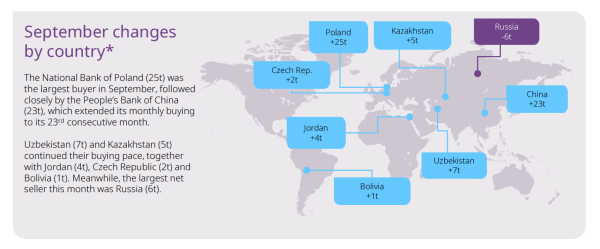 Which country’s central bank bought how much gold in September.
So far in 2026, global central banks have reported buying 228 tonnes of gold on a net basis; the RBI has bought zero. Meanwhile, the National Bank of Poland and the People’s Bank of China have each bought more than 100 tonnes this calendar year.
KioskNews shows a cleaned-up reading view extracted from the publisher’s page — the original always lives on their site, not ours.