Behind the riots, Europe wrestles with hard choices
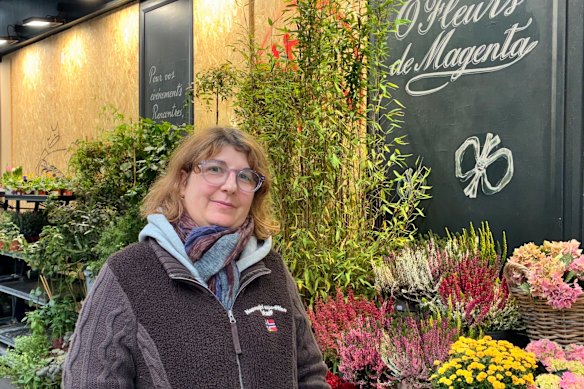
Paris/Madrid: The looters stole almost everything when they smashed their way into Clemence Ramon’s store during the latest wave of riots in France.
She watched them on the store’s in-house video from home, knowing there was no way to get help to the shop on Boulevard de Magenta when so many police were confronting protests across Paris. “They were like animals,” she says of the looters.
The florist, 45, has cleaned and restocked the store near Place de la Republique, a focal point for the riots on October 17, but the shattered windows are yet to be replaced. Thick timber boards cover the shopfront. And customers are coming back as Ramon talks to this masthead about what she has been through.
The media coverage of the past few weeks has shown the world footage of looted fashion boutiques, jewellers, shoe shops and electronics stores across France. Some of the thieves targeted items of value they could easily resell. At Ramon’s store, however, they merely destroyed for the sake of it and took whatever they could find.
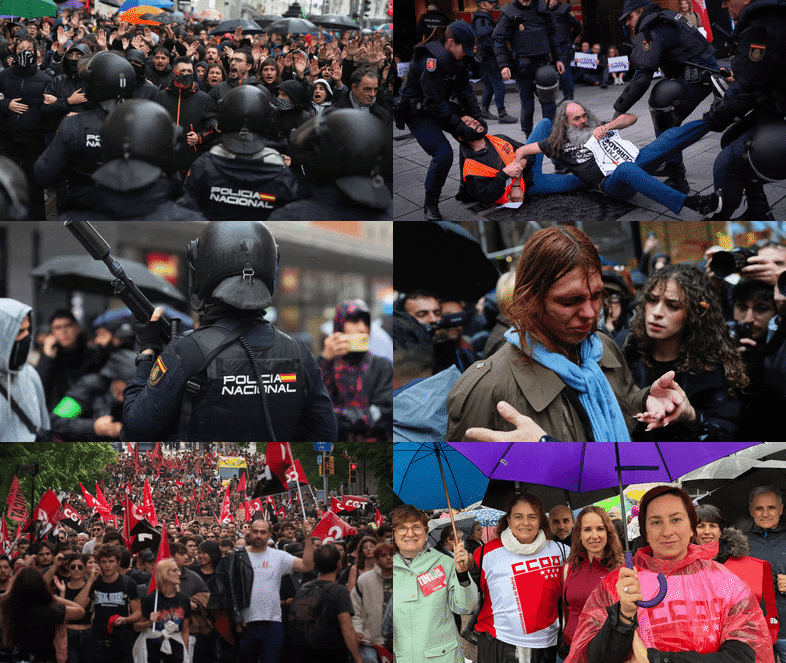
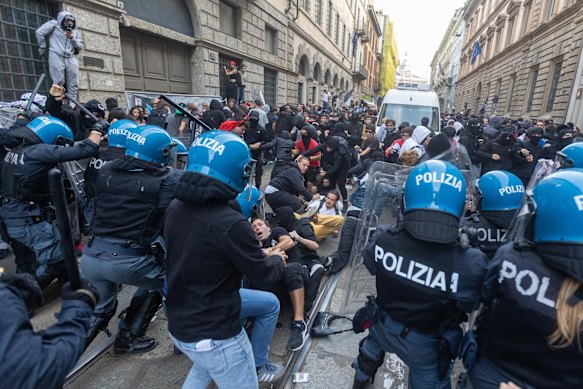
That means the protests, riots and looting in France are not just about economic hardship. And the problems are not limited to France. Across Europe, nations are engaged in hard debates about the fractures in their societies. Protests have turned violent in Belgium, Italy, Portugal and elsewhere. A general strike in Spain ended on Wednesday night. Protesters started fires on the streets of Barcelona and police shot tear gas into the crowd in Madrid.
Ramon cannot say much about the looters’ identities. They wore black balaclavas, like so many protesters in Paris, and black sports gear. She says they looked like teenage boys. “They were just destroying – they were not thinking about the people behind the shop, the families,” she says.
Ramon greets customers cheerfully as she talks to this masthead, surrounded by flowers decorated with eucalyptus leaves. She seems an optimist by nature and is buoyed by the solidarity in the local community. But she works 12-hour days and cannot understand why young people are so often reported in the media to be giving up on France, as if the country has no future.
“They say to journalists: ‘I hate France’ and ‘France does nothing for us.’ Well, if they are not OK to live here, they need to go,” she says.
“They are very lucky in France. We have a lot of support with apartments, with health, for families with children. In France, I think it’s one of the countries with the most help in the world. You can’t say France does nothing for us because it’s not true.”
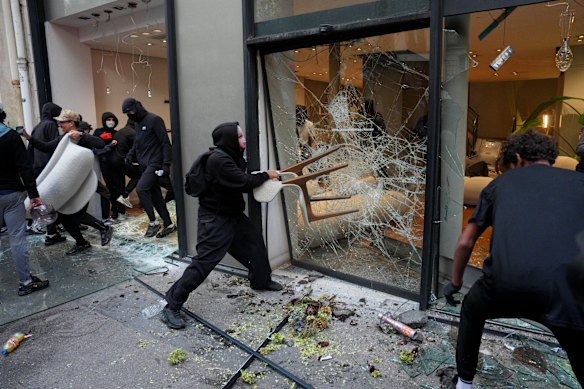
While some of the rioters and looters seen by this masthead in recent weeks appeared to come from migrant backgrounds, that does not explain the full force of the protests across Europe.
The rioters in France come from a mix of ethnicities and include young, white activists driven by hard-left ideologies. Their confrontations with police make global news and heighten pressure on political leaders, giving them an incentive to intensify their tactics.
Behind the black-clad rioters, however, are thousands of people marching in the streets. Young people in France are in despair over the state of their schools, and the yellow-vest protesters are angry about living standards. In Spain, 4 million people supported the general strike in the hope they would get government action on three things: housing, wages and consumer prices.
Each country is riven by different upheavals. The French protests are shaped by the frustration of voters who have given up on Emmanuel Macron, who promised so much when he became president nine years ago.
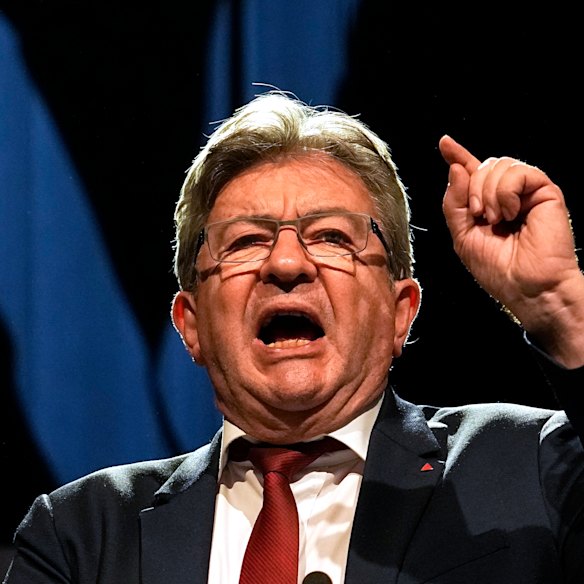
The hard left exploits the rallies in the hope they can lift their champion, Jean-Luc Mélenchon, into the lead at the presidential elections next year.
The latest Harris poll of voting intentions, released on Wednesday, shows that Mélenchon, who marches with the protesters as leader of La France Insoumise (the LFI, also known as France Unbowed), would attract 18 to 19 per cent support in the first round of voting. But the hard right, led by Marine Le Pen and her National Rally, would receive 34 to 36 per cent.
Every poll suggests she would defeat Mélenchon in the head-to-head contest in the second round.
The political forces are different in Italy, where Prime Minister Giorgia Meloni took power as a right-wing firebrand in 2022 and must face voters again next year. While some critics paint her as a fascist, one of her greatest challengers is Roberto Vannacci, the founder of hard-right party Futuro Nazionale.
Tens of thousands of Italians marched in support of a national strike on October 30, but the rallies were mostly peaceful. The worst violence was seen in Milan on the weekend of October 17 and 18 – parallel to the French riots – when several hundred people clashed with police and looted stores.
In Albania, protesters are angry at their government for allowing a large coastal resort backed by US President Donald Trump’s daughter Ivanka and her husband, Jared Kushner. In Serbia, massive rallies by students have helped topple a conservative government. Each country is different.
In Portugal, the soaring cost of housing has made this the central issue in public rallies. Protesters and homeless people have defied police for weeks at an encampment in the capital, Lisbon. They agreed to leave last Monday, but the unrest over housing is based on deeper problems in the community.
Most European countries have seen house prices outpace incomes for a decade – and nowhere has suffered as much as Portugal. A study from Eurostat, a European Union agency, revealed this month that the ratio of house prices to household income rose by 6.8 per cent across the European Union – meaning that homes were further out of reach for many. In Portugal, the ratio rose by 60.8 per cent.
Portugal was followed by the Netherlands (up 34.3 per cent), Hungary (up 26.5 per cent), Czechia (up 25.8 per cent) and Spain (up 24.5 per cent). The biggest improvements in this measure were in Bulgaria, Finland and Romania. There were slight improvements in Italy and France. Again, that is a sign that the key factor in a protest in one country might not be so pressing in another.
The factors behind the general strike in Spain were spelled out in three words on leaflets at the protests: salaries, housing, prices. Those at the march in Madrid told this masthead they had seen big rises in household costs and smaller increases in wages. Housing, they said, was now a crisis.
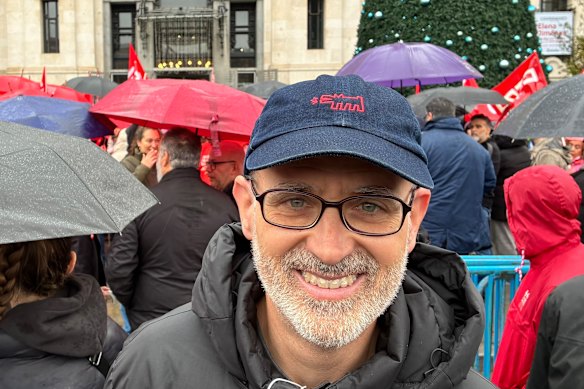
“The problem is getting so out of hand that we will need years to solve it,” says Santi Rello, a research manager in healthcare who joined the rallies in Madrid on Wednesday.
Until recently, Rello spent 45 per cent of his after-tax income on rent. He was living in a converted garage that had been turned into a ground-floor apartment with enough room for one person. While it was close to the centre of Madrid, it was dark and dank; family members have since helped him with a better home.
“The governments are always saying that the big problem is the shortage of housing, but they are not doing enough to build new houses,” he says. “Moreover, they are selling public housing to private funds, and it’s incredible that we are paying for this with our taxes.
“The government has sold buildings to people who put up the rent without any return to the government or to the people, so we are losing real estate.”
This trend has been under way for years. A Reuters report from 2014 highlighted the strains on households from government decisions to sell public housing to private companies. Global investors such as Blackstone and Goldman Sachs bid against each other to buy up properties – and are branded “vulture funds” as a result. Meanwhile, governments have done little to build new homes.
The problem may not be new, but the cumulative impact has been diabolical for Spanish households whose incomes do not keep up with rents. The slow burn has turned into a raging fire.
Rebeca Castaño, a teacher at a Madrid infants’ school, told this masthead on Wednesday that some of the children in her classes lived in homes where their families crammed four or five people into a single bedroom because housing costs were so high.
While each country is dealing with a different mix of pressures, the discontent is fundamentally about a decline in the standard of living for millions of families across Europe. At the same time, communities are undergoing lasting changes from the influx of migrants over decades – and popular opinion is shifting strongly against accepting any more.
In a time of hardship, voters can turn to tough talk. In Germany, the hard-right Alternative für Deutschland (the AfD) is winning votes with its pledge to enact “remigration” to send migrants back to their home countries. This rallying cry is now being picked up in Italy by Vannacci of Futuro Nazionale and in Spain by Santiago Abascal and his party, Vox.
The next test of voter sentiment on migration comes at the Spanish general election on November 29. Socialist Prime Minister Pedro Sanchez advocates settlement for migrants who deserve to stay. His main challenger, People’s Party leader Alberto Núñez Feijóo, wants to ban Islamic face coverings in public places and toughen border controls against new migrants. This is one factor in a broader contest about living standards.
While French voters appear to be turning to the right, it is challenging to mount a theory about a broader European trend at the ballot box. A conservative leader holds power in Italy and the hard right is on the rise in Germany, but the moderates are trying to cling to power in Sweden against a challenge from the left. In Hungary, a centrist toppled a right-wing strongman. In Serbia, students tore down a right-wing admirer of Russian President Vladimir Putin.
The common factor for many households in Europe is not so much which way they are marching at the polls, but what burdens they are carrying.
The lights are dimming on old assumptions about European prosperity and promise – at least until leaders produce more than promises.
Former Italian prime minister Mario Draghi, an economist so respected he was made president of the European Central Bank, warned of the malaise in a speech in May. He said the 27 nations of the EU were failing to deliver what the moment demanded: serious reform and growth.
“The problem is not the lack of ambition among the leaders,” he said. “It is what happens after ambition enters the mechanism. The result is action that can be so inadequate to the scale of the challenge that it becomes worse than inaction.
“And an EU that claims responsibility but repeatedly disappoints enters a cycle from which it cannot escape: weakness in delivery erodes legitimacy, and weakness in legitimacy makes delivery even more difficult.
“We must break this cycle.”
European leaders say they can break the cycle. They are yet to do so. Until they do, the rallies in the streets will only grow.
Get a note directly from our foreign correspondents on what’s making headlines around the world. Sign up for our weekly What in the World newsletter.
KioskNews shows a cleaned-up reading view extracted from the publisher’s page — the original always lives on their site, not ours.