MAC dismisses Xi pledge as familiar unity rhetoric
SAME OLD: The council said that the wording on unification was ‘not much different from the past,’ while an official criticized China’s reverence of Sun Yet-sen
By Chen Chih-cheng and Jake Chung / Staff reporter, with staff writer and Reuters


The Mainland Affairs Council (MAC) yesterday said that Chinese President Xi Jinping’s (習近平) vow to peacefully “reunify” Taiwan in a speech marking the 160th birthday of Sun Yat-sen (孫逸仙) is not new.
Speaking at the Great Hall of the People in Beijing yesterday, Xi said that resolving the Taiwan question is an “unwavering historical mission” of the Chinese Communist Party, without mentioning the use of force.
China adheres to “peaceful reunification and the policy of ‘one country, two systems,’” and is willing to talk to Taiwan while upholding the “one China” principle, Xi added.
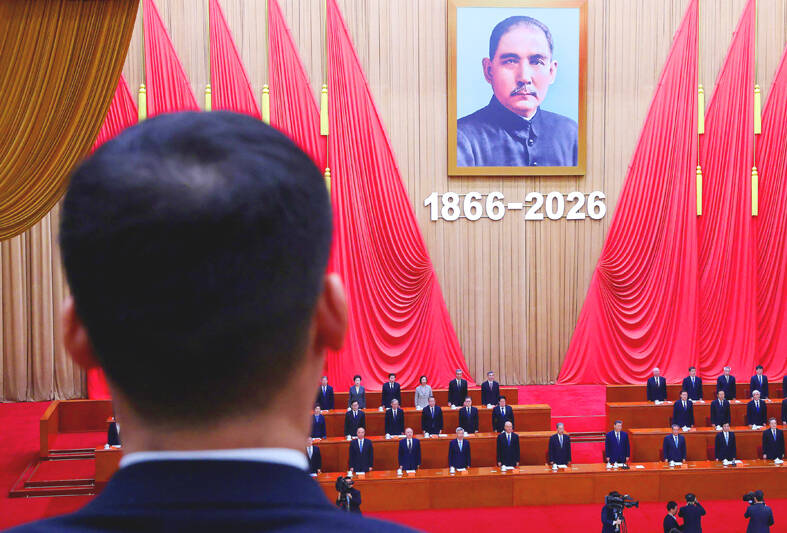
A giant portrait of Sun Yat-sen hangs above Chinese President Xi Jinping and other leaders attending a meeting commemorating his 160th birthday at the Great Hall of the People in Beijing yesterday.
Photo: Reuters
“As for the wording on Taiwan unification, it is not much different from the past,” MAC Deputy Minister Liang Wen-chieh (梁文傑) said.
Sun, a leader of the movement behind the 1911 revolt that ended Qing rule and founded the Republic of China (ROC), was born on Nov. 12, 1866.
Beijing hails him as a patriot and forerunner of the communist revolution, while in Taiwan he is the “father of the nation,” and his portrait hangs in the Presidential Office.
An official familiar with international affairs said that Beijing professes to revere Sun, but its actions run counter to his efforts to topple imperial rule and promote democracy and freedom.
Beijing’s government, with no limit on its leader’s time in power, resembles the imperial rule of the Qing Dynasty’s final days, and is commemorating the person who not only helped end imperial rule, but also vacated what was, at the time, the most coveted political office, the official said.
What Sun left behind was not a slogan, but a generation willing to form parties, run newspapers and criticize those in power, the official said, adding that such acts could be considered criminal in China, rendering any commemoration of Sun a mere facade.
Meanwhile, former Chinese Nationalist Party (KMT) legislator and Cross-Strait Development and Research Foundation chairman Ting Shou-chung (丁守中) and former Examination Yuan president John Kuan (關中) yesterday cohosted a rally to commemorate Sun’s birthday and promote cross-strait peace.
During the event they presented a “cross-strait peace initiative” cosigned by more than 200 pan-blue academics, which opposes war and urges both sides of the Taiwan Strait to negotiate a political arrangement based on equality and mutual respect.
Ting read out its four main points: Put peace and people’s welfare first and end mutual attacks and stigmatization; resume dialogue and expand civil exchanges; deepen cooperation on functional matters, including industry; and face history and reality to lay the groundwork for a final political settlement.
Kuan said Europe and the US are growing weaker and more divided while the “East is on the rise.”
As the greatest US national interest is to avoid war with China, Taiwan’s influence is waning and its role increasingly marginal, he said.
“The greatest sin of Taiwan’s government is not letting the people of Taiwan know the harm of war,” he said, adding that “only peace can protect Taiwan.”
KioskNews shows a cleaned-up reading view extracted from the publisher’s page — the original always lives on their site, not ours.