The worry for RBI in August inflation data: Jump in sugar and chip prices
India’s headline inflation — for households, wholesalers, and producers — increased in August. While the headline retail inflation rate rose to an eight-month high of 4.82%, wholesale inflation rose to 9.92% and producers’ output price inflation to 9.81%. But it will be the smallest of the three numbers which will worry the Reserve Bank of India.
The central bank’s inflation target is spelt out in terms of retail inflation, measured by the Consumer Price Index (CPI). And in August, CPI inflation saw some noteworthy developments. This has led to economists predicting the Monetary Policy Committee (MPC) will increase the policy repo rate on October 7 by 25 basis points (bps) to 5.5% – the first interest rate hike in three-and-a-half years. Days later, on October 12, CPI data for September is expected to show retail inflation comfortably crossed 5% in September, with some economists thinking it may be as high as 5.7%.
This puts the MPC in a spot it shouldn’t have gotten itself into; after all, in August it had said that there were “little signs of generalisation of price pressures”.
According to economists from ICICI Securities Primary Dealership, the MPC’s “insistence” in August on waiting to see price pressures become more general and terming the current inflation rise as a supply shock “does not hold up to scrutiny”.
“With broad array of input price pressures already showing up in PPI (Producer Price Index) measures synchronously across the world (including in China an economy known for producer price deflation), pass through to consumer prices is not a question of if but when. It is all the more so when underlying demand conditions are running strong like in India,” they said in a report on Tuesday.
The RBI expects CPI inflation to average 4.7% in July-September, 5.9% in October-December, 5.5% in January-March 2027, and 5.3% in April-June 2027.
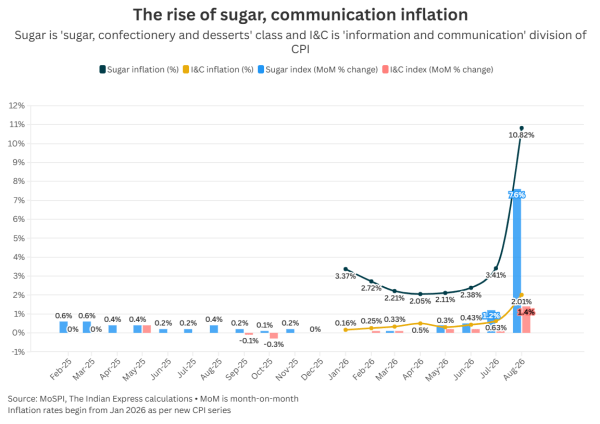 The rise of sugar, communication inflation.
Why sugar became key driver of August food inflation
Story continues below this ad
The most noticeable aspect of the August retail inflation data was the jump in sugar prices.
The price index for sugar soared 19% in August from July; the year-on-year inflation rate was 24%. The price of jaggery was up 8% from July, candy and misri 3%, sweets prepared using and without milk around 1.5%, cake, pastry, and breads 0.6%, and jams 0.5%.
On the whole, the price index of the ‘sugar, confectionery and desserts’ category of the CPI rose 7.6% month-on-month in August and was up 10.8% from last year. And even though this category only accounts for a tiny 1.4% of the entire CPI basket, it was “one of the largest drivers of food price momentum” in August and contributed around 15 bps to the headline inflation rate of 4.82%, according to Emkay Global Financial Services.
Sugar is a crucial ingredient at this time of the year, with major festivals just around the corner. It was with an eye on the festivals that the government last month allowed duty-free imports of up to 10 lakh tonnes of raw sugar until October 31, with domestic prices having spiked due to lower-than-expected production and multi-year-low inventories.
Story continues below this ad
Prices have continued to rise in September. According to the Department of Consumer Affairs, the all-India average retail price of sugar in August rose 15% month-on-month to Rs 55.21 per kg. The first half of September has seen another 10% increase to Rs 60.97/kg.
‘Chipflation’ begins to reflect in inflation rate
Another small portion of the CPI that is now being talked of as a contributor to India’s headline retail inflation rate are goods that contain memory chips.
The price of Dynamic Random Access Memory, or DRAM chips – used in everyday electronics – are expected to have risen more than 400% from the start of 2024 to the end of 2026. This is in stark contrast to the previous 70 or so years, when DRAM prices fell 90% every five years.
As this newspaper has been pointing out for several months, the spiralling price of memory chips used in the manufacture of consumer electronics – or ‘chipflation’ – is soon going to reflect noticeably in the headline retail inflation rate. That moment has finally arrived.
Story continues below this ad
Inflation for the ‘information and communication equipment’ category rose to 2.95% in August after its price index rose on a sequential basis for the ninth month in a row. Expand this pool to include other key consumer electronics that require memory chips –refrigerators, washing machines, and air conditioners – and the price rise caused by the global AI boom can’t be ignored.
Take the broader ‘information and communication’ category and its inflation more than tripled to 2.01% in August from 0.63% in July, with the relevant price index jumping 1.4% from one month to the next.
What spreading of price pressure means
The ‘sugar, confectionery and desserts’ and ‘information and communication’ categories together make up about 5% or so of the CPI. So why do they matter for policymakers? Because these higher prices can spread to other parts of the CPI, such as prepared meals.
We have seen stark examples of this ‘generalisation’ of prices. With commercial cooking gas getting expensive after the start of the West Asia war, restaurants and cafes sharply increased their menu prices.
Story continues below this ad
Spreading of price pressures across the CPI can also be seen in the various items the consumption basket contains.
The number of items whose inflation was more than 4% has increased from 65 in January to 110 in August. While 110 may look like a small portion of the CPI basket since it contains 358 items, consider the following: prices of 314 of the 358 items were higher in August compared to July. In February, this number was 236. Clearly, it’s not just sugar and consumer electronics that are becoming more expensive.

Siddharth Upasani is a Deputy Associate Editor with The Indian Express. He reports primarily on data and the economy, looking for trends and changes in the former which paint a picture of the latter. Before The Indian Express, he worked at Moneycontrol and financial newswire Informist (previously called Cogencis). Outside of work, sports, fantasy football, and graphic novels keep him busy. ... Read More
KioskNews shows a cleaned-up reading view extracted from the publisher’s page — the original always lives on their site, not ours.