From deer hides to semiconductors: Rethinking Taiwan’s economic miracle
Economist Wu Tsong-min challenges standard industrial policy narratives and arguments about the ‘Taiwan miracle’, arguing that flexible institutions — not just factory subsidies — drove the country’s historic transformation
By Ming-yeh T. Rawnsley 蔡明燁 / Contributing reporter


Four centuries before Taiwan became a semiconductor powerhouse, its deer hides were finding buyers in Japan. The products could hardly be more different, but economist Wu Tsong-min (吳聰敏) sees a question connecting them: what enables a society to turn overseas demand into economic opportunity?
For governments hoping to emulate Taiwan’s chip industry, the answer matters. Taiwan is frequently cited as evidence of what industrial policy can achieve. Wu invites us to look beyond the factories and examine the institutions that made successive waves of development possible.
In a recent interview for the National Taiwan Normal University International Taiwan Studies Center Podcast, produced in collaboration with the International Journal of Taiwan Studies, the National Taiwan University professor emeritus argues that Taiwan’s transformation rests on institutions: the “rules of the game” that determine whether businesses and individuals can respond productively to economic opportunity. These rules govern investment, competition and access to markets. They can encourage enterprise, but they can also obstruct it.

Taiwan Semiconductor Manufacturing Co Fab 12B in Hsinchu is pictured in this undated photo.
Photo courtesy of Wikimedia Commons
Wu’s account challenges a familiar explanation of the “Taiwan miracle”. Wu places institutional reform at the center of the story, asking how changes to economic rules created conditions in which businesses could grow. To understand the economy of advanced chips, he begins with the economy of deer hides.
From the late sixteenth century, deer hides from Taiwan were exported to Japan and venison to China. In the seventeenth century, the Dutch incorporated Taiwan into the wider commercial networks of the Dutch East India Company. The island’s dependence on overseas markets thus long predates its electronics industry.
THREE INSTITUTIONAL TURNING POINTS
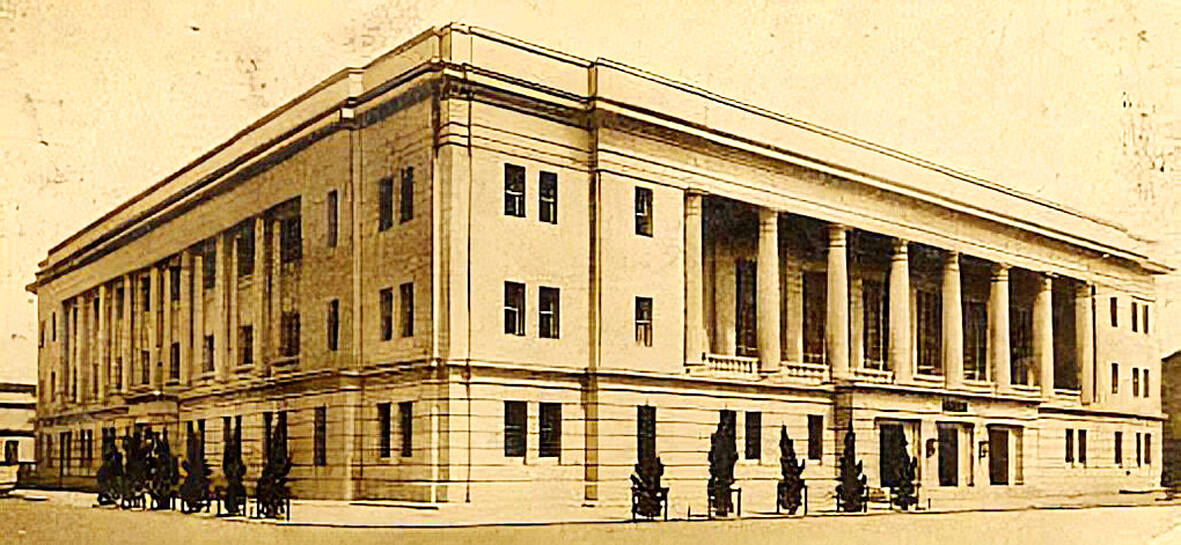
An undated illustration of the Bank of Taiwan, which was established in 1897 and headquartered in Taihoku (Taipei). Japanese colonial rule from 1895 to 1945 helped to establish the foundations for Taiwan’s modern economy.
Photo courtesy of Wikimedia Commons
Trade, however, did not automatically bring sustained growth. Producers also needed conditions that allowed them to expand production and benefit from exchange. Wu’s history follows this relationship through three turning points: 1895, 1945 and the reforms around 1960.
The first came with Japanese colonial rule in 1895. Changes to land rights and administration, alongside investment in transportation and public health, helped establish foundations for a modern economy. Their effects extended beyond the end of colonial rule.
These changes formed part of a system of political domination and violence. Recognizing their economic consequences, of course, does not justify colonialism. It does, however, help explain the institutional inheritance with which postwar Taiwan began.
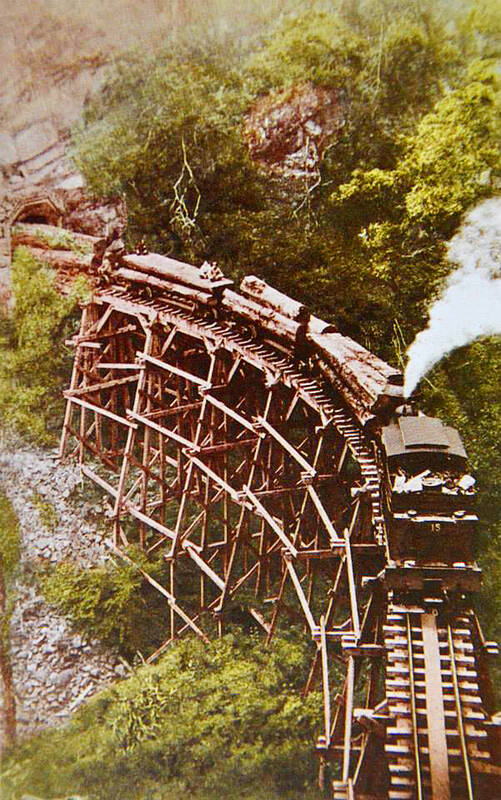
The Alishan Forest Railway during the Japanese colonial period.
Photo courtesy of Wikimedia Commons
The second turning point came in 1945, when the Chinese Nationalist Party (KMT) government took control. Accounts of Taiwan’s economic success often move quickly to the export boom that began around 1960. For Wu, the intervening 15 years are essential to understanding why growth subsequently accelerated.
The government imposed extensive controls on foreign exchange, imports, investment and private business. Hyperinflation devastated the postwar economy. An overvalued currency and a complicated exchange-rate system also made it difficult for producers to compete internationally.
The textile industry illustrates the mixed consequences of state intervention. During the 1950s, tariffs, import restrictions and subsidized credit helped domestic producers expand. Yet protection weakened incentives to improve productivity, while foreign-exchange controls constrained their ability to compete abroad. Policies that helped establish an industry could also limit its development.
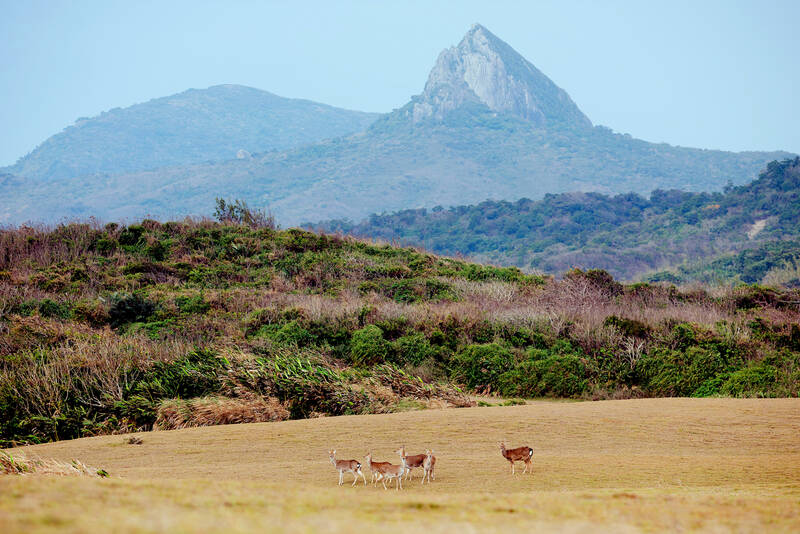
Formosan sika deer at Kenting National Park in this undated picture. Four centuries before the explosion of Taiwan’s semiconductor industry, sika skins and venison were being exported to Japan and China.
Photo courtesy of Wikimedia Commons
The third turning point came with reforms around 1960. Under pressure from US aid officials, Taiwan simplified the exchange-rate system, eased trade restrictions and improved conditions for private enterprise. KMT officials resisted dismantling controls. Changing the rules was a political struggle as well as an economic undertaking.
Businesses responded rapidly once those constraints eased. Exports expanded, private investment accelerated and Taiwan entered the sustained period of growth that became known as its economic miracle.
American assistance was crucial, Wu argues, for more than the money it supplied. Aid gave US officials leverage to press for reforms that the government had been reluctant to undertake. The significance of assistance lay partly in the institutional changes it helped bring about.
LIMITS OF INDUSTRIAL SUBSIDIES
This interpretation shifts the question from how much governments intervene to what their interventions enable. Wu’s argument does not require the state to retreat from economic life. Governments establish and enforce the rules within which markets operate. The issue is whether those rules support productive activity and allow businesses to respond when opportunities change.
The distinction is important as governments renew their emphasis on industrial policy. Governments want to secure supply chains and develop strategically important technologies. Semiconductor factories have become conspicuous symbols of these ambitions. Yet a factory is only one part of the economy that makes it viable.
Taiwan’s experience raises a difficult question for countries investing in chip production: can subsidies reproduce the conditions that allowed the industry to flourish? Financial support can help establish capacity. It cannot, by itself, recreate accumulated knowledge, skilled workers, competitive pressures or relationships with customers and suppliers.
Taiwan’s small domestic market made access to overseas buyers crucial. Its industries developed through networks of trade, investment, technology and knowledge extending far beyond the nation. International connections were part of the process through which productive capacity grew.
This dependence on international networks creates a tension for today’s policies of economic security. Governments are trying to reproduce aspects of Taiwan’s success while geopolitical rivalry is making some international connections more difficult to sustain. The pursuit of greater domestic capacity must contend with the cross-border relationships on which advanced industries depend.
TAIWAN IN A CHANGING WORLD
Taiwan faces its own version of that problem. Semiconductors are the latest expression of an economy repeatedly transformed by changing products and markets. Their success does not guarantee that the institutions supporting them will remain adequate as conditions change.
Geopolitics has long influenced Taiwan’s economic trajectory. Dutch expansion, Japanese colonialism, the Korean War and the Cold War reshaped its connections to the world. Artificial intelligence, supply-chain security and US-China competition now present another set of pressures. Meeting them will demand institutional adaptation as well as technological expertise.
Asked what a future historian writing Taiwan’s Economy: 500 Years might say about our era, Wu is cautious. Semiconductors would feature, and artificial intelligence might too. What remains uncertain is how Taiwan will respond to the changes still ahead.
Wu explored this history in his Chinese-language book Taiwanese Economy of Four Hundred Years (台灣經濟四百年) (2023). His English-language book, Institutions and Economic Growth in Taiwan: A Four-Century History is forthcoming next year from Cambridge University Press. Japanese and Korean translations of his work are also in prospect, opening further opportunities for readers beyond Taiwan to examine an economic history often compressed into the story of a miracle.
For countries seeking to emulate Taiwan, and for Taiwan itself, the value of this history lies in understanding how the conditions for growth were created. Institutions that supported one transformation may need to change before they can support another. Recognizing that need is easier than overcoming the political resistance reform can provoke.
From deer hides to semiconductors, Taiwan has repeatedly found new ways to participate in the world economy. Its next chapter will depend on whether it can sustain that capacity. As Wu puts it, “the ability to adapt is hard-earned.”
Ming-yeh T. Rawnsley is a research associate at SOAS University of London’s Centre for Taiwan Studies.
KioskNews shows a cleaned-up reading view extracted from the publisher’s page — the original always lives on their site, not ours.