‘We weren’t shy. We were queers in leather!’ Sunil Gupta on his momentous photographs of gay life
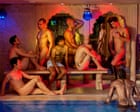
‘I’ve been very promiscuous,” Sunil Gupta says, reflecting on his experiments with photography since the 1970s. Gupta, who was born in India, brought up in Canada and moved to the UK in 1978 after two years studying in New York, has documented and described queer lives for five decades. In his work, he’s quietly tried to find new ways of seeing, exploring the potential of photography to blur fiction and reality, public space and intimate, clandestine moments. His work explores the ways we love and relate to one another, set against the ever-shifting tides of politics and society.
He photographs with love – but it hasn’t been without risk. An exhibition in India was once shut down by the government, and in his early days in the UK, when he was working with fellow photographer Tessa Boffin, he recalls curators “physically shrinking away when we walked in the room – two queers in leather were too much for them! But we were quite aggressively upfront with our sexualities, we weren’t shy about it.”
Ahead of his retrospective exhibition at Kettle’s Yard in Cambridge, Gupta talks through 10 landmark images from across his career.
1. No 43 from Christopher Street
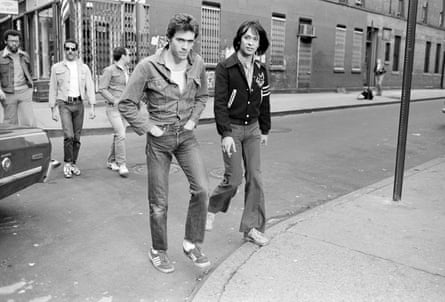
This is almost the only photograph in this series that prominently features a person of colour; it was unusual to see Asian people on Christopher Street in New York at the time, and I saw myself a little bit in the person on the right. These two in the foreground are very much what I remember from that time: you get the hair and clothes because you want to look the part, and you find someone to hang out with. Behind them is the counterfoil: the regular gay guys who parade up and down Christopher Street – but here, they’re in the background. I also like the lone figure further down the street – there’s something about the loneliness of cruising on the street.
2. From Towards an Indian Gay Image
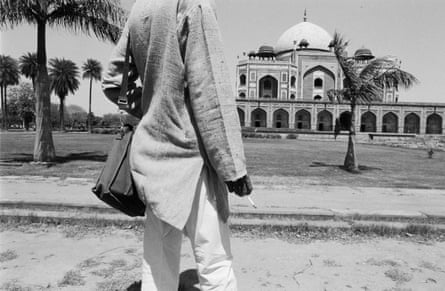
This picture is defining because I’d gone back to Delhi for the first time. I had grown up next to this tomb, which is why it keeps reappearing in the work. I was trying to find a way of photographing gay men in Delhi, but this was circa 1982 – nobody would be in a picture. There was complete silence around the subject of homosexuality. Even people who went out to have sex in public places – there was no chitchat, no language around it. So I began to take headless pictures but it wasn’t really going anywhere. But I liked this, and it made my degree show at the RCA. When I graduated, my livelihood was freelancing. I went to the Guardian, and they said, is there a story? I said yes, then I ran home and wrote a story and they published it in the paper – so it is also my first published picture.
3. From Trespass Series 1
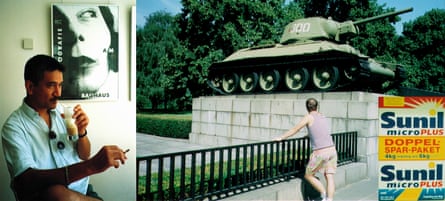
I made these montages on the first Apple computers that had lo-res scanners, I had a lot of fun with it. I printed them very big in a coffee shop in Soho. The discussion at that time, in 1992, was the opposite of Brexit – should we go into the single European currency? The left then was quite anti the euro, and it raised a lot of questions for migrants from the Commonwealth – we thought we would lose our right to be here. In this series I imagined Germany as the centre of a united Europe – geographically and economically.
4. From ‘Pretended’ Family Relationships
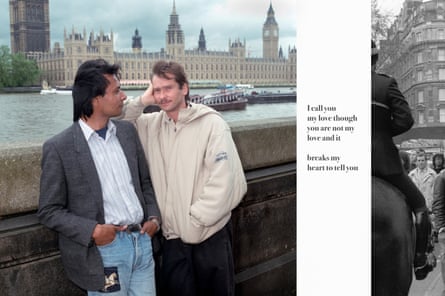
This began as a project about Clause 28, [later Section 28, a law introduced by Thatcher’s government in 1988 that banned local authorities and schools from “promoting homosexuality”]. In the late 1980s, I was living in a bubble in Brixton, with a white partner, and all the couples we knew were multiracial, and we thought that was cool and how it should be. I began to shoot but it was hard to get Black and Asian models to be in queer stuff in pictures, no one could be out. So they were fake couples, people I knew.
5. From Love and Light
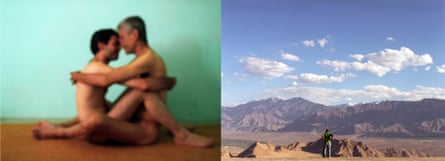
This marked my return to India in 2005. I had met this person in Leh, who was in film and theatre. He was a guru as well. We got together, it was very intense. I turned up in India with my suitcase, by which time he had lost interest. But I thought I would stay. The plan had been to make a series of pictures of us together in various interesting locations – instead it turned into just me in various interesting locations. And then at the end, I met my husband, Charan Singh, at an Aids conference in Delhi. He was a social worker and I was on stage as a person with HIV.
6. From Country: Portrait of an Indian Village (taken in 2007)
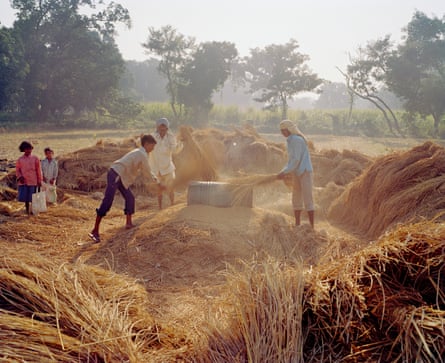
In London, you walk out and no one knows you. Then you go to this village in India and everyone knows who you are, who your grandfather was, how you arrived. After a few weeks it’s quite claustrophobic. I thought I’d make a project about a village in Rajasthan and I got very involved with it but it was as an outsider. But in this place, I wander around with a camera, I stop and chat. An uncle gave me a 300-year oral history. My cousin has built me a horrible concrete bunker on my father’s small piece of land which he thinks I might like to live in, which is very sweet of him. I guess if everything went belly up I could be there in the bunker.
7. From Sun City (main image)
This is based on a scene from Chris Marker’s La Jettée. It’s a coming together of a gay photo history I was never taught but I gathered for myself. Each person’s pose references a different historic image – from Robert Mapplethorpe to George Platt Lynes back to Wilhelm Von Gloeden and French Romantic painting.
8. From the Black Experience
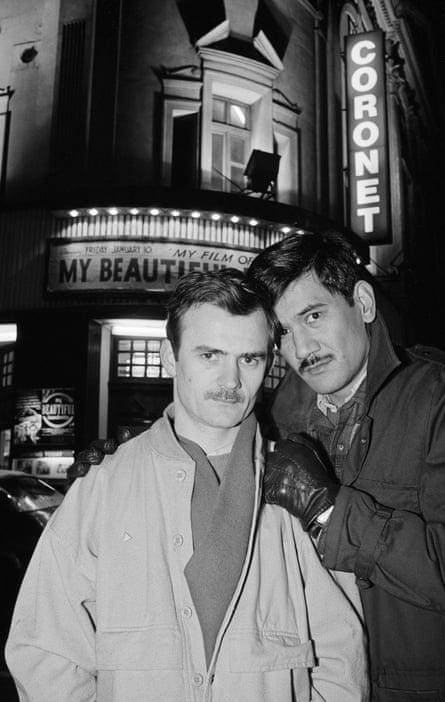
This was part of a show at [London gallery] Autograph in 1986, commissioned by the Greater London Council. The idea of Black then was anybody with heritage that came from a form of British empire – the GLC’s early definitions even included the Irish. I found myself with two struggles – Asians who didn’t think they were Black, and Black colleagues who weren’t looking at Asian culture at all. I thought if I didn’t make the pictures about South Asians there would be no images of us in the show – I made 10 pictures . . That exhibition was the start of Autograph. It’s incredible it’s still there.
9. From Homelands
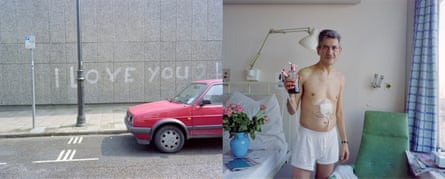
I was at a very low point. I was approaching 50. I’d been diagnosed with HIV, my work had gone down and my social life had gone. I got a three-year fellowship in Southampton, which was quite extraordinary. I made this project about me as a person with HIV looking at the landscape and where I had come from. These pictures were both made in London; one is in St Thomas’ hospital where I have my treatments, and the unpleasant experience of having a reverse drip coming out of my heart. The other image is on Drummond Street, where I would go to an Indian food place.
10. From Exiles
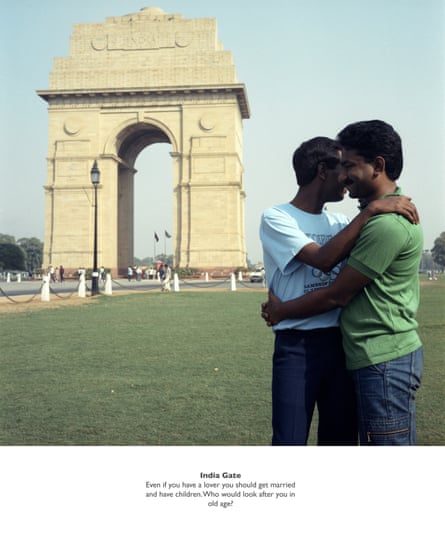
In 1986-7 I got a commission from the Photographers’ Gallery in London. I thought I’d use it to go back to Delhi and do a project about Indian gay men. My informants took me to the places they went cruising and agreed to be in the pictures, up to a point. I would chat to many more people just with a tape recorder. The extracts are from the recordings but they don’t always match the person in the picture. I felt just pictures wouldn’t convey the complexity of what was going on.
I think part of my journey has been to put Indian gay men into cultural history. When I was a student you couldn’t find them anywhere. I’m so excited this work has now been acquired by MoMA, so I feel they’re in the history books now. My job is done.
KioskNews shows a cleaned-up reading view extracted from the publisher’s page — the original always lives on their site, not ours.