‘Very messy eaters’: scientists solve the mystery of when black holes ‘burp’
Scientists have solved the mystery of when black holes “burp” – when the astronomical bodies launch jets after feeding on stars, blasting material enormous distances in space.
Black holes are objects so densely compact that beyond a certain point their gravity is too strong for light and matter to escape. This boundary of no return is known as the event horizon – the point at which escaping would require something to travel faster than the speed of light.
Despite their reputation as cosmic sinkholes, black holes are “actually very messy eaters”, said Dr Adelle Goodwin, an astrophysicist at Curtin University in Western Australia.
“You have to get really, really close to a black hole to get to the event horizon,” Goodwin, also a Forrest Research Foundation fellow, said. “Stars get destroyed further out than that.”
Scientists know from rare observations of stars being torn apart by black holes – a process that involves a stretching effect known as “spaghettification” – that “only about half of the star that gets too close to the back hole will end up eventually being swallowed by that black hole”, Goodwin said.
The other material is launched back into space in powerful jets and outflows, sometimes so large they “can influence the entire evolution of a galaxy”, she said. “You can think of it as a black hole burp.”
But the timing of these burps had previously been mysterious to astrophysicists. “Sometimes it would happen a year after the black hole destroyed the star, sometimes it would happen three or five years after.”
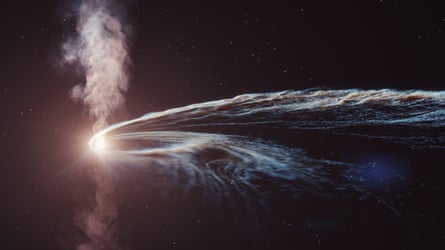
In new research published in the journal Nature Astronomy, Goodwin and co-author Dr Andrew Mummery from the Institute for Advanced Study believe they have found the answer, using radio telescopes to study 20 tidal disruption events – instances where stars are eaten by supermassive black holes.
“Radio is the only frequency where we can watch the jets and outflows as they’re moving outwards,” Goodwin said.
They found that supermassive black holes – which range in size from hundreds of thousands to billions of times the mass of our sun – fire off powerful jets in two distinct phases in their feeding cycle.
The first occurs when the black hole is feeding at very high rates. The second occurs hundreds to thousands of days after the star is first torn apart, when the feeding rate drops to about 2% of the maximum rate at which a black hole can swallow material.
That same threshold is already known to trigger burps from stellar-mass black holes, much smaller bodies about 10 to 50 times the mass of our sun.
The research showed that black holes appeared to release jets at the same point in their feeding cycle regardless of size, Goodwin said. She said the finding would enable scientists to precisely predict when such jets would be released, narrowing observation windows and freeing up precious telescope time.
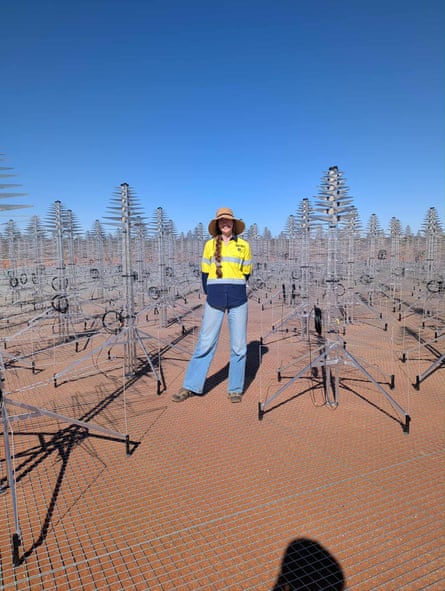
She added: “We can really start to understand not just when the jets are launched, but also how strong they are and if that is then dependent on the black hole properties.”
Dr Sara Webb, an astrophysicist at Swinburne University who was not involved in the research, said: “We are still trying to untangle the very fundamentals of the most extreme objects in the universe – supermassive black holes.”
Webb said the study showed “that supermassive black holes behave rather predictably at two distant periods in their evolution” and the researchers had “tie[d] this back to what we’ve seen previously on the much smaller scale stellar-mass black holes”.
KioskNews shows a cleaned-up reading view extracted from the publisher’s page — the original always lives on their site, not ours.