Alongside Zini and AG, election chief stresses election ‘conducted properly,’ results won’t change

The chairman of Israel’s Central Elections Committee, Justice Noam Sohlberg, reiterated in a video message on Sunday that last week’s national election was “conducted properly,” in a bid to quell claims of widespread voter fraud amid an ongoing investigation into reported allegations of a Qatari or Turkish interference scheme.
Sohlberg appeared in the video alongside Shin Bet chief David Zini, CEC acting director-general Dean Livne, and Attorney General Gali Baharav-Miara, with the four presenting a united front against the claims, spread in no small part by Prime Minister Benjamin Netanyahu’s Likud party, that Israel’s election was “stolen” or otherwise tampered with by hostile foreign actors.
The claims surfaced after Sohlberg requested on Thursday that Zini investigate suspicions of foreign interference in the October 27 election, amid allegations of a purported foreign effort — either by Qatar or Turkey — to pay Arab voters to boost turnout, which was at a historic high.
0:00 / 0:00
Promoted: Jewish Crossroads, Avi Issacharoff

The CEC has repeatedly said that the scope of the investigation is limited in nature, and that the results of the vote are not in question, but that has done little to quiet the claims.
“The election for the 26th Knesset was conducted properly,” Sohlberg said in Sunday’s video statement, and the results “reflect the will of the voters.”
Get The Times of Israel's Daily Edition by email and never miss our top stories
By signing up, you agree to the terms
He noted that his remarks also reflected the positions of Zini and Baharav-Miara.
“In recent days, many reports have been published about the ongoing Shin Bet investigation. Most of these reports are incorrect. The investigation is at a classified stage and is based on classified intelligence,” Sohlberg said. “At this stage, by its very nature, it is not possible to disclose its details,” he said.
The Supreme Court justice acknowledged the “serious suspicions” that recently emerged, requiring investigation, but stressed that “suspicions are only suspicions.”
“Solid evidence is required to challenge the election results,” he added. “We will investigate them thoroughly and get to the truth.”
However, he noted, “the claim that the evidence currently before us could overturn the election results as a whole is incorrect. Israeli citizens went to the polls this past Tuesday in record numbers. They expressed their views, and those views will be respected.”
He said that even if the suspicions are substantiated, “this would not undermine the integrity of the electoral process or the election results as a whole.”
As such, he said, the official results of the election will be presented to President Isaac Herzog as planned and on schedule this week, and the Knesset will be sworn in next week.
Likud: ‘A dark cloud’
Likud responded to Sohlberg’s statement by once again casting suspicion on the result of the vote, from which the party emerged as the largest faction, but without a clear path to forming a coalition government.
The prime minister’s party argued it was “highly perplexing” that he would describe allegations of foreign interference as “very serious,” and yet “preemptively determine that they had no impact on the election result,” before an investigation had been completed.”
It claimed that “a mere 4,612 votes stood between a Knesset seat shifting from Ra’am to the right-wing bloc — a shift that would have completely altered the election results and the political landscape.”

It was not clear how a single seat would have drastically altered the election result, as Likud claimed, given that the pro-Netanyahu right-wing bloc received a combined 53 seats in the election, compared to the anti-Netanyahu bloc’s 67.
Although a minimum of 61 seats are needed for a governing majority, most of the Jewish-led parties opposed to the premier refuse to form a governing coalition with the non-Zionist, Arab-led Joint List and Ra’am, which hold an unprecedented 19 of the 67 seats.
Likud, continuing, said that until the investigation into the allegations of foreign interference is concluded, “a dark cloud hangs over Israel’s election results.”
By contrast, Yashar chair Gadi Eisenkot, who leads the Zionist anti-Netanyahu bloc, welcomed Sohlberg’s statement and accused Likud of trying to “delegitimize” the results of Tuesday’s election.
“The despicable and malicious attempt to deny the election results, undermine the will of the public, smear an entire community, and drag Israel into another round of elections has failed,” Eisenkot said in a Hebrew-language post on X.
“Only someone who understands that they have lost would be willing to embark on such a blatant campaign of delegitimization — even at the cost of further damaging public trust in the institutions of the state,” he continued, asserting that the election results “are valid and clear.”
Eisenkot urged Israelis to “ignore the background noise and the hourly spin,” saying the government “has no majority, and it has lost.”
Shin Bet said divided over investigation methods
As the investigation proceeds, Kan reported on Sunday night that the Shin Bet is split over how to proceed.
According to the report, Zini is looking to expand the scope of the investigation with additional tools, but three senior officials within the agency are opposed, believing the measures are disproportionate to the scope of the suspicions.
An unnamed senior official was quoted by the network as saying that with the current available evidence, it is unlikely Zini’s proposed investigative measures would receive legal approval.
In response to the report, the Shin Bet told Kan that the agency encourages “a wide spectrum of diverse opinions” during its professional discussions, but that it does not comment on closed-door conversations.
Sohlberg seeks cooling off on anti-Arab sentiment
Sohlberg, in his video statement, also took the opportunity to stress that neither the investigation into the allegations nor any remarks about the investigation were “intended to cast aspersions on the Arab community’s vote.”
“Citizens who went out to vote were exercising their democratic right,” said the conservative judge. “Broad participation in the elections is a welcome development, both within the Arab sector and every other sector of Israeli society.”
According to Channel 12, there has been a sharp uptick in anti-Arab sentiment online since the election.

Citing a study by disinformation watchdog Fake Reporter, the network reported a 400 percent increase in anti-Arab discourse online on election day itself and the following two days.
On October 29 alone, it said there were more than 9,000 mentions online of anti-Arab hate speech, incitement, or fake news and conspiracy theories about election fraud, garnering millions of views.
Among those contributing to this atmosphere was the prime minister himself, who on Sunday shared a Ra’am election manifesto from more than two decades ago, falsely attributing it to Abbas, who only took the helm of the party in 2018 and has since worked to distance it from its earlier Islamist views and bring it into the mainstream.
According to the Israel Democracy Institute, the document shared by Netanyahu is the Ra’am party platform from Israel’s 1999 elections, when the party was led by Abdulmalik Dehamshe. The party was established in 1996 as a political arm of the Islamic Movement’s Southern Branch.
Among the positions contained in the old Ra’am platform are “ending the Israeli occupation and establishing a Palestinian state with its capital in East Jerusalem,” “granting a right of return to all Palestinian refugees in accordance with international law,” “releasing all Palestinian prisoners,” “canceling the racist Law of Return” that lets Jews automatically become citizens in Israel, and “legislating a constitution in Israel that recognizes its Arab citizens as a national minority, while changing state symbols accordingly.”
“This is Mansour Abbas’s platform. No government can be formed with him,” Netanyahu declared.
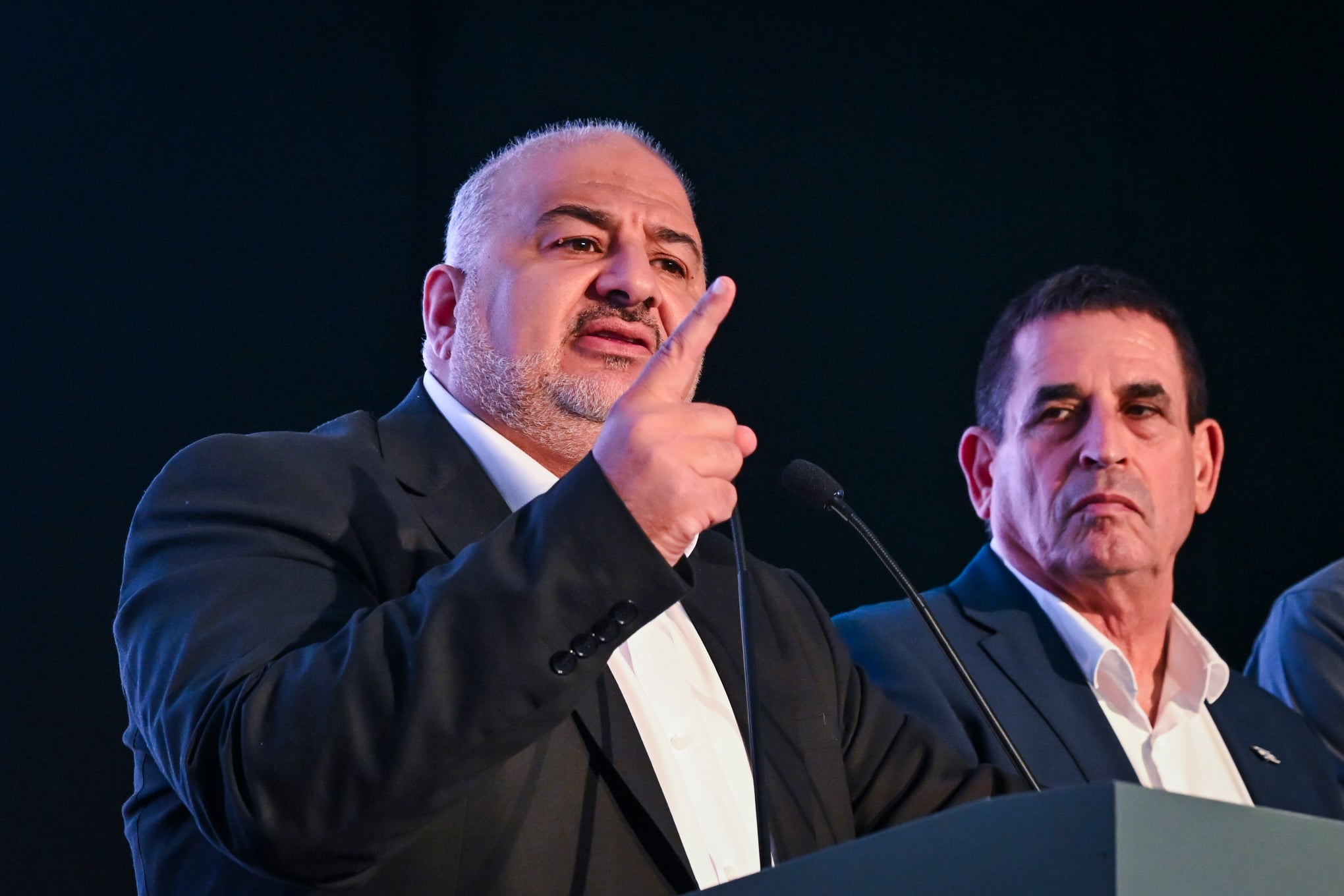
In fact, since taking the helm of Ra’am, Abbas has declared that he was severing ties with the Islamic Movement, opened the party up to Jewish membership, and affirmed that “Israel was born as a Jewish state and so it will remain.”
Abbas ran in Tuesday’s election with a Zionist former Yesh Atid lawmaker and senior police officer, Yoav Segalovitz, at No. 2 on the Ra’am candidate slate.
Under Abbas, Ra’am also conducted negotiations on joining a Netanyahu-led coalition after the 2021 election, but the move was nixed by Religious Zionism chief Bezalel Smotrich, and Ra’am ended up joining the so-called “change government” that unseated Netanyahu in 2021-2022.
Abbas responded to Netanyahu’s false post that “Netanyahu is well aware of the Ra’am platform and its demands,” since they were enshrined in the 2021 coalition agreements that failed to materialize and in the 2019 memorandum of understanding that Abbas has said Netanyahu tried to woo him with.
Two Ra’am activists accused of bribery released from jail
Despite Likud’s efforts, one angle of the narrative claiming that Israel’s election was stolen appeared to be faltering on Sunday, after the release from jail of two of the three Ra’am activists arrested on election day for allegedly planning to buy votes for the traditionalist Arab party.
No evidence linking that case and the alleged foreign interference case has been made public, and a law enforcement source cited by Channel 12 on Thursday said they were unrelated.
One of the suspects, Dr. Saef Abu Reash, was released without any restrictive conditions after the Beersheba Magistrate’s Court rejected a police appeal for seven days’ house arrest.
The second suspect was released to eight days’ house arrest, while the detention of the third suspect was extended for two days.
Ra’am chair Mansour Abbas has decried the arrests as undemocratic and “an attempt to influence the election results.”
During the court proceedings last week, police admitted that the homes of the three activists were searched without a warrant.
Hebrew outlets have reported that the arrests were conducted after a tip-off from Netanyahu’s chief of staff, Ido Norden.
With much of the attention focused on Ra’am, an unsourced report published by i24 News claimed that a Joint List lawmaker was questioned by police in recent days on suspicion of receiving a large sum of money from a foreign source.
According to the report, investigators believe the money came from Qatar, and there are suspicions that it may have either financed an election campaign or been used to bring in voters.
The report said, however, that there is currently no evidence suggesting the purported sum of money was put to either of these uses, and it is not clear if or how the money can be traced to Qatar.
Furthermore, a Joint List official told i24 that none of the party’s lawmakers have been questioned by police.
KioskNews shows a cleaned-up reading view extracted from the publisher’s page — the original always lives on their site, not ours.