Donovan’s Deep Dives: Taiwan’s territorial claims: A map no administration is willing to redraw
Inherited Republic of China claims collide with the nation’s political reality
By Courtney Donovan Smith 石東文 / Staff Columnist


For a small nation, Taiwan has an unusually long list of territorial disputes. In part or in whole, it has disputes over the Spratly Islands (Nansha Islands, 南沙群島) with Vietnam, the Philippines, Malaysia and Brunei. It also has another territorial dispute with Vietnam over the Paracel Islands, and with Japan over the Senkaku Islands (Diaoyutai Islands, 釣魚台).
Of course, the biggest territorial disputes are with the People’s Republic of China (PRC), which not only claims all of the above, but also Pratas Island (Dongsha, 東沙島), Kinmen, Penghu and all of Taiwan itself.
This creates considerable headaches politically for the government, especially — but not exclusively — administrations led by the Democratic Progressive Party (DPP).
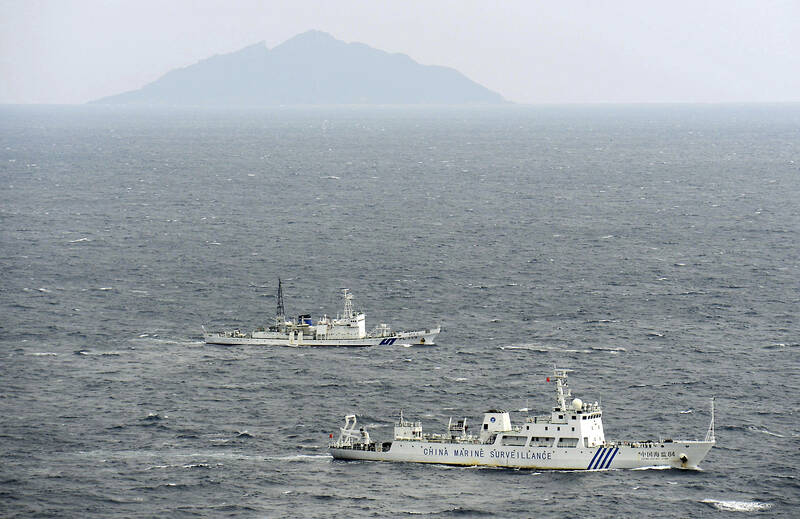
The photo shows Chinese Coast Guard vessels, bottom, and Japan Coast Guard vessels in November 2012 appear simultaneously in the waters around the Diaoyu Islands.
Photo: AP
ROOT OF THE PROBLEM
The root of the problem is that when the Republic of China (ROC) fled to Taiwan after losing the Chinese Civil War in 1949, they brought along ROC territorial claims.
Constitutional reforms beginning in 1991 distinguished the ROC’s “free area” from the mainland and cleared the way for a fully elected legislature. Previously, ROC maps included not only China, but also Manchuria, Tibet, East Turkestan and Mongolia. The primary difference between the ROC’s territorial claims and the PRC’s is that the Soviet Union pressured Beijing into recognizing the Mongolian People’s Republic as independent.
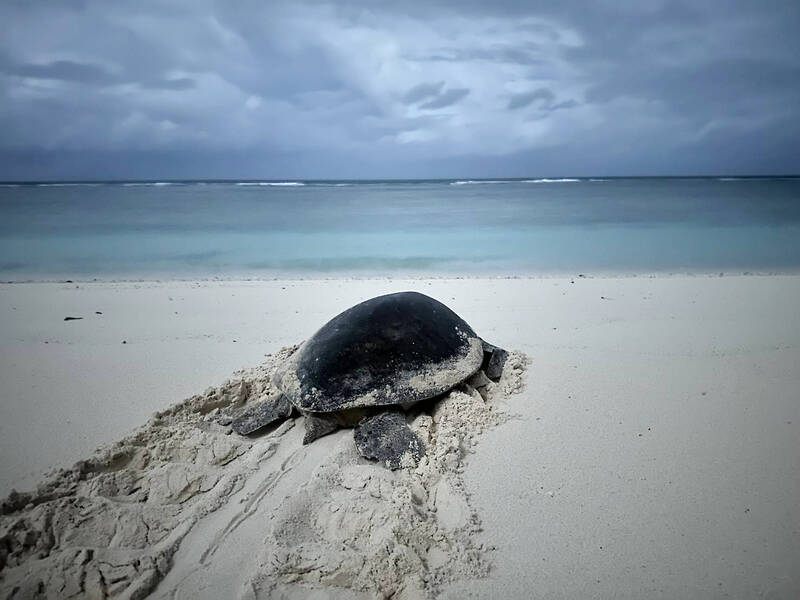
A turtle moves towards the ocean on Taiping Island in this file photo.
Photo courtesy of the Ocean Conservation Administration
In a very colonial mindset, the ROC released a map in the late 1940s showing an 11-dash line, claiming sovereignty over roughly 90 percent of the South China Sea. The PRC’s current 10-dash line (formerly nine-dash), with a few minor tweaks, is based on the ROC’s claims.
While the 1991 constitutional changes put to rest the absurdist fantasy of “reclaiming the mainland,” they said nothing about the South China Sea or the Senkakus. Those claims remain official even today.
The claim to Pratas as Chinese was strong, and the Taiwan Coast Guard occupies it today as a component of the Cijin District (旗津) of Kaohsiung City. Only the PRC disputes this.
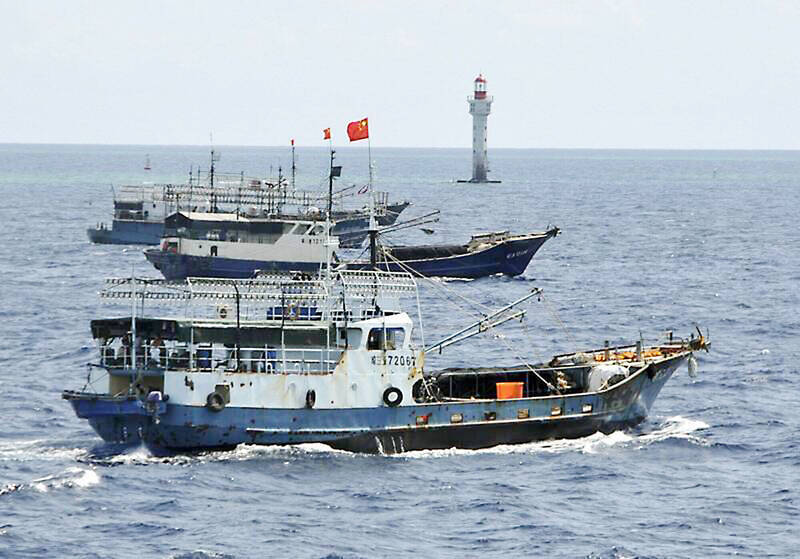
Chinese fishing boats sail past a navigational buoy near the Spratly Islands in the South China Sea in this file photo.
Photo: AP
Both the Vietnamese and Chinese have reasonable claims to the Paracels, but the ROC lost control in the civil war.
Claims to the Spratlys are far weaker, but both Taiwan and the PRC have bases there. Taiwan occupies Itu Aba (Taiping Island 太平島) today, but lost Thitu Island (中業島) in 1971 when ROC troops evacuated due to a typhoon and the Philippines swept in and took control. People forget, but at the time the Philippines was one of the most advanced countries in Asia. President Chiang Kai-shek (蔣介石) decided not to mess with them.
THE KMT APPROACH
Chinese nationalism has historically been central to the KMT, while the DPP developed from Taiwan-centered nationalism and the democracy movement.
The KMT’s core ideology is Chinese ethnonationalism, and hardliners take a very absolutist stance on sovereignty. When out of power, they use it to attack the DPP.
Sometimes, this can go so far as to extend to supporting the PRC over other countries in the region on the theory that it is better for Han Chinese to occupy territory than for others.
This was recently demonstrated when KMT Culture and Communications Committee Chairman Chen Yi-hsin (陳以信) attacked President William Lai (賴清德) of the DPP for not defending sovereignty and referred to Scarborough Shoal as Huangyan Island (黃岩島), Beijing’s preferred name, rather than the ROC’s official name, Democracy Reef (民主礁) — language that closely echoed the PRC position.
Yet, as the Thitu Island loss demonstrates, in power the party is more realistic and pragmatic.
The mix of ideology and pragmatism is probably best exemplified by former president Ma Ying-jeou (馬英九) over the Senkakus.
After World War II, the US maintained control of the Ryukyu and Senkaku Islands until handing them over to Japanese administrative control in 1972. As the handover approached, Chinese nationalists from Taiwan and Hong Kong protested over the Senkakus being given to Japan instead of the ROC. Protests started in the US, but eventually spread to Taiwan. See: “Taiwan in Time: A tale of two protests over specks of land” (April 7, 2019).
According to an interesting 2017 paper by Yoshiyuki Ogasawara (“Ma Ying-jeou’s Doctoral Thesis and Its Impact on the Japan-Taiwan Fisheries Negotiations), a group of protestors in 1971 marched to deliver a written protest to the American and Japanese embassies in Taipei. Ma “was one of the leaders who led this protest and allegedly yelled statements to the effect of, ‘Japan has no principles, America talks nonsense.’”
Ma cared about the issue so deeply that he wrote his Harvard doctoral dissertation on the Senkakus.
Periodically over the years, nationalistic activists would sail to the Senkakus to attempt to plant the ROC flag, sometimes successfully, sometimes not. In office in 2012, Ma met with and praised one such group who were fighting for fishing rights in the region.
Yet, just a few weeks before, he had sent a proposal to the Japanese, and in 2013 signed a joint fisheries agreement allowing Taiwanese access to some of the waters around the Senkakus. The agreement carefully sidestepped sovereignty issues.
THE DPP APPROACH
The DPP are Taiwanese nationalists. They have accepted the ROC framework for the pragmatic reason that voters do not want a war with the PRC over a name, constitution and flag.
By accepting this framework, they inherit the ROC’s territorial claims. Their lack of enthusiasm is palpable, but always reiterate these claims when pressed.
Less than two months into president Tsai Ing-wen’s (蔡英文) first term in 2016, the Taipei Times reported that a Presidential Office source stated that the administration had reached an internal resolution on Taiwan’s territorial claims over the South China Sea, which stressed the nation’s sovereignty over islands in the area, but made no mention of the so-called (11-dash) “U-shaped line” and “historical waters.”
When the presidential office was questioned publicly on this, they dodged the issue, stating: “The ROC government stands firm on its claim of sovereignty over islands in the South China Sea and their relevant waters, which are rightfully our rights in accordance with international law.”
A tribunal rejected China’s claim to historic resource rights within the nine-dash line beyond the maritime entitlements provided by UNCLOS. Because the ROC line had the same historical origin, the ruling also undermined expansive Taiwanese claims to historic waters, but it did not decide sovereignty over any island. The Tsai administration was obliged to condemn the ruling, and Tsai rushed to give a speech on a navy frigate.
In July, when claims of sovereignty over the Philippines’ Batanes Islands started appearing in state-owned media that China had a claim as they were historically part of “China’s Taiwan,” Domino Theory pressed the Ministry of Foreign Affairs (MOFA), and they replied, “There is no territorial dispute between Taiwan and the Philippines regarding Batan Island. It is the unrealistic fantasy of Chinese scholars.”
Despite repeated attempts to get MOFA to specifically state that the ROC recognizes Filipino sovereignty over the islands, they dodged the question. I laughed; of course, they would not answer that, but I admired the audacity in asking.
One exposition of this argument appeared in a 2004 paper by Tamkang University professor Chen Hurng-yu (陳鴻瑜). Chen’s case was also made in an editorial in this newspaper, “Manila’s weak claim to the Batanes” (Dec. 23, 2007).
The DPP has no interest in pressing them, and likely would rather drop them altogether, but they will not.
That would mire the administration in controversy, sucking up valuable political capital. That political capital is desperately needed elsewhere, including on defense.
If they look weak on sovereignty, this will give the opposition a vector to further question why they need bigger defense budgets.
It is easier to dodge questions and give boilerplate answers, because everyone is aware that in the real world, no administration — whether DPP or KMT — is in any position militarily to press the ROC’s territorial claims.
Donovan’s Deep Dives is a regular column by Courtney Donovan Smith (石東文) who writes in-depth analysis on everything about Taiwan’s political scene and geopolitics. Donovan is also the central Taiwan correspondent at ICRT FM100 Radio News, co-publisher of Compass Magazine, co-founder Taiwan Report (report.tw) and former chair of the Taichung American Chamber of Commerce. Follow him on X: @donovan_smith.
KioskNews shows a cleaned-up reading view extracted from the publisher’s page — the original always lives on their site, not ours.