Inter-agency task force proposes fee caps for all disability services, more families to receive subsidies

SINGAPORE: An inter-agency task force looking at measures to support families of people with disabilities has put forward its first set of recommendations, aimed at making services more affordable and accessible.
These include introducing fee caps for all disability services and raising means-tested subsidies for most families, the Ministry of Social and Family Development (MSF) said on Thursday (Sep 17).
The task force also recommended raising the eligibility threshold for means-tested subsidies to a monthly per capita household income of around S$6,000 (US$4,710), up from S$4,800.
It proposed stronger support for people with higher support needs, who typically face higher costs.
Lower-income households will continue to receive the highest levels of support and would pay no more than S$10 for community-based services such as day activity centres and the Enabling Skills for Life Programme, down from the current S$20 to S$60.
These changes are expected to be implemented by 2028, said MSF. By 2030, around 5,000 persons with disabilities accessing community and residential disability services are expected to benefit from these enhancements, it added.
MSF said that the task force’s first recommendations take a “two-pronged approach”.
“First, they seek to make disability services more affordable for families, including broader access to subsidies. Second, they aim to expand service capacity so that more persons with disabilities can access appropriate support," it added.
"Together, these measures will strengthen assurance for families and support long-term care planning."
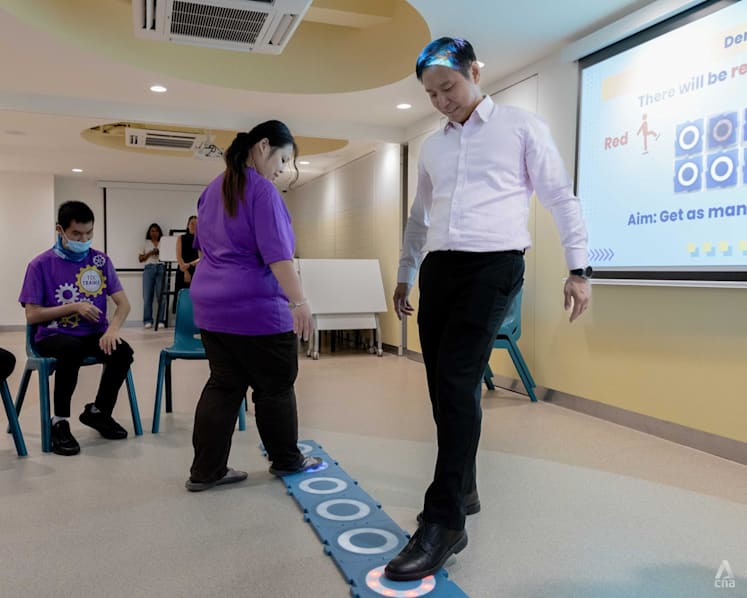
Speaking to the media at the TOUCH Centre for Independent Living at the Enabling Village, Senior Minister of State for Social and Family Development Goh Pei Ming said caring for a person with a disability is a "lifelong journey", with affordability being one of the biggest concerns raised by families of people with disabilities.
"Over time, care costs can add up. Families hope to get assurances that support will continue to be affordable," Mr Goh added.
FEE CAPS
Under the recommendations, MSF would introduce fee caps for all disability services before subsidies, limiting the amount families have to pay after subsidies.
Means-tested subsidy rates will also be increased by at least 10 percentage points for most families.
The enhanced subsidies would apply across a range of disability services, including day activity centres, the Enabling Skills for Life Programme, adult disability hostels, adult disability homes, children disability homes, the Enabling Transport subsidy and taxi subsidy scheme.
“Together, the fee caps and higher subsidies will help families better manage the long-term cost of disability care and support, while providing greater certainty as they plan for their loved ones’ future needs,” MSF said.
The task force also proposed raising the eligibility threshold for means-tested subsidies to extend support to more middle-income families.
This increase in the per capita monthly household income threshold to about S$6,000 would mean about 80 per cent of households of people with disabilities would be covered.
"More families who do not qualify for subsidies today will therefore be able to receive support for disability services, recognising the significant and long-term care costs that many families may face while supporting a loved one with disabilities," MSF said.
HIGHER NEEDS
As people with higher support needs and their families often require more intensive and sustained assistance over the long term, the task force recommended stronger funding support for selected services for this group.
The enhanced support will apply to the Enabling Skills for Life Programme and adult disability homes.
"These measures will help ensure that persons with higher support needs can continue to access quality care and support, while easing the financial burden on families," said MSF.
Families of people with higher support needs can expect monthly fees after government subsidies for selected services to fall by about 25 per cent to 80 per cent compared with current levels.
For example, a family of four living in an HDB flat and caring for a person with higher support needs, with a monthly household income of S$6,000 – or S$1,500 per person – would pay S$40 a month for a day activity centre, down from S$210. For adult disability homes, the fee would fall from S$3,500 to S$700.
For a family of four with an income of S$13,000 a month – or S$3,250 per person – day activity centre fees would fall to S$400 from S$710, while adult disability home fees would fall to S$1,600 from S$7,000.
DAY ACTIVITY CENTRES, SHELTERED WORKSHOPS
To ensure families can access the support they need, the task force proposed increasing the number of spaces in day activity centres and sheltered workshops.
"Affordability enhancements must be accompanied by sufficient service capacity so that families can access the support they need," said MSF.
The task force proposed to add another 1,300 spaces at day activity centres and sheltered workshops by 2030, beyond the 1,000 additional places announced in 2024.
This brings the total number of additional spaces to 2,300 by 2030, on top of the current capacity of 3,600.
In 2026, close to 440 day activity centre and sheltered workshop spaces have been set up in areas such as Queenstown, Bukit Merah and Ang Mo Kio. Another 440 spaces are expected to be operational in 2027.
“The additional places will enable more persons with disabilities to access appropriate support closer to their communities, while giving families greater assurance that their loved ones can continue to receive more care, support and opportunities for meaningful engagement over the long term,” MSF said.
The ministry added that the government will work closely with social service agencies over the next few years to ensure that services are available to those who need them, as well as to implement the affordability enhancements by 2028.
"Through the first set of recommendations, we want families to know that disability services will remain accessible and affordable, and that the government will be with them every step of the way across different stages of life," Mr Goh said.
CNA has asked MSF for more information on the recommendations announced on Thursday.
"These affordability and capacity enhancements represent the first set of recommendations from the task force," said MSF.
"They are an important step towards strengthening assurance for families with persons with disabilities across different stages of life, while recognising that support needs may evolve over time."
The full set of recommendations will be announced by early October.
The Taskforce on Assurance for Families with Persons with Disabilities was announced by Prime Minister Lawrence Wong in December 2025.
It is looking at three key areas – affordability, employment and community living.
Since January, the task force has been engaging with people with disabilities, caregivers, employers, community partners and key stakeholders on issues including employment, community living and affordability.
Including Mr Goh, the five-member inter-ministry task force appointed by Minister for Social and Family Development Masagos Zulkifli are:
- Minister of State for Health and Digital Development and Information Rahayu Mahzam
- Senior Parliamentary Secretary for Social and Family Development and Law Eric Chua
- Senior Parliamentary Secretary for Manpower and Finance Shawn Huang
- Senior Parliamentary Secretary for Education and National Development Syed Harun Alhabsyi
KioskNews shows a cleaned-up reading view extracted from the publisher’s page — the original always lives on their site, not ours.