EU urges Britain to raise tariffs on Chinese vehicles
Brussels has told British Prime Minister Andy Burnham that Britain needs to raise tariffs on Chinese cars and align more closely align with EU trade policy to avoid “made in Europe” barriers on key exports, the **Financial Times** said yesterday.
In response to lobbying for equal treatment for British products, the bloc told London its best solution would be to join the EU’s customs union, the newspaper said, citing two people familiar with the matter.
“A customs union would solve most of the problems of ‘made in Europe,’” an EU official told the paper. “And also the question of tariff differences, which leads to fears the Chinese could avoid our tariffs by routing through the UK.”
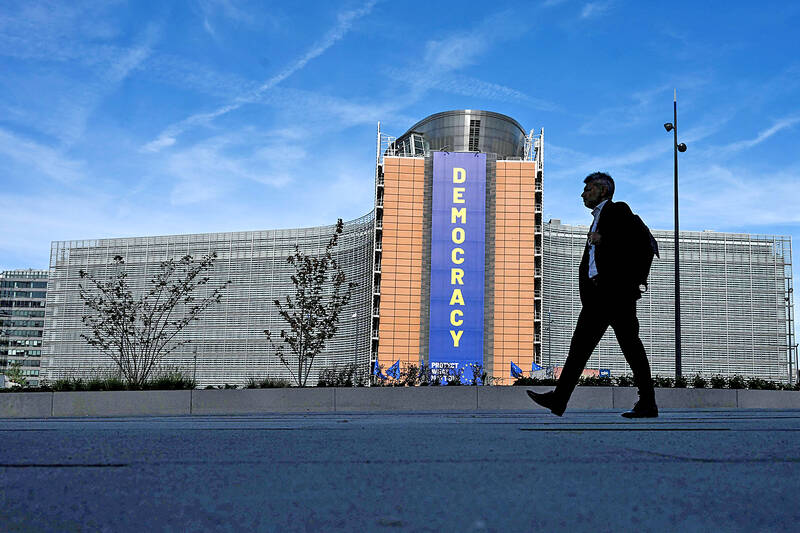
A pedestrian walks past a giant banner reading “Democracy: Protect what matters” displayed on the Berlaymont building, headquarters of the European Commission, in Brussels on Wednesday.
Photo: AFP
Burnham said this week he would make the case for Britain to be considered a “trusted partner” under the bloc’s proposed “Made in EU” rules, warning that the UK’s exclusion could damage its car industry.
The “Made in Europe” policy aims to curb reliance on Chinese components by prioritizing European-made goods — a worry for the British auto industry which feeds parts into EU supply chains and sells cars across the bloc.
The bloc would use every available tool to reduce its “unsustainable” trade deficit with China, European Commission President Ursula von der Leyen told the European Parliament in her “State of the Union” address this month.
The EU and the British Foreign Office did not immediately respond to Reuters requests for comment outside business hours.
Separately, German industry association BDI yesterday called for a more determined effort to reduce economic risks linked to China, arguing that Europe must diversify supply chains and forge new partnerships while avoiding broad-based protectionism.
The BDI, representing major German manufacturers, said in a policy paper that “de-risking” should be pursued more consistently, though it stopped short of spelling out specific measures.
German industry has been increasing pressure on Chancellor Friedrich Merz to take a tougher line towards Beijing, with companies calling for stronger action to address what they describe as unfair competition from Chinese rivals.
“Systemic competition with China’s economy is increasingly challenging the open social market economy and requires an appropriate industrial and trade policy response,” BDI chief executive Tanja Goenner said.
The EU should have tools to respond rapidly to unfair competition, such as anti-dumping and anti-subsidy measures, Goenner said, while warning that any new trade defense measures must be carefully calibrated.
The BDI also urged Germany and the EU to broaden ties with other regions based on economic and security interests.
KioskNews shows a cleaned-up reading view extracted from the publisher’s page — the original always lives on their site, not ours.