The challenges facing Singapore’s haze law — and where it can gain more teeth
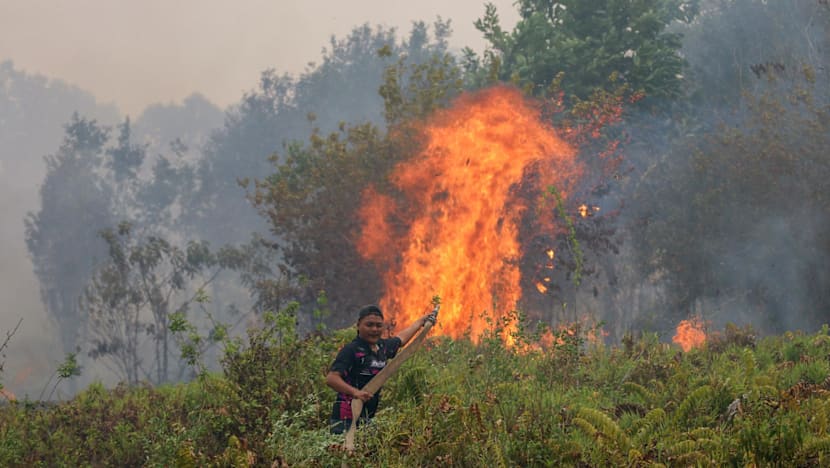
SINGAPORE: More than a decade after Singapore enacted its anti-haze law, not a single company or director has ever been prosecuted under the statute.
With haze originating from Indonesian forest and peatland fires once again cloaking the region in recent weeks, the absence of convictions has spurred scrutiny over the legislation’s teeth.
Singapore has since said that it will strengthen the law in the next parliamentary sitting in November.
Speaking to CNA, legal experts said the lack of legal conclusions over the past decade risks casting the 2014 law as a “paper tiger”, though the Transboundary Haze Pollution Act (THPA) already possesses extra-territorial reach and has exerted commercial pressure in other ways.
Since the Act took effect, 26 notices have been issued: six in 2015, and 20 this year, including notices served on Oct 23 to 10 Singapore-based firms for the first time.
Four of the six earlier cases from 2015 remain open. The following year, a director of one such Indonesian firm was served a legal notice for an interview with the authorities while he was in Singapore, but he did not turn up and left the country.
The primary bottleneck, analysts told CNA, was the evidential and practical hurdles of securing cross-border cooperation, obtaining relevant information from overseas jurisdictions, and compelling foreign witnesses to appear in court.
Mr Tan Chong Huat, senior partner at RHT Law Asia and chairman of RHT Group of Companies, said critical evidence, such as operational records, land documentation, pertinent fires, and key witnesses, is typically situated outside Singapore.
"Obtaining admissible evidence and securing cooperation from overseas entities or witnesses may also be difficult," he said.
The Ministry of Law said as much on Oct 23 as it announced a new specialist panel to probe firms linked to haze.
“Government agencies, including the Attorney-General’s Chambers, may face legal and practical limitations in carrying out such work in other jurisdictions. This is because there are generally limitations imposed by countries on what work can be done in their territories by overseas government agencies,” said a spokesperson.
Amid heightened state action towards haze-linked firms, the government will be tabling legislative amendments on an urgent basis to sharpen the THPA’s legal teeth and give the specialist assessment framework legal force. If passed, the amendments would make it an offence for companies to refuse to appoint assessors or fail to cooperate fully with their investigations.
The panel, comprising experts with experience in cross-border inquiries and investigations, will be advised by law firm Davinder Singh Chambers.
Companies identified by the government may be directed to appoint, at their own expense, assessors from the panel to examine their operations, corporate relationships and supply chains.
Coordinating Minister for National Security K Shanmugam on Oct 19 said Singapore "will use every legal and regulatory lever at our disposal to exert pressure where it matters" on companies suspected of causing the haze yet refuse to cooperate.
Mr Tan said of the move: "The desired outcome is not necessarily prosecution success.
“The overarching objective is to demonstrate to the region that our government has the will and means to enforce the desired behaviour to prevent haze and pollution in Singapore."
Ahead of the tabling of the amendment Bill, CNA spoke to legal experts about what has stalled prosecutions for over the years, what legal changes are needed to overcome existing barriers, and how Singapore can bring every lever it has to bear so errant firms are held accountable.
EXISTING LAW ALREADY ESTABLISHES LIABILITY
Noting that the THPA in its current form is already broad in scope, legal experts said the law is not limited to the holders of Indonesian concessions behind the haze-causing fires and other companies that directly cause the fire.
"An entity that condones another’s fire-causing conduct, for instance by permitting it to occur, is also caught (under Section 2(3))," said Mr Mark Mangan, partner at law firm Lindsay Francis & Mangan.
This means that the law can also apply to parent entities participating in the management of a firm that occupies the plot of affected land, said Mr Kenneth Pereire, managing director of KGP Legal LLC.
That said, however, liability for a company does not arise simply out of a corporate relationship, said Mr Tan of RHT Law.
"Liability of a parent or other related entity is not automatic merely because of its corporate relationship and would depend on the statutory requirements being established," he said.
In other words, a company's liability must be proven under the law, and not be assumed automatically based on its corporate link to an entity responsible fora haze-related act.

EVIDENTIAL CHALLENGES OF PRESENT LAW
Experts noted that although the THPA possesses extraterritorial reach – enabling it to target overseas companies whose haze-producing actions impact Singapore – the primary hurdles stem from practical and evidential difficulties.
To assist in determining responsibility and identifying the origin of haze, Section 8 of the THPA establishes "rebuttable presumptions", noted Mr Kenneth Pereire of KGP Legal.
The presumptions spelled out under the Act essentially shift the burden of proof – if authorities prove certain baseline facts, the law automatically assumes a conclusion until the accused party can prove otherwise.
For example, once certain facts linking a fire to haze in Singapore and an entity to the affected land are established, the Act can presume that the entity engaged in or condoned conduct that caused or contributed to the haze, unless the entity proves otherwise.
Nevertheless, Mr Pereire highlighted that proving the underlying facts required to trigger these presumptions, along with other statutory requirements, remains a challenge.
He also noted that THPA provides the NEA with information gathering and investigative powers.
"However, those powers do not remove the practical challenges of obtaining overseas evidence and witnesses, securing compliance with a notice to a person abroad to provide specified information, prosecuting that person for non-compliance, and enforcing any resulting penalty," he added.
That said, Indonesia and Singapore have pledged to establish a joint task force that could cross these evidential hurdles, experts noted.
Indonesia Foreign Minister Arrmanatha Nasir said the task force will link information sharing, financial intelligence, cross-border evidence gathering, as well as asset recovery.
“No border should shield those who profit from burning our forests,” he said on Tuesday in a joint press conference with Singapore Foreign Minister Vivian Balakrishnan.

NEW SPECIALIST PANEL
To this end, companies with haze links identified by the government will be required to engage a team of investigation firms and legal advisors from the new specialist panel to conduct thorough inquiries into their operations, corporate relationships and supply chains.
The assessors will submit an evaluation report to NEA, which will take the findings into account in determining whether further action is warranted, said the Law Ministry and the NEA on Friday.
Asked about this new panel, experts said its existence will discourage businesses from taking part in haze-causing activities or being associated with entities that carry out such acts.
Mr Tan described the panel as the Singapore government "closing out the enforcement levers by tightening the disclosure and reporting processes".
The panel, he said, can be effective as long as the entities have some nexus to Singapore.
Mr Mangan added that this type of probe by a specialist panel is often undertaken in instances of money-laundering, breach of sanctions regime or other alleged corporate misconduct.
"This is the first time that such a technique has been applied to determine whether companies are complicit in environmental damage, shifting the onus on them to demonstrate that they have a clean bill of health as it were," he said.
"Among other benefits, this should discourage companies in the future that wish to do business in Singapore from being connected in any way with the burning."
AMENDING THE ACT
As for how the THPA can be strengthened further beyond what has been announced, legal experts suggested a range of tweaks ranging from facilitating information gathering to stiffer penalties for companies and their directors.
Mr Tan of RHT Law suggested targeted evidential presumptions where objective satellite, meteorological and land-control criteria are established.
He added, however, that a meaningful opportunity for entities to rebut such presumptions must be preserved.
Mr Pereire noted that the present law imposes a fine of up to S$5,000 (US$3,900) or up to three months’ jail, or both, if a person within Singapore alters, suppresses or destroys information that the authorities seek.
The same penalties also apply if the person provides false or reckless information to the authorities.
To strengthen the government’s ability to gather evidence from those served with THPA notices, he suggested that this clause in the Act be extended to persons outside Singapore as well.
The law currently already covers persons within or outside Singapore who fail to do or refrain from doing anything required of them without a reasonable excuse.
Presently, those guilty of this offence shall be liable to a fine not exceeding S$5,000 or jailed for a maximum of one month, or both.
Some of the experts also suggested stiffer fines for liable entities, beyond the aggregate maximum S$2 million provided for under the existing law.
"Given that the revenues of major agribusiness groups run into the billions, S$2 million maximum fine is but a mere slap on the wrist," said Associate Professor Eugene Tan, law don at the Singapore Management University (SMU).
He also suggested that culpable key officers of an entity found liable should be jailed and "not be allowed to hide behind the corporate veil".
"As a company cannot be jailed, holding key officers personally liable for haze-causing actions can reduce the potential moral hazard that arises when the consequences of corporate decision-making are borne by the company but not by the key decision-makers or shareholders," he said.
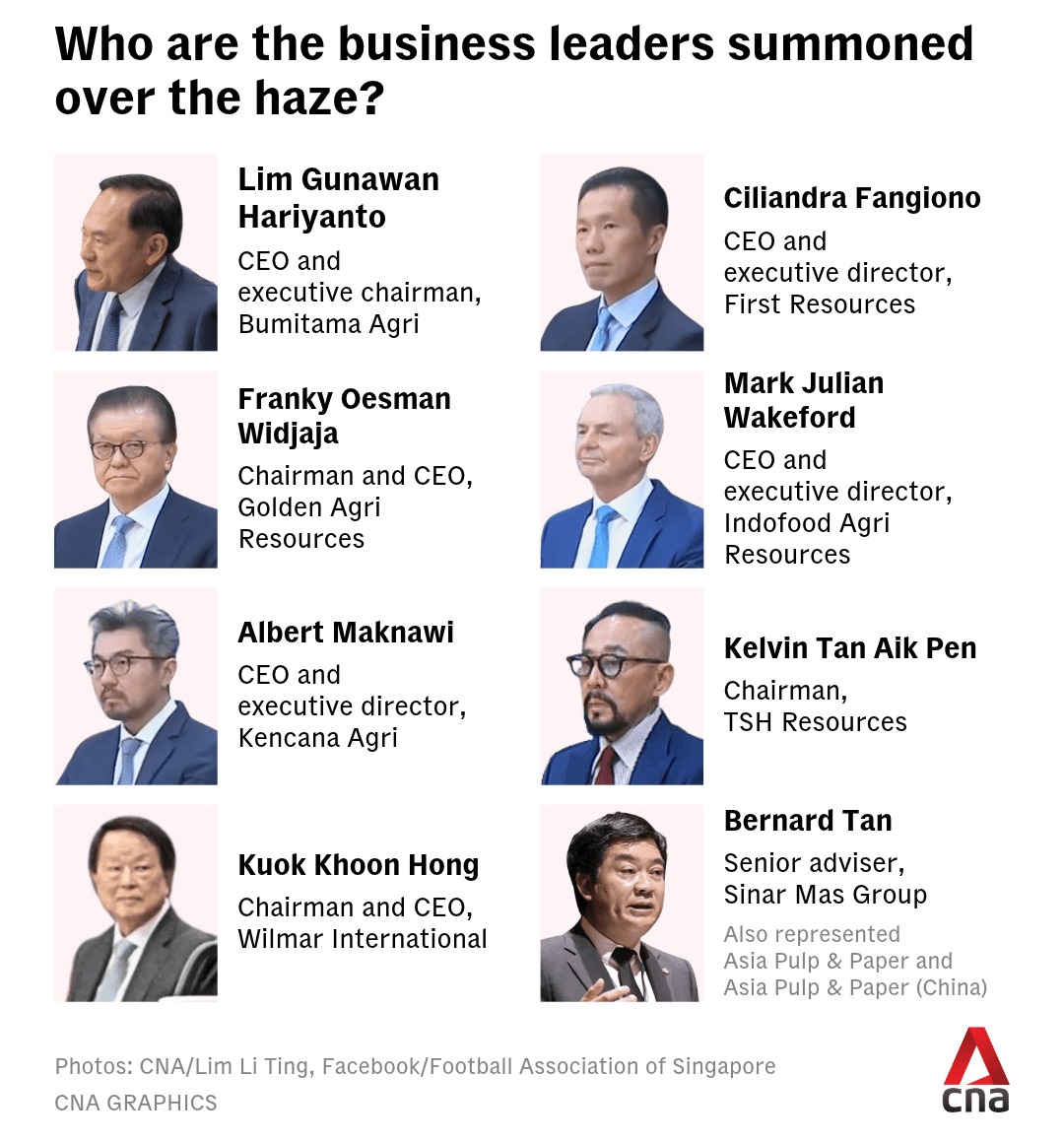
The experts, however, stressed that any form of liability or conviction against individuals needs to be based on their role in the haze-related activities, and not automatically be based on their title or position in a related company.
As for whether the law can target the entire supply chain, experts said such a change could be considered in principle, but with sufficient safeguards against overreach.
Mr Tan of RHT Law said that commercial associations should not automatically amount to criminal liability.
"Any new liability should clearly identify the required nexus, such as knowledge, control, material assistance, failure to carry out prescribed due diligence, or continued dealing after specified warning signs," said Mr Tan.
"Proof becomes more difficult as the chain becomes longer and may require traceability records, beneficial-ownership information, procurement documents, financing arrangements and evidence of knowledge or control."
GOING BEYOND PROSECUTION
Beyond making prosecution easier, legal experts said Singapore could consider measures aimed at preventing haze-linked risks before fires occur.
To this, Mr Mangan said that there are laws in other jurisdictions which Singapore could examine, such as the European Union.
The grouping’s legislation on deforestation, for instance, requires companies to exercise some level of due diligence to examine the origin of certain high-risk commodities before trading in or using them, he said.
Mr Pereire suggested a law imposing due diligence duties on companies that source, process or finance specified commodities such as palm oil, timber and pulp and paper.
"The duties should be tailored to each company’s role – for example, traceability requirements for companies handling commodities and risk-screening requirements for financiers," he said.
He added that companies could be required, where reasonably practicable, to identify suppliers and the suppliers' fire prevention measures and history of fire incidents, and keep records of such checks.
"Where a serious risk is identified, companies could be required to seek corrective action and, if it remains unaddressed, suspend or terminate the relevant sourcing or business relationship," he said.
Agreeing, Mr Tan of RHT Law said that an approach of due diligence and disclosure is "more legally defensible" than a broad extension of liability across the entire supply chain.
Apart from the THPA, he suggested considering complementary regulatory and disclosure-based measures, noting that there are already sustainability reporting requirements for listed companies here.
"Any haze-specific disclosure requirement could therefore be considered in the context of this existing framework, subject to appropriate materiality criteria and reporting standards," he said.
KioskNews shows a cleaned-up reading view extracted from the publisher’s page — the original always lives on their site, not ours.