Matthew Taub: Carney had no plan for what would happen if the PA didn’t hold elections
On Sept. 23, I sent Global Affairs Canada an inquiry containing 11 detailed questions about the commitments behind Canada’s recognition of Palestinian statehood one year earlier. Among them was a specific warning that Palestinian legislative elections scheduled for Nov. 28 would not take place. Seventeen days later, Palestinian Authority President Mahmoud Abbas announced that the elections would be postponed until September 2027.
Sign In or Create an Account
Global Affairs Canada acknowledged my inquiry almost immediately, advising that it would need several days to respond. The questions carried a Sept. 25 deadline for an article I was preparing for National Post. The department eventually provided a written statement outlining Canada’s support for Palestinian statehood and reform of the Palestinian Authority, but it did not address the warning about the elections or explain what would happen if they were postponed.

Columnist Jesse Kline keeps you up to date with what’s happening in Israel and the effects of antisemitism on life here in Canada. Friday mornings.
By signing up you consent to receive the above newsletter from Postmedia Network Inc.
A welcome email is on its way. If you don't see it, please check your junk folder.
The next issue of Channel Israel will soon be in your inbox.
We encountered an issue signing you up. Please try again
One question was referred to the Department of National Defence. It concerned Operation Proteus, Canada’s contribution to international efforts supporting Palestinian Authority security forces. I asked who vets personnel receiving Canadian-supported training, how those assessments are conducted and what safeguards would govern extending that training into Gaza. National Defence confirmed receipt on the inquiry but, as of this writing, has not provided a substantive response.
The correspondence raises broader questions about the conditions underpinning Prime Minister Mark Carney’s recognition of Palestine. On July 30, 2025, Carney announced Canada’s intention to recognize Palestinian statehood, predicating the decision on commitments by Abbas to reform Palestinian governance, hold elections in 2026 in which Hamas could play no part and demilitarize the proposed state. Canada formally recognized Palestine two months later, before those commitments had been fully implemented.
A year later, Hamas has not been disarmed, significant Palestinian Authority reforms remain unfinished and the elections will not take place in 2026. Global Affairs Canada’s response stated that recognition was predicated on the Palestinian Authority’s commitment to reforms. It welcomed progress in governance, judicial systems, economic resilience and democratization but provided no measurable benchmarks, independent verification procedures or consequences for failing to fulfill those commitments.
The election issue was particularly foreseeable. On Sept. 10, Fatah secretary-general Jibril Rajoub reportedly stated that the Nov. 28 vote would not proceed on schedule. My inquiry specifically cited his warning. Yet the department’s response merely observed that transparent elections require conditions allowing Palestinians to vote safely.
Abbas has attributed the postponement to Israeli actions and conditions in Gaza. However, the Palestinian Authority’s electoral difficulties predate the current war by nearly two decades. Abbas was elected president in 2005 for a four-year term and has remained in office without another presidential election. The last Palestinian legislative elections took place in 2006, when Hamas won a parliamentary majority. Repeated efforts to organize subsequent national elections have failed. That history was well established when Canada accepted Abbas’s commitment to hold elections in 2026.
Another unresolved issue concerns the Palestinian Authority’s longstanding prisoner and martyr payment system, commonly called “pay for slay” by its critics. Under the former arrangements, Palestinians imprisoned for security offences, including individuals convicted of murdering Israeli civilians, received payments that could increase with the length of their sentences. Families of Palestinians killed in the conflict also received financial assistance.
In February 2025, Abbas announced that the system would be replaced with a needs-based social welfare program. The announcement was presented as a significant reform, but questions remain about whether payments linked to imprisonment or attacks have ended in practice or continue through alternative administrative arrangements.
I asked Global Affairs Canada whether the system had been eliminated in substance and what independent verification Ottawa had undertaken. The department provided neither a direct answer nor supporting evidence.
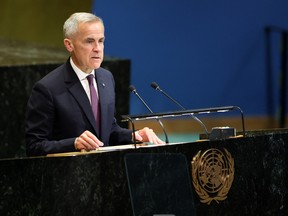
Hamas’s disarmament presents a similar question. Carney has repeatedly insisted that Hamas must surrender its weapons and have no future role in Palestinian governance, including in his Sept. 22 address to the United Nations. Global Affairs Canada described disarmament as a continuing priority but supplied no independent evidence that Hamas had begun disarming. It also did not explain whether Hamas-affiliated electoral lists would be permitted to participate in future elections.
Financial accountability formed another part of the inquiry. At the UN General Assembly, Carney announced an additional $100 million in assistance for Palestinians, bringing Canada’s commitments since October 2023 to more than $600 million.
Global Affairs Canada confirmed that $80 million of the new allocation would address humanitarian needs, including food, health care, shelter, water and sanitation, while $20 million would support peace and stabilization initiatives.
The department did not provide the requested recipient-level breakdown, identify any allocation to UNRWA or disclose findings from reviews of possible aid diversion. It instead outlined its oversight framework, including partner assessments, anti-terrorism screening, compliance requirements and ongoing monitoring.
Questions about Canada’s proposed restrictions on goods originating in Israeli settlements also went largely unanswered. Following the joint sanctions announcement by Canada, France and the United Kingdom on Sept. 8, I asked about what legal authority the government had to impose such restrictions, their geographic scope and an explanation of how they would affect the Canada–Israel Free Trade Agreement. Global Affairs Canada reiterated its opposition to settlement expansion but did not provide the requested legal analysis.
Similarly, when asked what concrete measures Canada was taking against Iran and its proxies, the department reaffirmed Israel’s right to self-defence, condemned Hamas’s October 7 terrorist attacks and reiterated Canada’s commitment to combating antisemitism, without identifying the specific measures requested.
The correspondence illustrates a distinction between announcing foreign-policy objectives and demonstrating how they are being implemented. Canada has consistently maintained that recognition of Palestinian statehood is intended to preserve the possibility of a negotiated two-state solution, strengthen Palestinian institutions and advance peaceful coexistence with Israel.
The government’s written response, however, did not establish how it measures compliance with the commitments associated with recognition, which reforms it considers complete or what consequences follow when promised milestones are missed.
The postponement of Palestinian elections brings those questions into sharper focus. On Sept. 22, Carney welcomed the scheduling of elections as evidence of progress toward democratic reform. The following day, I asked Global Affairs Canada whether that timetable was credible. On Oct. 10, Abbas announced that it would not be met.
Canada must now determine whether the postponement affects its assessment of Palestinian Authority reforms, its election-related assistance or the expectations attached to recognition. The government has not explained whether any consequences will follow.
Canada recognized Palestinian statehood on the strength of commitments that remain mostly unfulfilled. The election postponement provides a concrete test of whether those commitments carry measurable obligations or remain diplomatic assurances without defined consequences.
National Post
Join the Conversation
This website uses cookies to personalize your content (including ads), and allows us to analyze our traffic. Read more about cookies here. By continuing to use our site, you agree to our Terms of Use and Privacy Policy.
KioskNews shows a cleaned-up reading view extracted from the publisher’s page — the original always lives on their site, not ours.