Women who run: A day at a trial run for Home Guard recruitment in Jharkhand
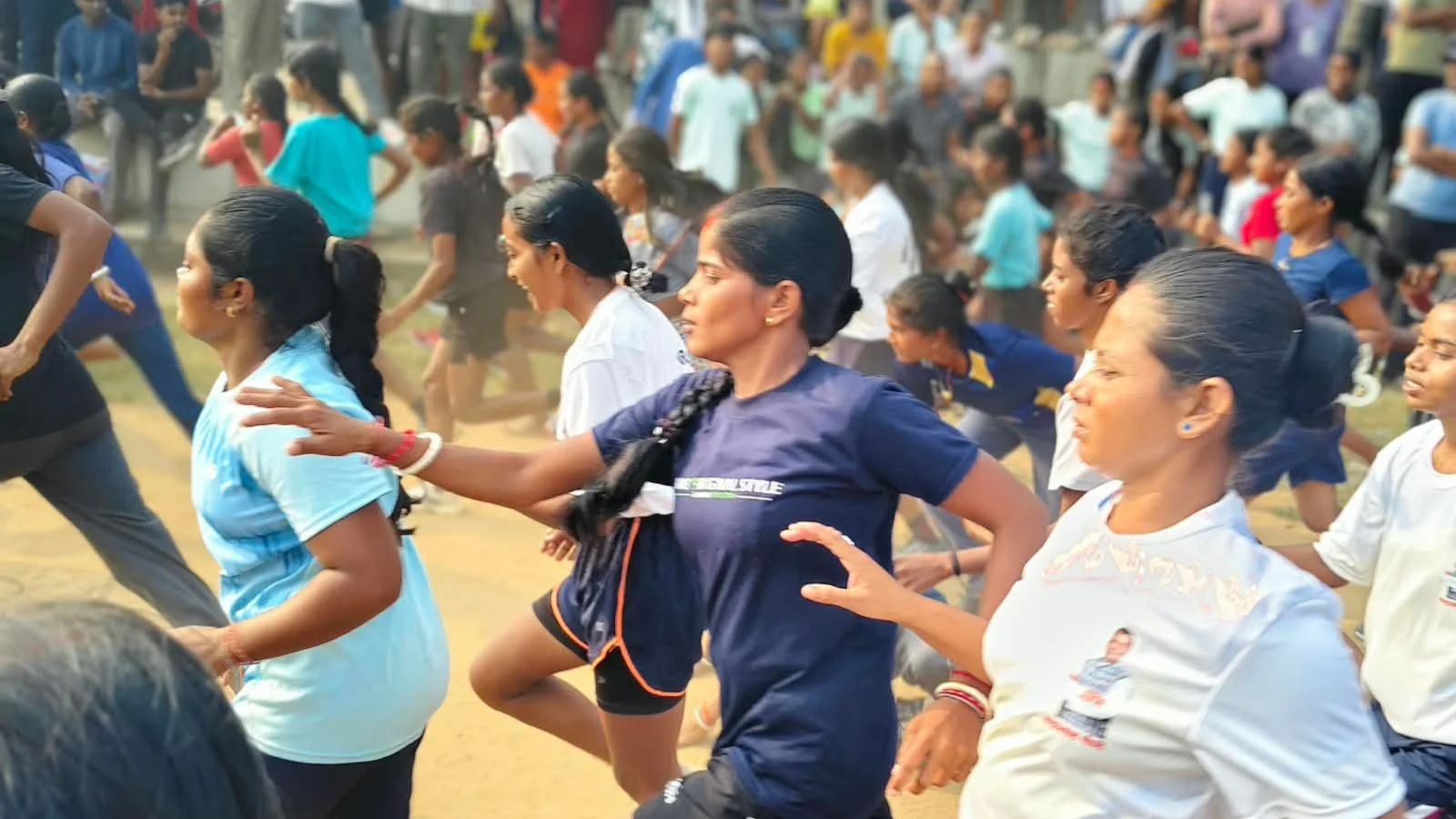
 Meena completed the run in the ‘excellence’ category — those who clock under 8 minutes.
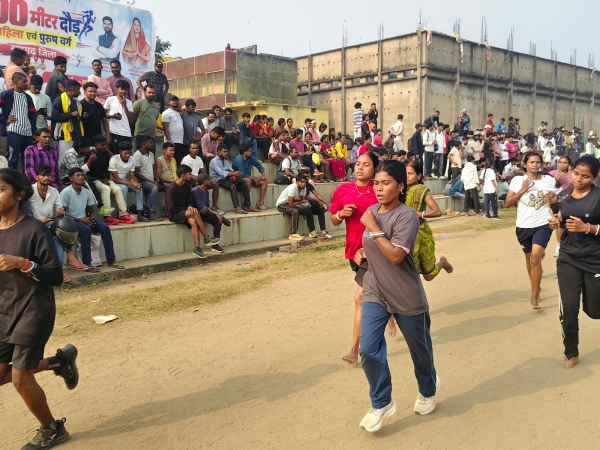
Meena is among around 6,000 women from six blocks in Ramgarh who have turned up at the Sidhu Kanhu Stadium for a day-long trial run ahead of the physical efficiency test for recruiting Home Guards across Jharkhand. Around 20,000 men and women from across Ramgarh district will compete for a mere 284 vacant posts of Jharkhand Home Guard Vahini. In Ramgarh, the test was to be conducted between October 24 and November 5, but has now been postponed due to cyclone Arnab.
By 5 am, the stadium is packed with women runners and a few men. The organisers say the day’s trial run is largely for women, and the men’s run was held earlier. Just as dawn breaks, the women spill out of packed auto rickshaws that are stuffed with water containers and bags of sportswear. Many of them are young mothers, accompanied by their husbands and babies. After arriving in sarees, many of them change into shorts and pyjamas. Some simply tuck in the pallu and pleats of their sarees and queue up for the run.
A voluntary auxiliary force under Jharkhand’s Home Department, Home Guards assist the police in traffic management and law-and-order. Currently, there are 795 Home Guards in Ramgarh district. While not a government job, it’s highly coveted since it comes with the khaki uniform and carries benefits such as maternity leave and night-shift allowances for women personnel.
“Jharkhand has around 30,000 active Home Guards, including nearly 12,000 women,” says Kailash Karmali, the State Commandant of Home Guards.
Neelima Surin, District Commandant of Home Guards, Ramgarh, says, “Home Guards are paid a daily allowance for their duties, unlike the monthly salaries for police personnel.” Monthly pay can go up to Rs 32,000 for 30 days of duty, Surin says.
 Around 6,000 women from six blocks in Ramgarh participated in the practice run.
The trial runs, conducted by different academies, are an opportunity for candidates to run on the ground where the official recruitment test will be conducted. These are practice races, but Meena and the others who have turned up at the stadium today sprint as if their lives depended on it.
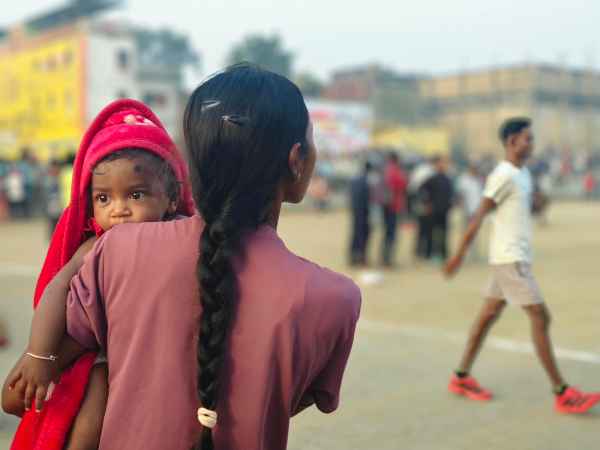
Meena’s husband catches up with her at the finish line, “just in case she has cramps and needs a leg massage”.
But Meena is fine, smiling broadly. “She used to be a state-level kabaddi player,” Hiralal says proudly.
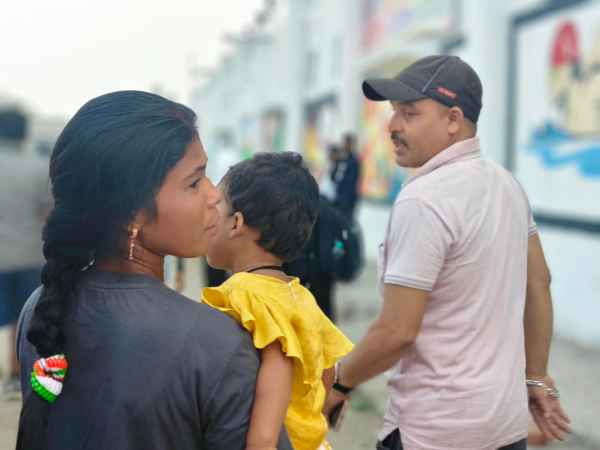 Meena Kumari with her daughter after finishing the practice run. Her husband Hiralal walks alongside them.
On October 15, the day of the trial run, the couple woke up at 4 am and ate black chana and bananas before going for a warm-up run at a ground near their house. By 6 am, they had left their village, Chotki Tongri in Hazaribagh district, for the stadium, a 15-km drive in their car.
At the ground, before the run, Meena changes into a T-shirt and track pants that she has packed from home.
She was 18 and studying BA History, when she had to drop out of college and give up her preparations for the Railways Group D exams. Her parents, she says, couldn’t afford her education or her dreams.
Then in 2021, she married Hiralal. Besides their daughter, the couple have a seven-year-old son from Hiralal’s late wife.
A political science graduate, Hiralal runs a Pragyan Kendra, a single-window for government, financial and digital services, in their village.
Story continues below this ad
Meena says money has never been a problem since she got married, but she longed for a job and the financial independence that comes with it. “My husband earns, but I want to spend my own money — on our family and on myself,” she says.
Hiralal, she says, has always motivated her. “I told her she could pursue what she wanted… I’ll back her,” he says.
When the Home Guard opportunity came up, he encouraged Meena to start preparing. He pointed to the state-level kabaddi medals she had won for her school, saying it would give her an edge in the 1,600-metre run. Meena fulfilled the eligibility criteria: education up to Class 7 for a rural posting, age between 19 and 40 years as of January 1, 2026, and a minimum height of 148 cm for women.
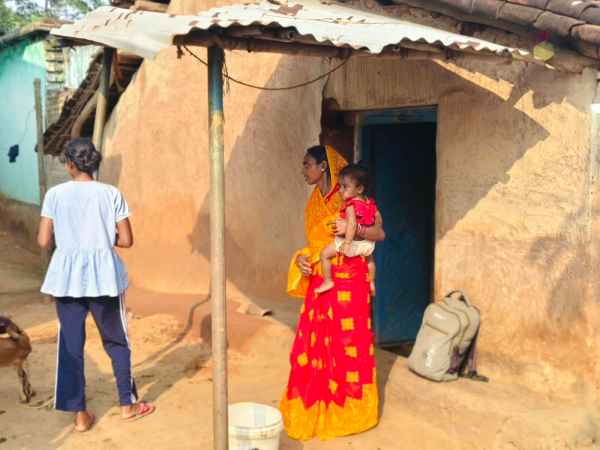 For Panchami, who belongs to the Munda tribe, the opportunity to train for the Home Guard recruitment has brought her confidence. She finished among the top 10 aspirants from Ramgarh’s Gola block and received a medal from the organisers.
Since she applied for the job, Hiralal has been her personal coach. At 4-4.30 am every day, he takes her out for training, while his family — parents, brother and sister-in-law — take over child care and other responsibilities at home. “It has just been a month since we started training. Our daughter usually comes along. After we return, I prepare breakfast, so our son can go to school,” Meena says.
She knows the job is a long shot, but she desperately wants it for herself. “Women in Jharkhand face a lot of judgment — for our clothes, for what we do. We need to change these mindsets. I know people will talk behind my back, but one day, when I achieve something, they’ll praise me,” she says.
Story continues below this ad
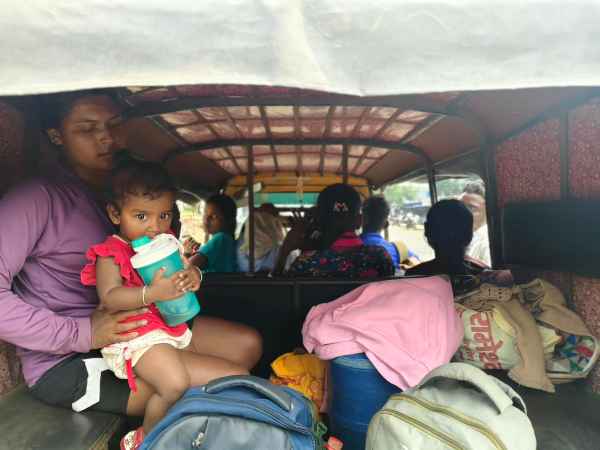 Women, packed in an auto, return from the stadium.
What she is most excited about is the khaki uniform. “Alag level ka personality hai (It’s a different level of personality),” says Meena, who wears sarees at home.
Meena is aware of a recent video that went viral — of Kavita Kumari, a 26-year-old widowed mother from Soso village, Ramgarh, who ran barefoot in a saree during a recent trial run. Meena finds Kavita “inspiring”, but says it’s not unusual for women from Adivasi communities, who have always had a sporting tradition. “After Kavita went viral, we realised that for those outside Jharkhand, it is fascinating, but for us, it is normal, just a way of life,” she says.
‘Can’t wear shorts in the village’
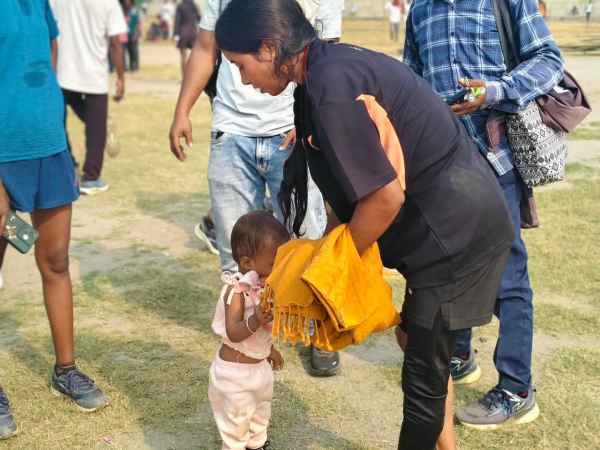 Yashoda Devi tends to her daughter Myra at the stadium
Around 8.30 am, the microphone in the stadium blares, “Kahin saree, kahin suit, kahin maathe pe hai sindoor, kaano mein hai baali, gale mein hai mangalsutra (some are in sarees, some in salwar-suits, some are married, with vermillion on their foreheads and mangalsutra around their necks)”.
In a makeshift room at the far end of the ground, Yashoda Devi, 26, changes out of her salwar-kameez into a T-shirt and a pair of shorts.
Story continues below this ad
“Our society is still conservative, so she can’t wear shorts in our village. She changes here, so she can run comfortably,” her husband Santosh says, cradling their nearly year-old daughter Myra.
From Gargali village in Mandu block, the couple had covered around 25 km on a bike to reach the stadium. When Yashoda emerges in her sportswear, she takes Myra into her arms, plays with her for a while before joining a queue of around 100 runners on the track.
She is soon back, completing the 1,600-metre run in a little more than seven minutes.
“I underwent a Caesarean delivery nearly a year ago, and I still have stomach pains,” Yashoda says, clutching her waist. She had worn an abdominal support belt during the run.
Story continues below this ad
Her mother-in-law, concerned about Yashoda’s health, had objected to the training. “But I told her, I have to run,” she says.
Yashoda was 17 when she married Santosh, a farmer who also works at the Krishi Vigyan Kendra. Though she completed her graduation in sociology after marriage, she says she still has a lot of dreams and is determined to run as best as she can.
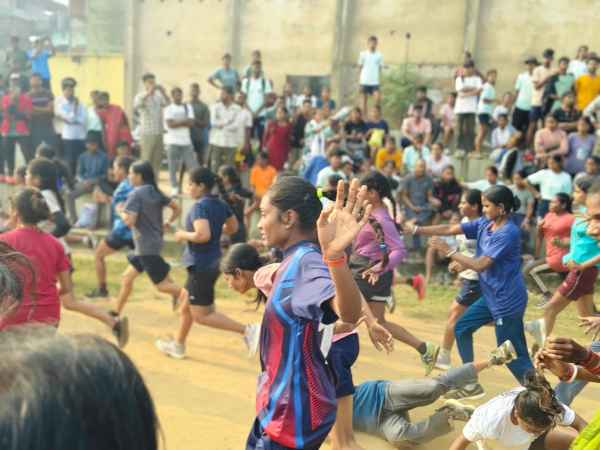 Women trip, as the dust raised by their run blinds them.
It was this determination that saw her getting up, seconds after she tripped on the field, blinded by the dust kicked up by the other runners. But she had gone on to finish the race in the ‘excellence’ category. “I would have done even better if I had not tripped.”
These days, Yashoda has been waking up at 4 am and preparing food for her family before leaving for practice at a ground nearly 2 km from their village. “My husband looks after our daughter while I train,” she says.
Story continues below this ad
With their 10-year-old son attending a private school in Hazaribagh, a bulk of Santosh’s monthly income of Rs 10,000 from the Krishi Kendra goes towards his school fee. Yashoda, who is part of a 14-member self-help group, says she hopes she can contribute to the family’s expenses once she starts earning.
Her self-help group was recently part of an initiative to erect an Ambedkar statue in their village, but it ended badly over a land dispute with members of a dominant community in the village.
The incident left her shaken, but she believes the job will help her gain confidence. “What I couldn’t do before marriage, I will do now,” she says.
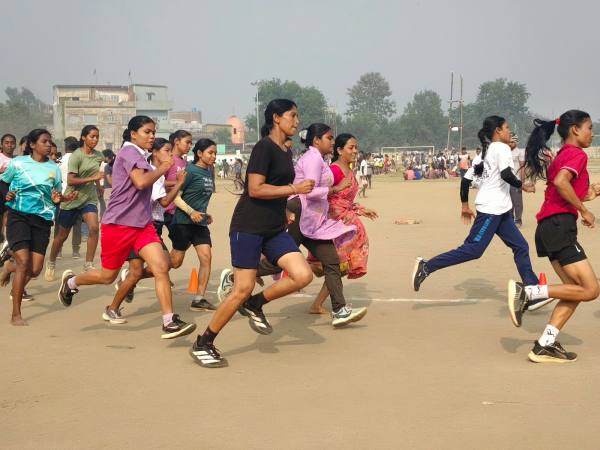 Punita Devi (in black T-shirt) takes her lap in the shoes she borrowed from her friend
Every day, Punita Devi, a widow from Melani village in Ramgarh’s Patratu block, would commute nearly 30 km to Ranchi’s Chandni Chowk for work. She lifted bricks at construction sites and did other odd jobs, earning around Rs 350 a day, “of which Rs 50 went towards auto fares”.
Story continues below this ad
With that income, food rations and what she grew on a small patch of land, Punita, a single mother, raised her two daughters, 16 and 13, and her 12-year-old son.
For the past three months, however, Punita, 32, has had a different schedule. Every morning, she wakes up at 4 am and runs nearly 5 km from Pokhra More to the Haripur panchayat building.
She runs in a saree because she doesn’t want to draw any attention or controversy, something that has chased her for years.
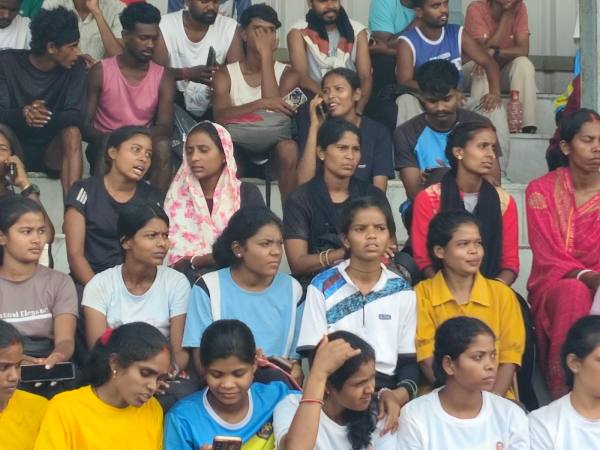 Punita Devi (in black and wearing bangles) and others await their turn at the stadium.
Punita was 17 when she lost her father to tuberculosis, and was married later that year. But her husband, a labourer at Jindal Steel and Power Limited in Patratu, died of liver illness. “On Purnima night in 2019, he woke up to chew tobacco. He complained he was feeling unwell and lost consciousness. We rushed him to the hospital, but he died around 10 am,” she recalls.
It’s hard for a single woman in these parts, says Punita, who was accused of being a “witch” and disowned by her in-laws. But Punita says she stayed put in her husband’s house, later getting her children into government residential schools.
Around three months ago, after she heard of the Home Guards recruitment, Punita began her training under a coach in Gola block, close to her mother’s home in Ranchi.
Samir Ayubi, the coach, recalls that when he met Punita and heard of what she had gone through, he offered to train her for free. “She will definitely get the job, given her potential. There is also a 5% quota for widows,” says Ayubi.
At the Ramgarh stadium, Punita walks in unaccompanied, and lugs her bags. When she runs, there is no one to cheer for her.
She feels “alone” when she sees women with their husbands, but the dream of a government job keeps her going. “I borrowed shoes from a friend and ran,” she says. “All for my children’s future.”
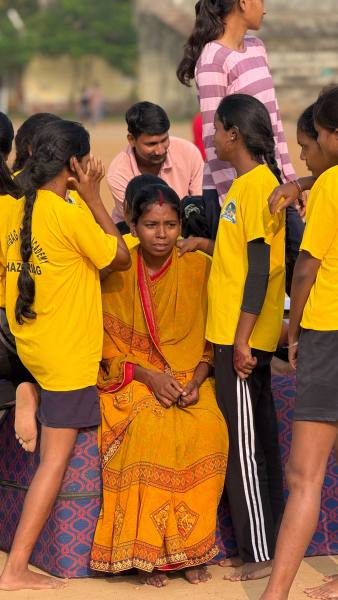 Priyanka Devi in Hazaribagh where she practises.
When Priyanka Devi runs, it’s with the hope that it will lead her to her son, whom she has not seen for the last four years since her husband deserted her in 2022. “My son is now seven. He lives with his father,” says the 25-year-old, at her parents’ home in Ichak village, Hazaribagh.
Priyanka was 17 when she got married and moved to her husband’s home in Digwar, in Ramgarh district. Her husband, she claims, harassed her for dowry and accused her of being a “witch” before throwing her out of the house in 2022. She approached the Hazaribagh district court, seeking legal action, but the court, directing her husband to pay her a monthly maintenance of Rs 2,000, disposed of the case, says her advocate Rakesh Kumar Ranjan. “Her husband filed for divorce in Ramgarh, but the divorce has not been finalised,” he says.
Priyanka says she doesn’t want a divorce. All she wants is to live with her son. “When my husband left me, my son was three. For the last four years, I have not even seen my son’s face,” she asks.
KioskNews shows a cleaned-up reading view extracted from the publisher’s page — the original always lives on their site, not ours.