Distorted ‘facts’, personal attacks – how Taiwan’s CTi News spreads falsehoods about Singapore

SINGAPORE: The YouTube video opens like a regular news talk show: a brightly lit studio, panelists seated in a row, presenter neatly clad in a blazer. As the camera begins rolling, it zooms in on a large, text-cluttered bulletin board, which expands to fill the screen as the presenter reads off it in Mandarin.
The story of the day, according to Taiwan’s CTi News, is a big one: on Dec 21, 2025, Singapore’s Prime Minister Lawrence Wong supposedly gave an interview to the Canadian Broadcasting Corporation (CBC) in which he “pledged to cooperate with US chip export controls on China”.
As the first panelist launches into his comments, a caption flashes up on the screen: “Mainland media reveals Lawrence Wong's interview in Canada: China won't get a single extra chip from Singapore.”
The reality: No such interview ever took place. The caption on the CTi News video was entirely fabricated.
The CBC, responding to queries from CNA Verify, confirmed that they had no interaction or interview with Mr Wong that day, nor could they recall doing such an interview in December 2025 more broadly. Wider checks by CNA Verify found no indication of such an interview, and no such interview is listed on the Prime Minister’s Office’s website, which publishes transcripts of all of Mr Wong’s interviews.
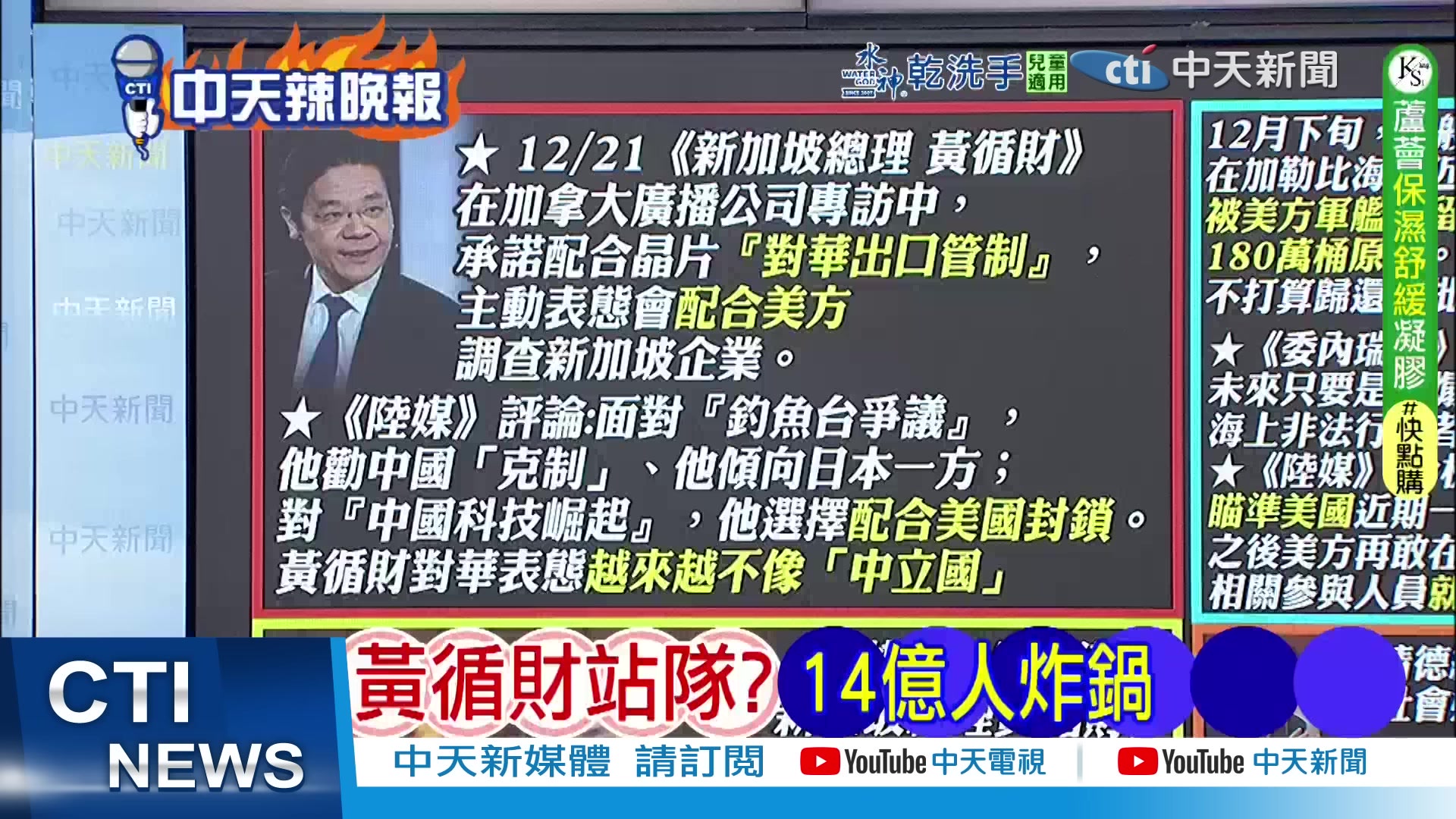
CTi News is the news division of the Chung Ti’en Television (CTi TV) network, one of the best-known names in Taiwan’s media industry. The division is no stranger to controversy: its reporting has previously sparked criticism, protests, and censure – including, most significantly, the loss of its Taiwan broadcasting license six years ago.
In May 2025, Li Chih-te, the director of the now-defunct Asia Fact Check Lab, stated at a face-checking summit that CTi News’ content had grown more radical since becoming online-only. The channel was also cited twice by the Taiwan FactCheck Center, a Taiwanese fact-checking nonprofit, for inaccurate reporting that same year.
The loss of their Taiwan broadcasting licence does not extend to Singapore, where CTi content is available on subscription-based TV services, as well as on YouTube and the CTi News website. Both its news and entertainment programmes are carried here by the 24-hour TV channel CTi Asia – with news content making up the bulk of programming by airtime.
The fabricated CBC interview is not an isolated incident.
An AI-assisted analysis of 370 videos published on five CTi YouTube channels between November 2025 and September 2026 found that half of them – 186 videos – contained at least one false, misleading, or unsubstantiated claim about Singapore, its Prime Minister, or both. This figure includes videos which were repackaged or posted more than once.
Many of these videos contained factual errors and recycled unsubstantiated, or outright false, claims which previously circulated on mainland Chinese social media, like the Canadian “interview” example. Others started from a factual kernel but went on to distort real events and developments by taking them out of context, or layering in spurious details, allegations, and causal links.
CNA Verify has reached out to CTi,but has yet to receive a reply after more than three weeks.
Political scientist Chong Ja Ian, an associate professor at the National University of Singapore (NUS), described CTi News as one player – albeit an “especially controversial” one – in a wider “ecosystem” which enables falsehoods to gain more traction than they otherwise might.
“By amplifying and extending false narratives commonly found on PRC social media and sometimes mainstream media and appearing like a separate, Taiwanese source, CTi News makes those narratives appear more credible and believable than they actually are,” he told CNA Verify.
For this investigation, CNA Verify focused on the videos’ “visual surfaces”, including titles, thumbnail images, and chyrons – large, on-screen text captions – as well as presentation aids like bulletin boards that were used during broadcasts. These “surfaces” were where the problematic claims appeared most persistently, sometimes lingering on screen for minutes at a time. While the claims were also repeated by CTi News presenters and panelists in some instances, these were easier for a casual viewer to miss, compared to their prominence in the visual layers.
Associate Professor Austin Wang from the University of Nevada, Las Vegas, who researches US-China-Taiwan relations, cognitive warfare and misinformation, said such text used in videos has a “very strong anchoring effect” on viewers.
“Thumbnails are often the reason people choose to click and watch a video in the first place – so they tend to already believe what the headline says,” he said.
Assoc Prof Wang added that people tend to look for shorter clips instead of watching an entire video in full. “In those short versions, the evidence provided is likely to be biased towards whatever appeared on the thumbnail or the headline,” he said.
“So, people’s worldview keeps being reinforced by the framing provided by that media.”
CTi News puts out a sea of content, churning out hundreds of videos daily across these five YouTube channels combined. The 186 problematic videos CNA Verify identified have garnered millions of views.

SOCIAL MEDIA AS A SOURCE
CNA Verify’s analysis found that at least 50 of the CTi News videos reviewed by CNA contained inaccurate or unsupported claims that had previously circulated on Chinese social media and “self-media”, or independent content creation sites. These points were incorporated into the talk show programmes in the videos, where they were couched as legitimate news about Singapore or its Prime Minister.
In some instances, CTi News even used near-identical phrases from mainland Chinese social media posts which fabricated news and developments about Singapore.
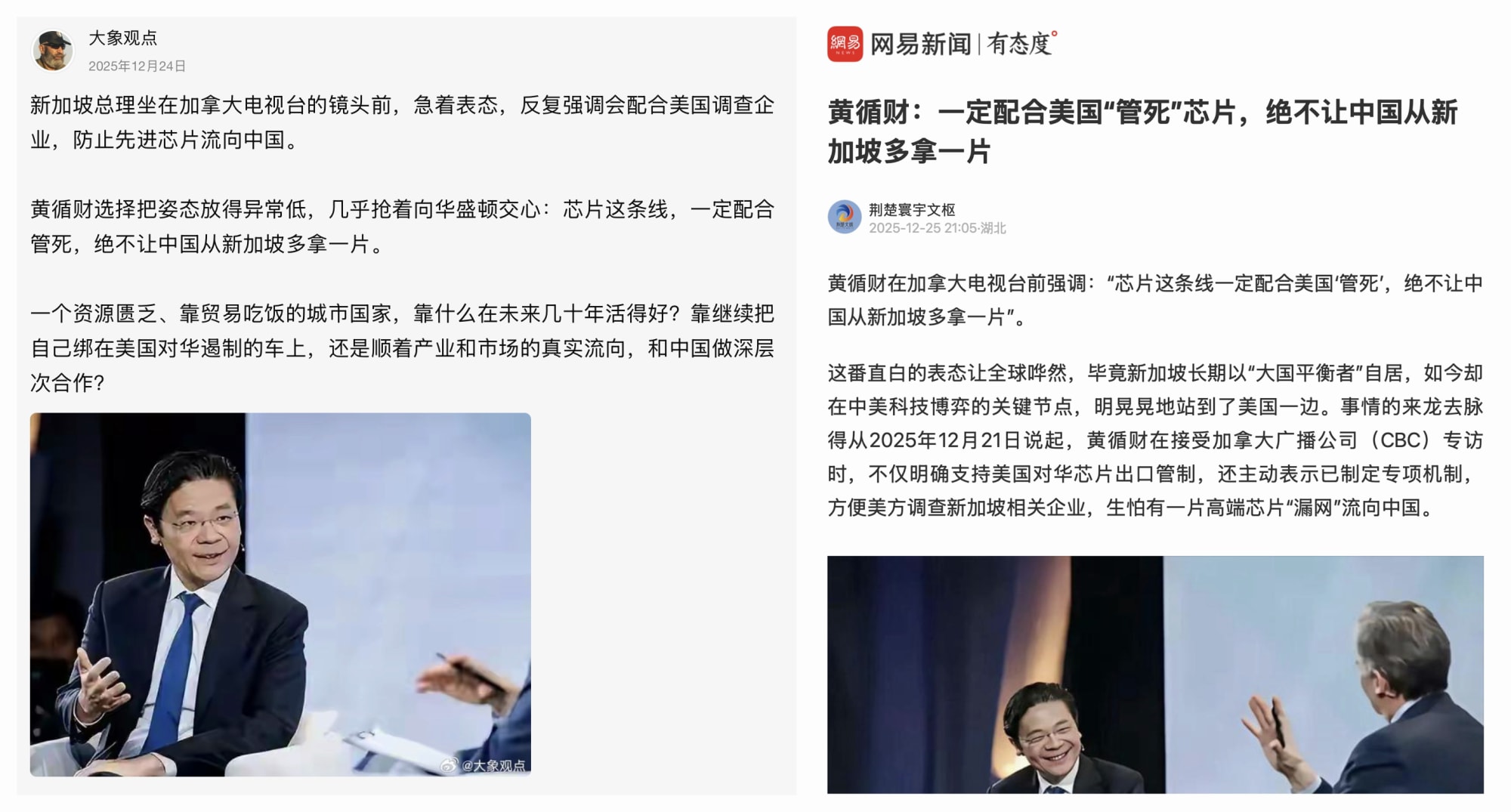
Mr Wong’s purported “interview” was one such example: CNA Verify found that this claim began appearing across posts on various Chinese self-media platforms in late December 2025. While the specific wording of the posts varied, they all repeated the same central allegation: that Mr Wong said Singapore would be cooperating with US export controls, and as a result, would not be giving China “a single chip”, in reference to the advanced hardware coveted by Chinese artificial intelligence companies.
The earliest identified source was a Dec 24, 2025 anonymous blog post on the Chinese social media platform Weibo, which claimed that Mr Wong told an unnamed Canadian TV channel that Singapore “will not allow China to get a single (semiconductor) chip”. The next day, a similar post appeared on NetEase’s self-media platform Wangyihao, this time attributing Mr Wong’s supposed statement to a Dec 21 interview with the CBC.
Both posts also used similar, uncredited photos of Mr Wong in the middle of an interview that could give the impression that they showed the purported Canadian interview in question. In fact, the photos were taken at a November 2025 event in Singapore where Mr Wong spoke with Bloomberg News editor-in-chief John Micklethwait, who is British.
Three days later, on Dec 28, the claim appeared almost word for word in a segment of the CTi News programme “Spicy Evening News” that was uploaded to YouTube.
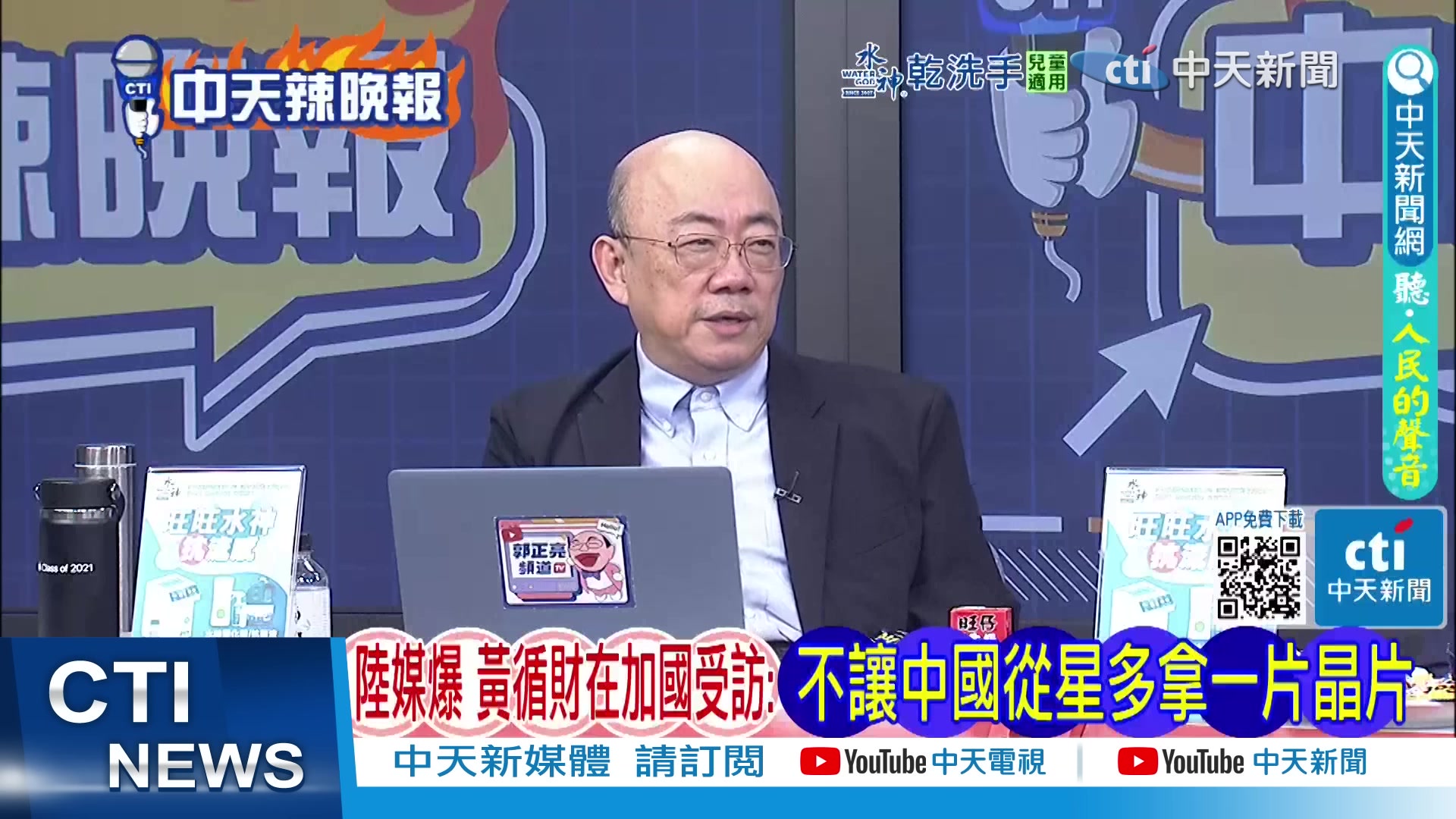
Checks by CNA Verify found no evidence that the interview took place – or that Mr Wong had ever made comments to this effect.
TWISTING THE TRUTH
In its review of the 186 problematic videos, CNA Verify found that CTi News’ coverage often stemmed from genuine events or a real news peg, but distorted these by layering inaccurate details and unsubstantiated causal links on top of them.
Some of the videos revolved around similar themes, ranging from “doomsday” narratives about Singapore’s port and economic performance to warped readings of trade statistics and diplomatic developments. Others mislabeled genuine figures or took them out of context, while others added in details that never existed.
One example involved CTi News’ coverage of a commentary about Singapore’s potential role in managing cross-Strait tensions, published in the Hong Kong-based Asia Times on Jan 19, 2026.
The author of the commentary, writing in his personal capacity, suggested that Singapore could consider using Project Starlight – its decades-long military training programme in Taiwan – as leverage to discourage pro-independence rhetoric, arguing that “further provocations will be treated as a threat” to the safety of Singapore personnel on the island and “withdrawal is not off the table as a consequence”.
At no point in the Asia Times commentary were these points presented as official Singapore government policy.
But three days later, on Jan 22, CTi published the first of 11 videos on its YouTube channels which suggested that they were.
In large, stylised Chinese text, the video thumbnail proclaimed: “Having Gone Too Far With Pandering to Japan, Lawrence Wong Wakes Up; Singapore Affirms One China Policy, Threatens Troop Withdrawal Over Independence”.
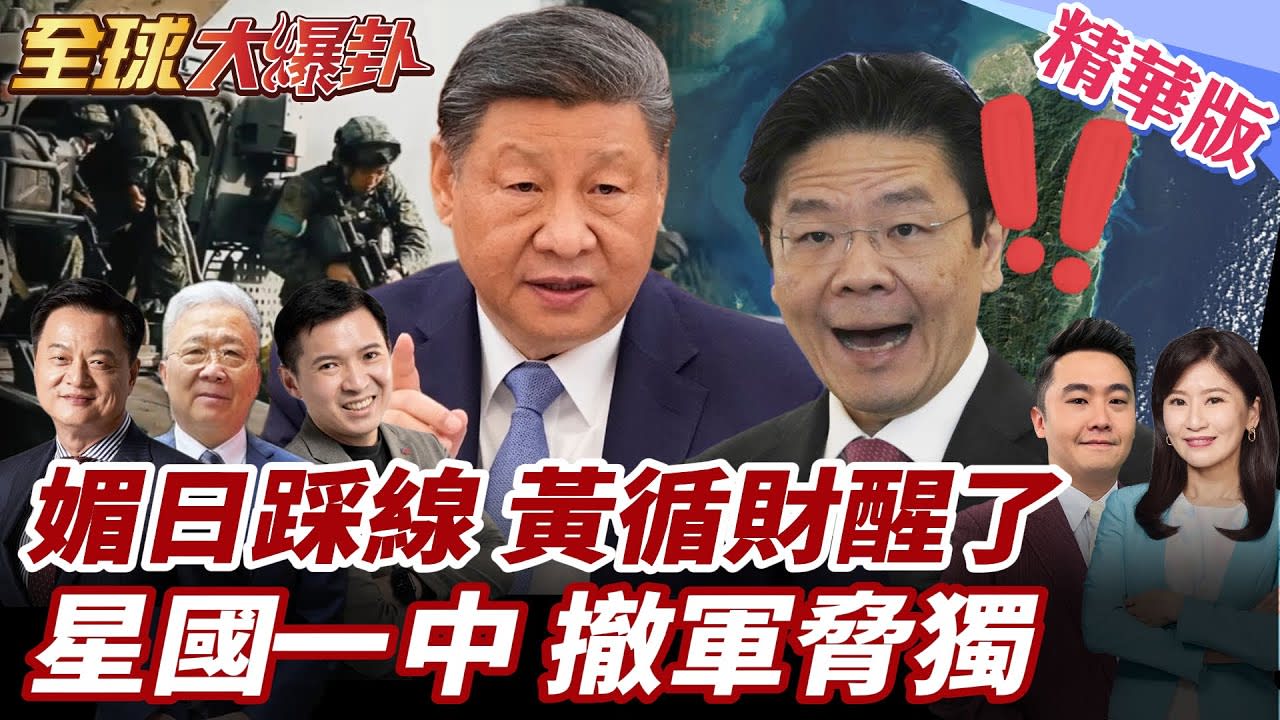
CTi News was aware of the Asia Times commentary, even referencing it in a bulletin board that was used during the episode. But this attribution was omitted from the video’s title, thumbnail and on-screen text captions, all three of which suggested that Project Starlight was under review.
Even after Singapore’s Ministry of Defence (MINDEF) issued a statement on Jan 24 to clarify that the Asia Times piece had been written in the author’s personal capacity and did not reflect official MINDEF or Singapore Armed Forces policy, CTi News persisted with this framing. The six videos published after MINDEF released its statement also did not reference it.
One video, uploaded on Jan 26, ran the on-screen caption “Lawrence Wong decides to withdraw Project Starlight from Taiwan”. This text remained on-screen for three minutes.
FALSEHOODS IN BLACK AND WHITE
In the Project Starlight videos, as with many others, the problematic claims appeared on screen in clear, eye-catching text. CNA's investigation found that inaccurate claims were routinely displayed prominently during CTi News videos, making them difficult for even a casual viewer to miss.
For instance, a group of four videos on SingaporeForeign Minister Vivian Balakrishnan’s official visit to Beijing in May 2026 contained a fabricated claim that Singapore had committed itself to cutting ties with Japan, or was at least trying to distance itself from Tokyo. All four videos contained the claim across multiple surfaces – including video titles, thumbnails, on-screen text captions, and bulletin boards – with at least one video displaying it in all four.
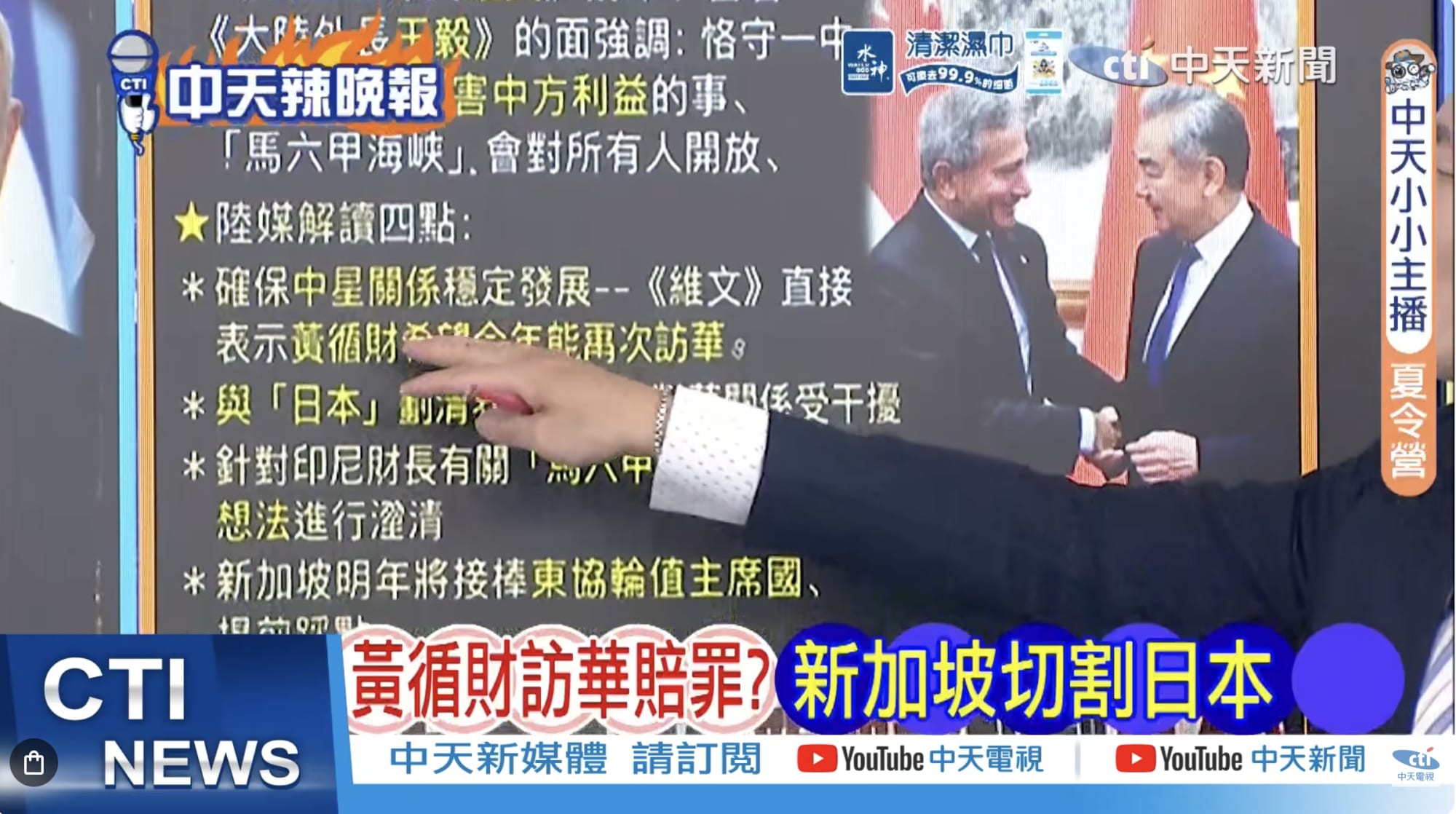
By contrast, CTi News’ presenters and commentators sometimes present a more qualified stance than the claims displayed on screen.
But it is the visual elements that have the most potential to reach even a casual observer, experts said. CNA Verify found that some text captions remained on screen for anywhere from a few seconds to as long as five minutes.
Assoc Prof Chong of NUS noted that the differences between what is said and what is shown could allow CTi News to claim that it entertains a range of positions. However, he added, “this constant repetition of false and misleading claims, some of which are complete fabrications, can (still) shape audience perceptions.”
A CONTROVERSIAL TRACK RECORD
CTi News’ editorial standards and journalistic practices have drawn scrutiny for years, including accusations of pro-Beijing bias as well as inaccuracies in its reporting.
In December 2013, the Singapore Trade Office in Taipei criticised the channel’s coverage of Singapore for “inaccuracies and misleading arguments”. It cited, among other examples, a false claim that then-Prime Minister Lee Hsien Loong had said he would cane those convicted over the Little India riot.
In November 2020, Taiwan’s telecommunications and broadcast regulator, the National Communications Commission (NCC), unanimously voted not to renew CTi News’ broadcast licence. At a press conference announcing its decision, the commission cited a high volume of viewer complaints, inadequate internal controls and repeated breaches of broadcast rules among its reasons. In the six years leading up to the decision, CTi News had been issued 23 fines totaling NT$11.53 million (US$349,500), including several for fact-checking failures.
CTi News described the communications commission’sdecision as politically motivated and an attack on press freedom. Although it went off-air in Taiwan in December 2020 as required, it filed several appeals against the decision, and litigation remains ongoing.
But the episode did little to dampen its reach or popularity, according to the University of Nevada’s Assoc Prof Wang.
“They put all their capital and investment into online broadcasting, so their target audience expanded. They also started to care more about overseas Chinese, especially Chinese Americans living in Southeast Asia,” said Assoc Prof Wang, adding that CTi News appeared to have been “quite successful” in adapting to an online media environment. The five CTi YouTube accounts studied by CNA currently command over 10 million subscribers.
Losing its licence may also have had the unintended effect of “freeing” CTi News to act as it pleases without the NCC reining it in, he said.
Separately, in May 2026, a CTi News anchor was indicted by Taiwanese authorities for allegedly bribing military sources to leak classified information, although there is no indication that his employer was aware of or authorised the activity. In a statement issued in January 2026, when the news anchor was first detained, CTi called for a fair judicial process and said that they did not know the details of the case.
But this track record is not well known outside Taiwan, said NUS’ Assoc Prof Chong, adding that CTi News is viewed as both a popular and trustworthy source of news among Mandarin-speaking audiences in Singapore and Malaysia.
“There is a lack of awareness regarding the controversies surrounding CTi,” he said. Moreover, as CTi is an established media brand with permission to air in Singapore, “viewers often assume that its news is credible, well-sourced, and well-researched – especially compared to random online channels and AI-generated content,” he added.
MAKING IT PERSONAL
CTi News’ antagonistic coverage of Singapore and its Prime Minister has persisted for nearly a year. Across the 10 months’ worth of videos reviewed by CNA, CTi News’ attacks peaked in late 2025 and mid-2026, with quieter periods in between.
Singapore and Mr Wong are not the only targets of CTi News’ videos, which have focused with even greater frequency and intensity on other Asian leaders like Japanese premier Sanae Takaichi and Philippine President Ferdinand Marcos Jr. As with its coverage of Mr Wong, these videos often mix facts with sensationalism, rumour, and sometimes vicious invective.
The shift in CTi News’s treatment of Mr Wong was nonetheless striking. Its coverage of him prior to November 2025 was mixed, even positive, in tone. The hostility only appears to have begun in late 2025, starting with a series of videos criticising Mr Wong for comments he made on Japan’s post-war relations with its neighbours.
In late November 2025, CTi News posted a video claiming that multiple member countries of the Association of Southeast Asian Nations (ASEAN) had “angrily denounced” Mr Wong for his comments, leaving him a “laughing stock” – none of which is true.
This framing continued over the next few months. In multiple video titles and on-screen captions, CTi News claimed — without evidence — that the entire bloc had “lashed out” at or “shunned” Mr Wong, sometimes using insults that suggested he had been “slapped in the face”.

Since then, CTi News has kept up this antagonistic line in its Singapore coverage. Its videos have routinely blamed Mr Wong for purported “crises” facing Singapore — many of them invented — portrayed him as “panicked” or “close to collapse”, or presented him as in need of correction by other senior political figures.
“Given that Wong is currently Singapore’s Prime Minister, he is a target for much of the unhappiness toward Singapore’s positions,” said Assoc Prof Chong of NUS.
KioskNews shows a cleaned-up reading view extracted from the publisher’s page — the original always lives on their site, not ours.