Reclaiming a decade: NHG Health chairman Tan Tee How’s mission to add 10 healthy years to 1.5m lives
SINGAPORE – Chairman of NHG Health Tan Tee How brings a distinct, non-clinical lens to one of Singapore’s most pressing healthcare challenges – narrowing the gap between lifespan and health span.
“While Singaporeans live to an average of 84.5 years, their average health span – the period of life spent in good health – stands at 74.9 years. So there’s a 10-year gap, and there are no indications that this gap is closing. This is what we are concerned about,” he said.
“We saw this coming right when NHG Health was set up 26 years ago,” he added.
Today, this demographic wave is no longer on the horizon but a reality, he said.
Singapore officially crossed the threshold into a super-aged society in June 2026, with one in five citizens aged 65 and above. By 2030, the ratio will climb to one in four.
“Our focus must therefore shift beyond extending life expectancy to improving the quality of those additional years.
“To manage the shift, we must look beyond hospital beds and clinical interventions. Otherwise, Singaporeans spending the final decade of life in ill health (will) place immense strains on families, caregivers and the public healthcare system,” he said.
Confronting a super-aged reality
At 67, Tan has come full circle in his service to public healthcare.
Unlike many healthcare leaders, he was not medically trained. His first foray into healthcare was in April 2000, when he took the helm as NHG’s founding group chief executive officer, a role he held until December 2003.
After leaving, his subsequent postings took him away from the sector for more than 15 years until he retired in February 2018 after holding top posts across the civil service, including that of commissioner of inland revenue. But his interest in public healthcare continued to stay with him.
In a rare media interview since his first exclusive with veteran health correspondent Salma Khalik in 2000, Tan said: “Before I retired, I spoke to my friends in public healthcare and said I would like to sit on the boards of public healthcare institutions. Because of my past experience, I found it interesting and challenging, so I wanted to continue contributing.”
He served on the board of the National University Health System from 2016 to 2019, before returning to NHG Health as its deputy chairman in April 2019. He assumed the role of chairman in April 2021 – a position he has now held for nearly six years.
Top of the agenda for Tan is grabbing Singapore’s super-aged bull by its horns.
“That’s why we at NHG Health believe health starts with the people. By recognising this, we will be able to co-build a healthcare system for a super-aged society with people – individuals, families and the community,” he said.
“That was why we (created) the 15M Social Movement to invite residents, families, friends, neighbours and the community across central and northern Singapore to connect and act together for each other’s health.
“We want to build communities where people look out for one another, form meaningful connections, and take shared action to live well together.”
Likening it to the scouting movement, he added: “I am sure the founder, Lord Robert Baden-Powell, did not intend to start a movement when he wrote the book Scouting For Boys.”
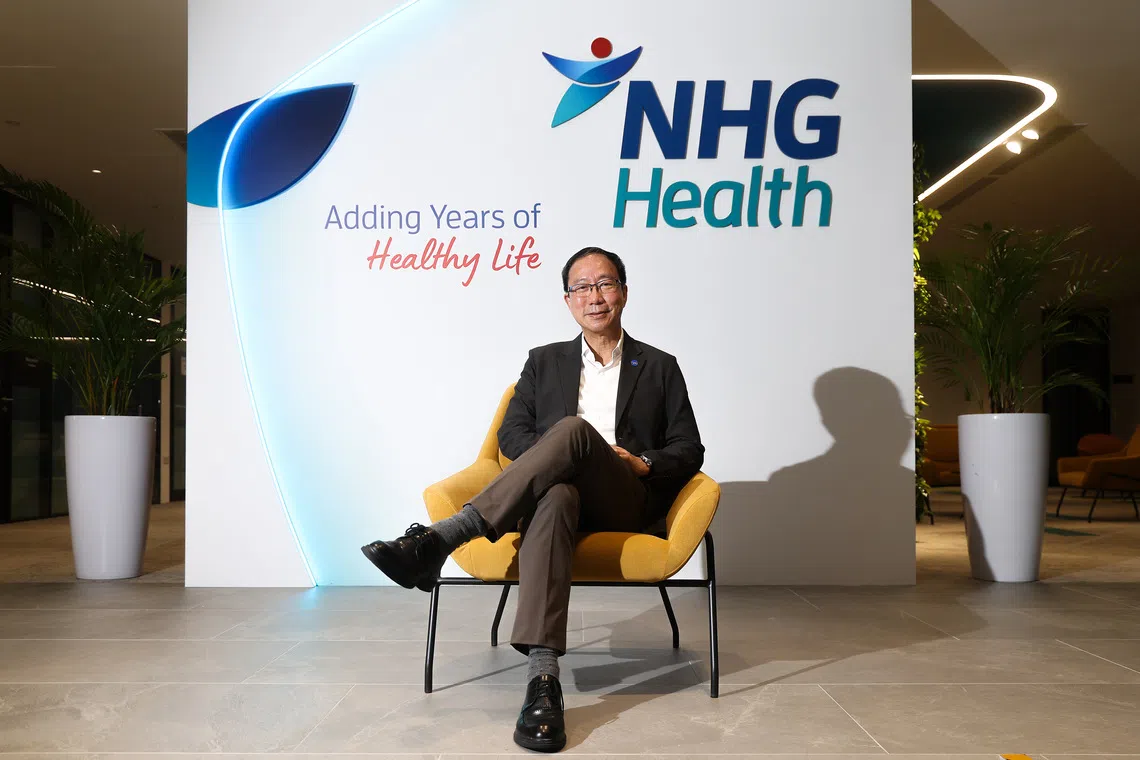
Top of NHG Health Chairman Tan Tee How’s agenda: Closing the 10-year gap between lifespan and health span through the 15M Social Movement.
PHOTO: LIANHE ZAOBAO
Tan said Baden-Powell was then on active military duty in Africa, where he came to the conclusion that the outdoors is a very good classroom for developing children’s talents and making them good citizens.
“He wrote the book, and the scout movement came into being.”
For 15M to grow as “organically as the scouting movement”, Tan said it should make people aware of what makes a difference to their health.
Since its launch in 2024, the movement has reached about two million residents through outreach and engagement activities.
In 2026 alone, more than 13,000 residents attended Healthiverse, with over 6,300 taking preventive health actions, such as undergoing health screenings or enrolling in Healthier SG. Through expanded efforts, residents have also taken part in preventive health activities more than 455,000 times.
Healthiverse is a flagship public health festival organised by NHG Health to promote community well-being and support the movement to add 15 million years of healthy life across central and northern Singapore.
“The (15M) movement will help add 15 million years of healthy life together by helping our 1.5 million residents in central and northern Singapore regain the 10 years typically lost to poor health by bringing on board the many stakeholders: various community groups, social services groups and resource owners,” said Tan.
“Even the libraries, where you can gather a group of pregnant women to read and discuss books on pregnancy, birth and bringing up children. That can be considered part of creating health.”
“Every year we have a two-day programme called Pop Collect (Population Health Collective) where we bring together all these groups as part of the movement and share ideas on how to do better and what has worked in one area. It is also a forum where we propagate and disseminate some of the findings, and some of the things that we should be paying more attention to,” he added.
From sick care to whole care: Rethinking healthcare delivery
“Integration is very important because to serve the needs of residents who may fall sick, we have to organise ourselves better. Here, we want our staff to work closer together. We amass expertise to be able to do a lot more by bringing certain services closer to the residents,” Tan said.
One example is the initiative by the NHG Eye Institute to set up community eye clinics eight years ago, with one at the former Ang Mo Kio Specialist Centre and two others at Hougang and Geylang polyclinics.
“When we have these community eye clinics, some of the checks or reviews are done here.
“In some of the cases, patients are seen by optometrists rather than ophthalmologists. This way, we organise ourselves to be more useful and productive without compromising the quality of care,” Tan said.
The cluster is also working very closely with private general practitioners located in central and northern Singapore to streamline referrals to specialists at the hospitals.
“We are advising GPs to make the arrangement based on where the patient can be seen at the earliest. We would advise the patient that for that specialist, the wait time is shorter. We call this load balancing, and we believe that in doing so, it will mean patients benefit by not having to wait too long to see a specialist.
“We also have a system where, once the patient has been seen (by the specialist), he is referred back to the GP. So we close the loop. This is seamless integration, and we are trying to work towards it,” he said.
“In the past, the GPs operated quite independently of the public healthcare system, but today, we work very closely to do that. And key data in medical records will be shared with the GPs under the Central-North Primary Care Network.”
However, Tan admitted that things do fall through the cracks.
Citing a Straits Times Forum letter about two blood tests scheduled 30 minutes apart at two different institutions, Tan said it was unfortunate that the Electronic Medical Record system was unable to flag this. But because it was brought up, the problem was fixed through human intervention.
“We are working on longer-term measures to make the system flag similar problems and bring them to our notice. These are all the things we have fallen short of and where we feel that we should and could do better to serve our residents better,” he added.
Name change but still one family
Moving healthcare to the community under 15M does not mean overloading the staff, Tan said. “For a start, we have to deploy more nurses to the community. I think it’s inevitable. At the same time, we as a system must look at how to make better use, more productive use, of our staff. For example, we now have advanced practice nurses at the emergency departments, and they can do their assessment of musculoskeletal cases.”
Residents in the region under NHG Health can also access more than 110 Community Health Posts, including 94 that are co-located with Active Ageing Centres.
Supported by community nurses, nurse clinicians and telehealth services, the posts provide easier access to health advice, vaccinations, Healthier SG support and chronic disease management closer to home.
The cluster also adopted artificial intelligence, such as Note Buddy, so that doctors could tend to patients instead of typing out notes.
“Ultimately, the next step is using AI in clinical decision-making. Already, some efforts are being made in areas like radiology. It makes a lot of difference as it takes away the mundane (tasks) from our staff and lets them do work which they are trained for,” said Tan.
When asked if the rebranding of National Healthcare Group to NHG Health meant a different outlook, Tan said it is not merely cosmetic.
“NHG Health basically informs our residents that we are an integrated healthcare provider, and we are organising our services around the residents. Otherwise, residents will have to navigate multiple institutions on their own.
“We let people know that this is NHG Health, (with the) same logo backed by substantive changes such as integration, seamlessness in the way we organise our care and services to serve them,” he explained.
One NHG, which represents a unified, integrated identity and collaborative approach, is an internal messaging system because it started off as a collection of institutions.
“It was only maybe less than 10 years ago that the current configuration of NHG Health came into being. There were founding members of NHG Health – Tan Tock Seng Hospital and the polyclinics.
“But there are also new members, like Khoo Teck Puat Hospital that used to belong to Alexandra Health and Woodlands Hospital. So we need our institutions to move from their own way of doing things to the One NHG way of doing things. Otherwise, patients will be confused,” Tan said.
NHG Health has standardised care across its hospitals, with patients undergoing major procedures following the same evidence-based protocols to shorten hospital stays.
Shared real-time dashboards also allow teams across hospitals to compare performance and improve care pathways.
“It takes time, but I believe that as they begin to navigate our new system, they will understand that we are part of one system,” said Tan.
KioskNews shows a cleaned-up reading view extracted from the publisher’s page — the original always lives on their site, not ours.