Visiting Sungei Buloh? Look out for ‘The Boss’, possibly the reserve’s new crocodile king
SINGAPORE – There is a new boss in Sungei Buloh.
A hefty 3m- to 4m-long saltwater crocodile, known simply as “The Boss”, is said to have taken over the reign from “Tail-less” – the previous top croc at the wetland reserve.
Tail-less, so named because he had a stump where his tail should have been, disappeared from the area about a year ago, possibly usurped by the new king.
While National Parks Board (NParks) officers say that properly identifying a particular crocodile as the dominant reptile requires further study, it uses the term informally to describe how crocodiles assert themselves and occupy territories in the mangroves.
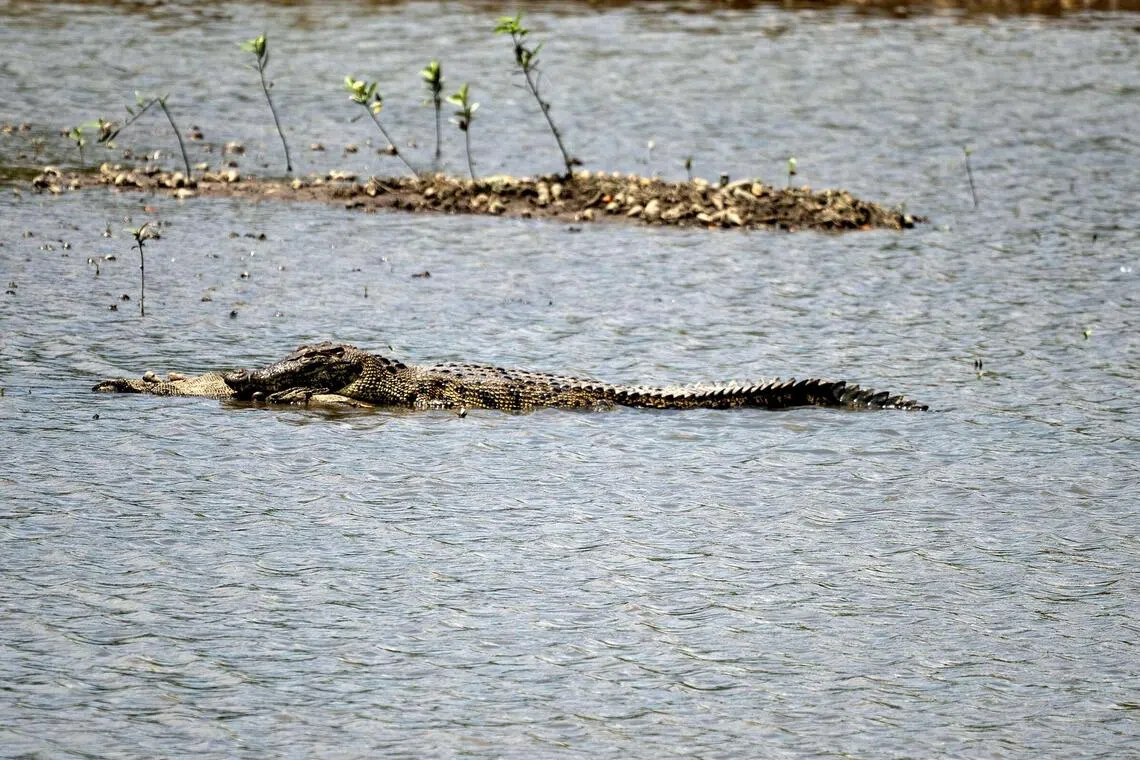
A saltwater crocodile spotted in Sungei Buloh Wetland Reserve. A large crocodile is rumoured to be the new “boss” of the Sungei Buloh territory since the previous dominant male, Tail-less, disappeared.
PHOTO: NPARKS
Sungei Buloh is home to most of Singapore’s crocodiles as its mangroves and waterways offer the most suitable habitat – one that is protected and provides plenty of prey to feed on. There are about 20 crocodiles at any one time, typically consisting of a large male and several smaller females.
Elsewhere in Singapore, they have been spotted sporadically at Kranji Reservoir or recreational areas like Sentosa and Keppel Bay.
According to NParks officers at the reserve, an established male usually tolerates females in his territory and assesses whether another male is welcome.
If an intruding reptile refuses to leave, the established male will bite and possibly kill the intruder, Yang Shufen, director of conservation at NParks, told The Straits Times during a recent visit to the reserve.
Keeping track of these apex predators – and keeping visitors safe – is an ongoing challenge in the densely populated city.
NParks held its first regional crocodile management workshop in Sungei Buloh on Oct 26, bringing together experts from Australia’s Northern Territory, Sarawak, Brunei and the Philippines – areas with larger crocodile populations – to learn more from one another and improve crocodile management methods.
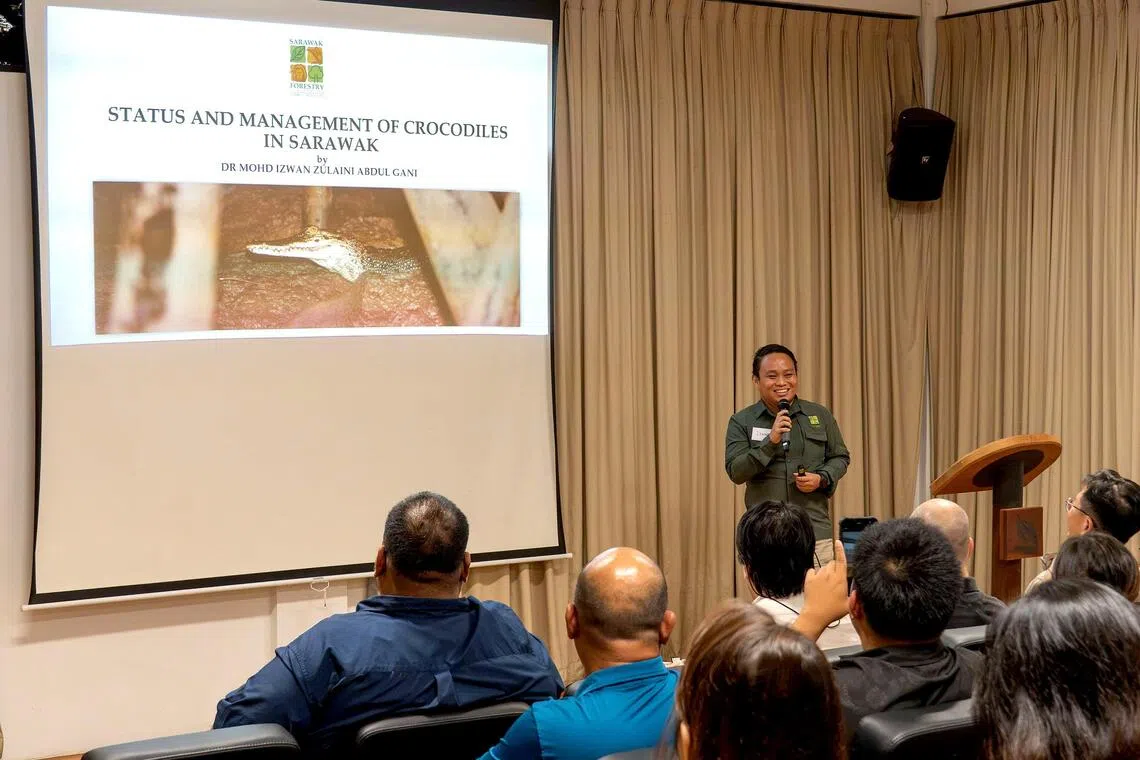
Mohd Izwan Zulaini Abdul Gani, head of the Crocodile Management Section at the Sarawak Forestry Corp, sharing his experience during the regional crocodile management workshop on Oct 26.
PHOTO: NPARKS
Estuarine crocodiles can be dangerous when people live or work near their habitats.
Between 2021 and 2026, Sarawak recorded 65 confirmed attacks, leaving 42 dead and 23 injured.
Recently, a 14-year-old boy in Sarawak was killed in a crocodile attack after being reported missing while loading oil palm fruit into a boat. A villager found his body in the crocodile’s jaws the next night.
In the Philippines, 106 attacks between 2000 and 2026 resulted in 37 deaths and 69 injuries.
Australia’s Northern Territory logged 86 attacks between 1971 and 2026, with 24 fatalities and 62 injuries, while Brunei recorded 21 attacks from 2015 to 2025, resulting in nine deaths and 12 injuries.
NParks director-general Chang Siow Foong said at the workshop that managing crocodiles in an urban setting involves difficult trade-offs, especially when sightings happen near recreational spots.
Chang said: “When a crocodile is found in an area that poses a real risk to public safety, the window for action is often narrow. Options for translocation or rehoming, within Singapore or beyond, are extremely limited.
“Crocodiles are apex predators with strong homing instincts.”
Mohd Izwan Zulaini Abdul Gani, who heads the Crocodile Management Section at the Sarawak Forestry Corp, recounted how his team glued a satellite tracker onto a rehomed crocodile’s head and discovered that the animal found its way back to its capture site within 18 days.
That strong homing instinct in these territorial reptiles is why NParks cannot simply catch crocodiles spotted at places like Sentosa or East Coast Park and release them in Sungei Buloh.
Besides swimming back to busy beaches, a male released into the reserve would likely be attacked by the existing resident male. “It’s almost like placing a guy in a classroom with a bully,” Yang said.
When a crocodile poses a serious risk in a recreational area and cannot be safely rehomed, NParks has to humanely put it down.
On May 6, a crocodile measuring about 2m was spotted in waters off Sentosa Cove and trapped by NParks before being sedated and euthanised later that night. NParks’ group director of wildlife management, How Choon Beng, said the decision was made for public safety as there were no viable rehoming options, ST reported.
During the workshop, Singapore representatives also compared field notes with regional counterparts on nocturnal spotlight surveys – including which torchlights work best for spotting eye-shine – as well as habitat mapping and trapping methods suited to different crocodile sizes.
“After the workshop, I felt very reassured. I was comforted to know that our safety measures were on the right track,” Yang said.
Singapore has not seen any crocodile injuries in recent years, though people can sometimes get too close for comfort.
At Sungei Buloh, officers said visitors often misjudge the risk because crocodiles stay mostly hidden underwater – they can hold their breath for up to an hour and frequently float with just their eyes and snouts above the surface.
Curious visitors would poke their heads through fences to get a clearer look at a reptile perching above the water or try to get as close as possible to capture a selfie.
That is a mistake.
Crocodiles move easily between water and land. When the tide rises, crocodiles can climb over low barriers to reach inland ponds. On land, estuarine crocodiles can lunge rapidly and move in brief bursts, at 17kmh to 18kmh.
“If they can swim across, they will swim,” Yang said. “If not, they will just climb over land.”
To reduce the risk of encounters, NParks has put up railings, low fences and warning signs along Sungei Buloh’s trails, which previously had no barriers when the area was known mainly as a bird-watching site. Even so, officers said some visitors try to climb over barriers for a closer look or hand phones to toddlers to take photos near a crocodile.
NParks advises anyone who spots a crocodile to stay calm, back away slowly and avoid approaching, provoking or feeding it. Visitors should stay behind railings, follow warning signs and report any sightings in Singapore to NParks’ Animal Response Centre.
KioskNews shows a cleaned-up reading view extracted from the publisher’s page — the original always lives on their site, not ours.