Chance discoveries: Wildlife enthusiasts find rare dragonflies after dark
SINGAPORE – The appearances of two rare dragonflies in Singapore – one an all-white spectre of an insect, the other a black specimen belonging to the world’s heaviest dragonfly species – have got some naturalists here buzzing with excitement.
The yin-yang discoveries, both made after nightfall on mainland Singapore, were highlighted in October in local scientific journal Nature In Singapore.
The giant hawker (Tetracanthagyna plagiata), the world’s heaviest living dragonfly, was spotted in August at the Old Upper Thomson Park Connector.
The palm-sized individual with a 14cm-long wingspan is the first male giant hawker dragonfly collected here since 1950, according to one expert. The average dragonfly here tends to have a body length of about 4cm. Wingspans are usually 9cm and below.
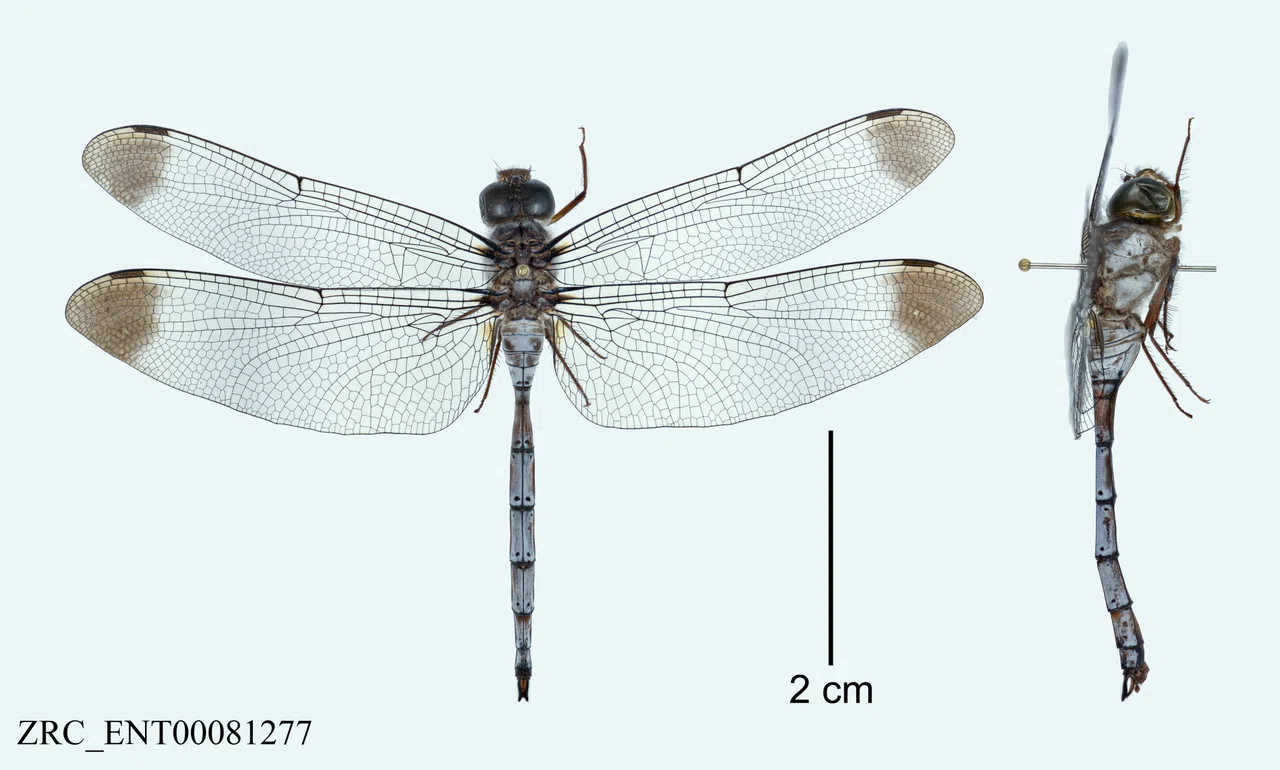
The white duskdarter (Zyxomma obtusum), Singapore’s only fully white dragonfly, was found in a Sungei Kadut home on a July night.
It marked the first time this species has been spotted on the mainland. It was previously thought to be found only on offshore Pulau Ubin.
Dragonfly enthusiasts say the finds show that Singapore’s nature areas could still yield surprises, even though they are so well explored.
The nocturnal behaviour of many dragonflies could also explain why new discoveries about this group of carnivorous insects are still being made, they said.
The Republic is home to at least 139 species of dragonflies and damselflies, collectively known as odonates. Three of them – including the blue midget damselfly (Mortonagrion aborense) – were added to the national list between 2022 and 2025.
In these cases, their existence in Singapore had been uncovered because a nature photographer had spotted something they thought was unusual. Specialists later confirmed the species’ identities.
The giant hawker was spotted on Aug 7 by Bryan Seah and Vivian Seah – two friends unrelated to each other – during a night walk to spot nocturnal wildlife at the Old Upper Thomson Park Connector.
It had been past 11pm when the duo was startled by what sounded like a bird crashing to the ground. They eventually found the dragonfly spasming among debris and leaves. It was not clear what had grounded the insect.
“I recalled seeing a female once four years ago, it was so big that I ran away,” said Bryan Seah, a wildlife photographer, who immediately consulted a friend from the community on the species’ identity.
Despite their attempts to help it take flight, the insect died after half an hour and he submitted the record to the museum.
Marcus Ng, co-author of the 2022 field guide to Singapore’s dragonflies and damselflies, who helped Seah identify the species, said the find was Singapore’s first male giant hawker specimen since 1950.
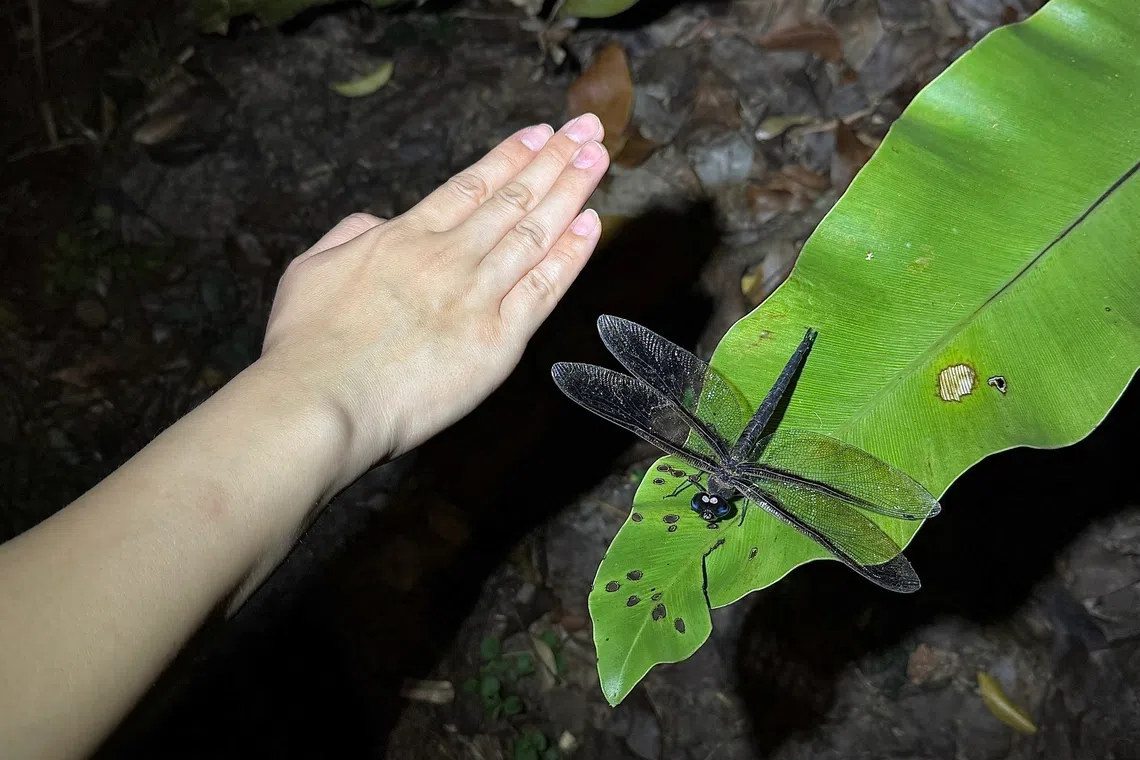
A male specimen of the giant hawker dragonfly at the Old Upper Thomson Park Connector.
PHOTO: BRYAN SEAH
Once thought to be confined to Nee Soon Swamp Forest, the Republic’s last substantial freshwater swamp, the species appears more widespread than once believed, though still tied to healthy forests and streams, said Ng, a freelance writer.
The find gives scientists a fresher look at the male’s physical features, said Ng.
The only other specimen of the giant hawker in Singapore known to him is a decades-old one at the Lee Kong Chian Natural History Museum.
Another specimen at the Natural History Museum in London is in a tattered condition.
“Despite the fact that they’re so large, few people see them, probably because they are active during twilight. They’re quite well camouflaged too, and we suspect they hide very high up in the canopy,” said Ng.
In contrast, females, which can have a wingspan of up to 16.5cm in length, are more often seen as they lay eggs in streams during the day and may perch fairly low.
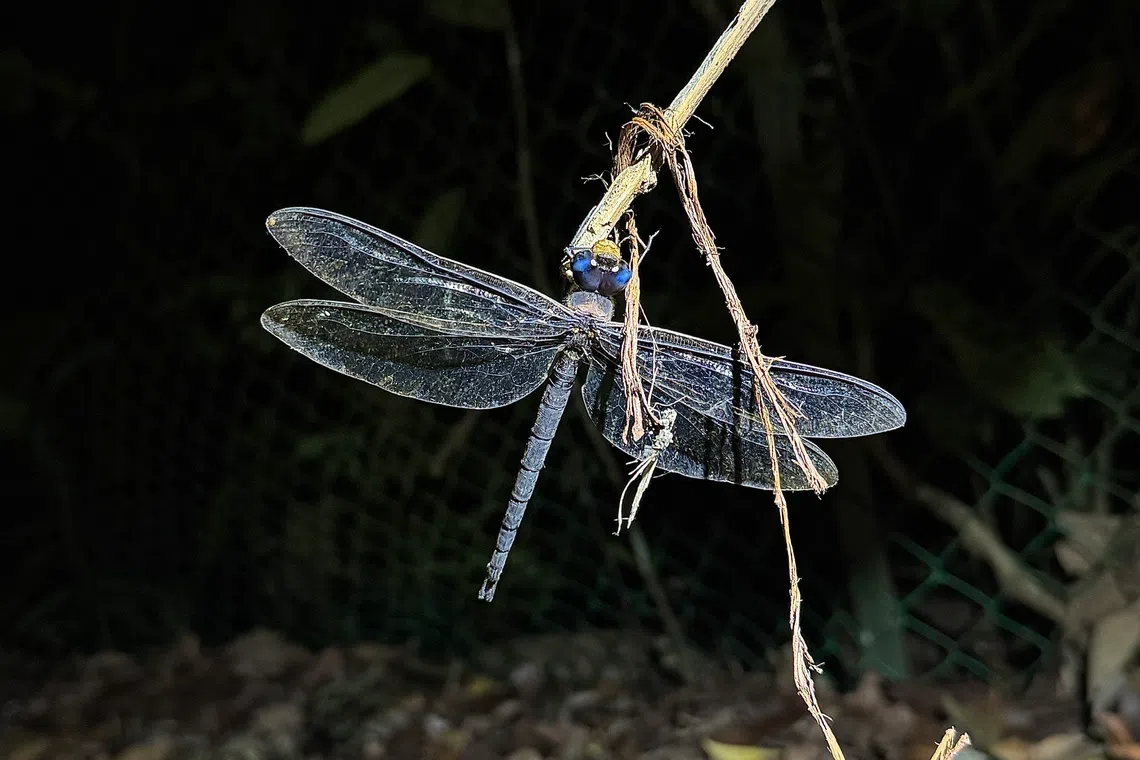
The white duskdarter (Zyxomma obtusum), Singapore’s only fully white dragonfly, was found in a Sungei Kadut home on a July night.
PHOTO: BRYAN SEAH
On the discovery of the white duskdarter on mainland Singapore, the insect was found in a Sungei Kadut home at 8pm by entomologist (insect scientist) Ang Yuchen, who had “a notion that it was significant”.
He then handed it to his fellow insect specialist Lumin Ong.
Ong, who preserved the specimen as a first for Singapore’s collection, said his jaw dropped when he was handed the insect.
Its absence from the mainland had long been a puzzle for dragonfly enthusiasts, given that the species thrives in disturbed forests and semi-urban habitats in Malaysia.
“The white duskdarter’s existence on the mainland has always been a hunch... so the confirmation should be met with a celebration,” said Ong.
Like the giant hawker, the white duskdarter is believed to be harder to spot because it is active mainly during twilight hours.
PHOTO: HOU YUNHAN
For biodiversity consultant Robin Ngiam, who co-authored the 2022 dragonfly field guide, the discovery raises the prospect of an unrecorded mainland population, potentially spilling over from the nearby forests in Mandai or the Rail Corridor.
Like the giant hawker, the white duskdarter is believed to be harder to spot because it is active mainly during twilight hours.
It also has a tendency to perch deep in vegetation. In this case, the specimen appeared to be drawn by lights inside the house.
Ong and Zick Soh, who co-authored the white duskdarter finding, said the species could have arrived on mainland Singapore after dispersing from larger populations in the region.
But this species could have faced difficulty competing with more dominant and common dragonflies on the mainland for food and space.
Ong and Soh, an HR business partner, said these chance discoveries highlighted how Singapore’s knowledge of odonates relied on vigilant nature observers rather than formal scientific studies.
And while many dragonfly watchers tend to be active in daytime hours between 9am and 5pm, the new night-time finds could compel the community to do later surveys.
“A few dusk sessions at forest edges and swamp-forest pools, plus a look at lit buildings that back onto nature areas, would go a long way,” said Ong and Soh.
KioskNews shows a cleaned-up reading view extracted from the publisher’s page — the original always lives on their site, not ours.