Rare condition leaves teen’s nerves without protective covering, slowing nerve signals
SINGAPORE – When secretary Dawn Lee was in her 29th week of pregnancy 16 years ago, she suffered a fever of 42 deg C and had to undergo an emergency caesarean.
“When I asked the nurse to bring my baby Jarren to be breast-fed, I was told he was in intensive care and had been diagnosed with a genetic condition,” Lee, 45, said.
His father, Kelvin Ng, remembered that the baby was in an incubator and receiving oxygen when he first set eyes on him.
“When I picked him up to carry him, he was very floppy, unlike his older brother Junius. He was then quickly pushed into NICU (neonatal intensive care unit),” recalled the 46-year-old information technology engineer.
Koh Ai Ling, a consultant with the Department of Genomic Medicine at KK Women’s and Children’s Hospital (KKH), said Jarren had low muscle tone, or hypotonia, at birth and needed breathing and feeding support.
It was initially thought that Jarren had muscular dystrophy, a genetic disorder that causes progressive muscle weakness, loss of muscle mass, and impaired mobility over time. However, his battery of tests pointed to a different diagnosis.
Koh said: “(Jarren) underwent various investigations, including blood investigations, brain imaging, muscle biopsy, electromyography (a test that measures muscle and nerve activity), a nerve conduction study and genetic testing. It was his nerve conduction study that was suggestive of congenital hypomyelinating neuropathy (CHN).”
She said CHN is a rare neurological disorder that affects the function of the peripheral nerves, which carry signals between the brain, spinal cord and the rest of the body.
“In CHN, the protective covering around the nerves, called myelin, does not develop normally. Myelin acts a little like the insulation around an electrical wire, helping nerve signals travel quickly and efficiently. When myelin is missing or poorly developed, nerve signals can be slowed or disrupted.
“Affected individuals may experience muscle weakness, low muscle tone, and breathing or swallowing difficulties,” Koh added.
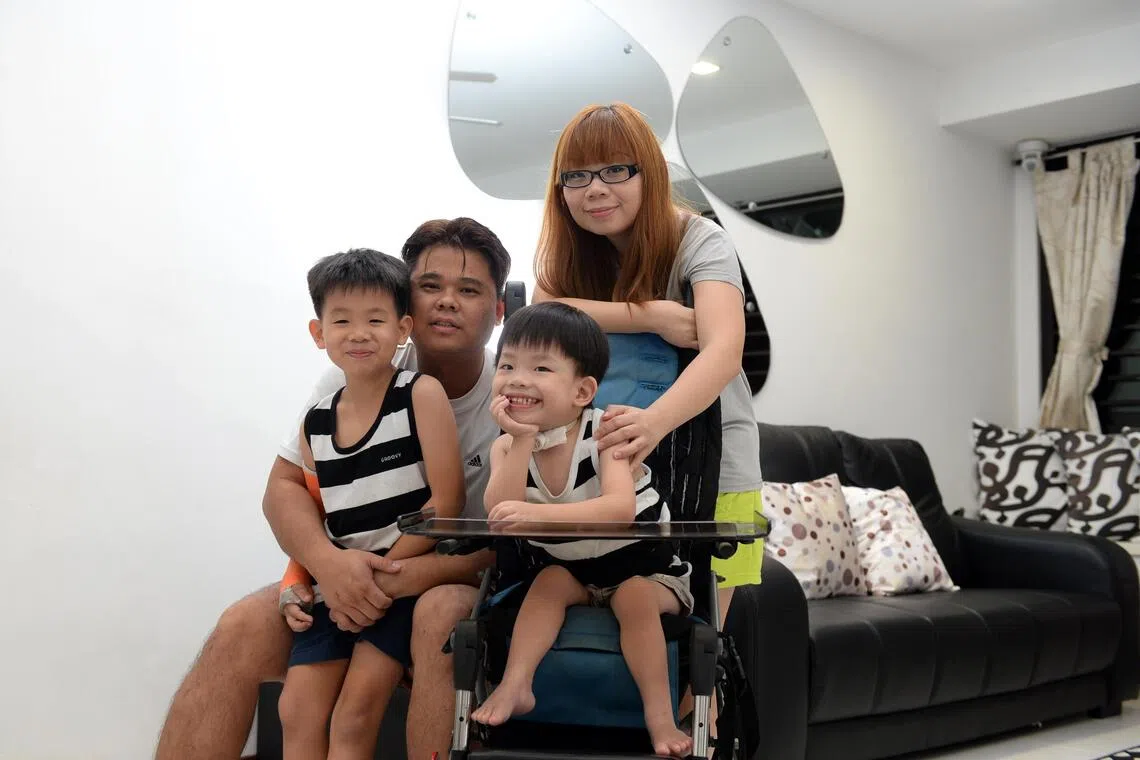
By the age of six, Jarren (in the wheelchair) had already been through 14 operations.
PHOTO: ST FILE
Lee said Jarren was frequently admitted to ICU, with each stay lasting months.
CHN is extremely rare, occurring in fewer than one in a million live births globally. There is no routine antenatal screening test specifically for the condition, as its symptoms can overlap with those of many other conditions, Koh said.
“In more severe cases, doctors notice signs during pregnancy or soon after birth. Reduced fetal movement, low muscle tone or weakness in a newborn may raise concerns about a neuromuscular disorder. (But) the severity can vary.
“Some babies show obvious weakness from birth, while others initially present with subtle signs that may go undetected. This means the diagnosis requires putting together several pieces of information over time,” Koh explained.
If a particular genetic cause is already known in a family, prenatal genetic testing may be possible. However, in Jarren’s case, Koh said the various genetic tests performed did not identify a genetic cause.
A condition with no cure
Like many rare genetic disorders, Jarren’s condition has no cure.
He was tube-fed through a nasogastric tube until he was two, when he underwent an operation to insert a PEG feeding button into his stomach. This is a short, flat feeding device that sits against the skin of his abdomen.
He also underwent a tracheostomy procedure that same year, and, due to the severity of his condition, Jarren relies on a ventilator for respiratory support, which is monitored by his respiratory physician.
He undergoes a sleep study every year to monitor his sleeping issues, especially at night, so that the doctors can adjust his ventilator settings when required.
Jarren is under the care of a multidisciplinary team from the Children’s Complex and Home Care Services, including allied health specialists in physiotherapy, occupational therapy, speech and language therapy and dietetics.
His main doctor, senior consultant Cristelle Chow of the General Paediatrics Service (Children’s Complex and Home Care Services), said: “The active interventions for Jarren include nocturnal ventilator support through a tracheostomy and a motorised wheelchair.
“The therapists regularly assess his physical and mobility needs, as well as the support he may need with everyday activities such as dressing, bathing, eating and moving around. A dietitian addresses his nutritional needs, which change as he grows older.”
Chow, on the other hand, looks after his general health and routine care needs, such as vaccinations, school and psychological needs, and physical symptoms.
Defying the odds
Jarren currently undergoes an annual microlaryngobronchoscopy, a procedure that uses a tiny camera and scope to examine the inside of a patient’s breathing passages. The procedure may not be needed when he becomes an adult.
While some medical literature says that, depending on the severity of the condition and the specific genetic mutation involved, some babies with CHN do not live past the age of three, Jarren has beaten those odds.
At 16, having completed his N-level exams, Jarren hopes to pursue a career in cybersecurity “to defend Singapore from cyberattacks”, he said.
“I am also looking forward to making new friends at ITE (Institute of Technical Education) next year.”
KioskNews shows a cleaned-up reading view extracted from the publisher’s page — the original always lives on their site, not ours.