‘I’m not a dangerous woman’: how retirees Sandra and Marlene became the faces of hate speech laws in Queensland

Sandra Keller, 75, and Marlene Grace, 72, are the faces of hate speech in Queensland, according to the Crisafulli government. Last week, both retirees were surrounded by police and arrested for “distribution, publication or display of a prohibited symbol”, as was Marlene’s 76-year-old husband, Paul.
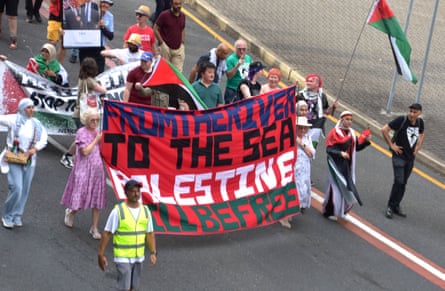
For both women it was their first time being arrested. Their crime: carrying a banner that read “from the river to the sea, Palestine will be free” through the streets of Brisbane at a permitted rally last Sunday.
Police allege the two retirees, one a retired mental health counsellor and the other a cardiac nurse, caused a person to feel “menaced, harassed or offended” by their use of the slogan.
They are the latest of more than 40 people arrested, accused of breaching Queensland’s Fighting Antisemitism and Keeping Guns out of the Hands of Terrorists and Criminals Amendment Act 2026.
“I’m the most law-abiding person. I’ve never had a speeding ticket. I’ve never had a parking fine,” Grace said.
“I’m not a dangerous woman. I look after my grandchildren. I’m looking after my grandson today. I look after another one tomorrow. My children wouldn’t have me looking after their children if I was a danger”.
Both vow to do it again.
Keller said she took the action because she was “upset and concerned about the mutilation of children and the destruction in Gaza” and to protest against the legislation for restricting her free speech. Both deny their actions were hateful.
“[The prohibited expression] can’t possibly be hate speech. I wasn’t saying anything hateful against anybody at all,” Keller said.
“Palestinians have a right to live on that land. That’s what that means to me”.
In the eight months since the law went into effect, 37 protesters have been charged for hate speech under the legislation. Others, like Keller and Grace, have been cautioned after their arrest due to a lack of a criminal record.
The oldest is 77, the youngest 18.
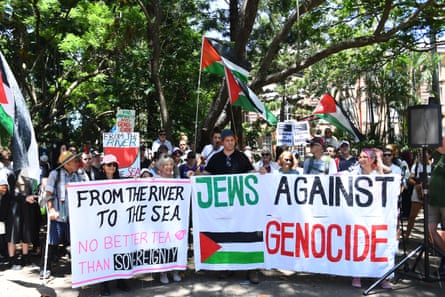
Two of the people accused of antisemitic hate speech are Jewish.
Justice for Palestine Magan-djin are challenging the law in the high court, arguing it is an unconstitutional restraint on their right to free expression. On Friday, the matter was briefly mentioned in the high court. The government argues the laws are constitutional. The matter will now likely be heard there in the middle of next year.
Justice for Palestine Magan-djin lead organiser Remah Naji – the lead plaintiff in the high court challenge – said Keller and Grace were ordinary people trying to express their political views peacefully.
“In a context of genocide when people are getting massacred, when hospitals and schools and universities are being bombed and flattened to the ground, we are asking if someone’s words can be harmful to people. I think it’s insane to even think it”
Rushed into law
The attorney general, Deb Frecklington, told parliament earlier this year that there were three elements of the law “which ensure it does not unreasonably limit freedom of expression”.
First, the legislation did not prohibit “expressions which closely resemble a prohibited expression”, just the two common slogans used by the Palestine movement enumerated in the act, Frecklington said
The rarely used slogan “globalise the intifada” is also banned; saying or displaying either is punishable by up to two years’ jail.
after newsletter promotion
That’s only illegal if doing so makes a person feel “menaced, harassed or offended”, something Frecklington described as a “high bar,” citing a high court case that found that the clause only banned conduct “calculated or likely to arouse significant anger, significant outrage, disgust or hatred in the mind of a reasonable person in all the circumstances”.
It is also not illegal to use the slogan to argue against its use.
Third, the act also establishes a range of defences allowing people to say the banned words for genuine artistic, religious, educational or historical purpose, or in the public interest, such as during a “genuine public dispute”.
Passed in response to the Bondi terrorist attack, after months of behind-the-scenes work, the legislation was rushed into law in March, with just seven days set aside for public comment.
In response to a right to information request by the Guardian for documents relating to the Bondi terrorist attack or the development of the legislation, the department found more than 125 folios of documents but has been banned from releasing any of them for 10 years on the basis that they are cabinet documents, a practice that was heavily criticised by the government in opposition.
The law has proved remarkably easy to evade for those who want to. Protesters routinely turn up to rallies with the banned slogan written in Swedish or Indonesian, replace a single word in the sentence with a rhyming one or reverse the order of “river” and “sea” to chant it legally.
But they haven’t protected everyone.
The Guardian has observed two protesters being threatened with arrest for signs bearing the wrong expression.
Many have claimed a defence, such as Liam Parry, who used the slogan to explain what he said was its history at a rally in March. He was arrested and charged anyway. At most rallies, every person using the expressions is arrested.
Keller said one of the great ironies is that many of the arrests have taken place at Brisbane’s Emma Miller Place, a park in the city CBD.
It is named for a suffragist who was so outraged by a brutal police crackdown on peaceful protesters during the 1912 Brisbane general strike that she assaulted police commissioner William Cahill with a hatpin, causing him to be thrown off his horse. She was 72.
Keller said she was inspired by women like Miller and Merle Thornton, a feminist honoured with a statue this week for chaining herself to a Brisbane bar to fight for an equal right to drink.
“I wanted to stand up just the same as those women, for what I believe in. I have that right,” she said.
KioskNews shows a cleaned-up reading view extracted from the publisher’s page — the original always lives on their site, not ours.