Fahadh Faasil on Don’t Trouble the Trouble: ‘It is a kids’ film for grown-ups’
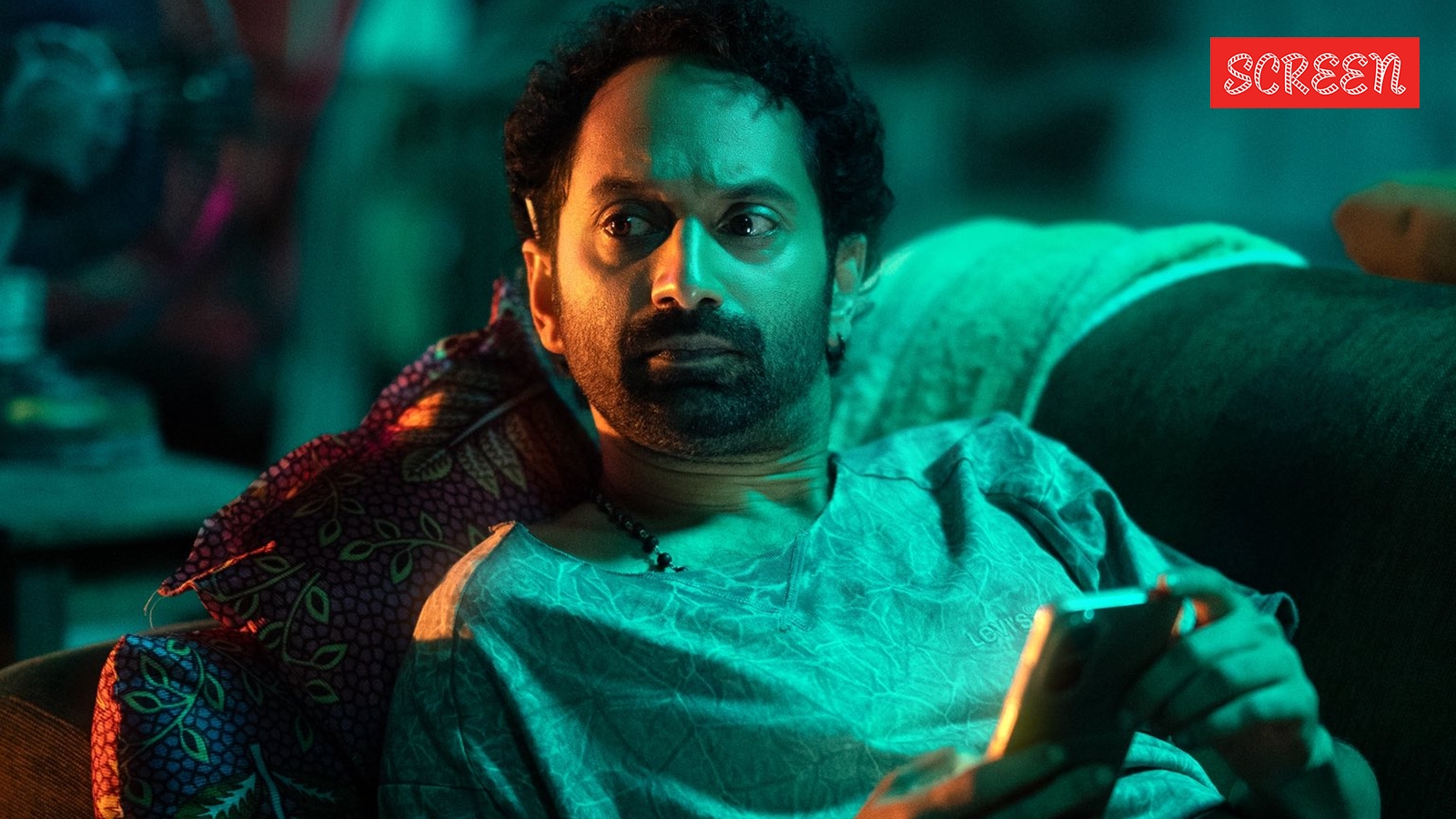
Fahadh Faasil thought in Malayalam, converted the thought to English, and then performed the line in Telugu. He did this for every single dialogue across 79 real locations in Hyderabad over a year and a half of production. He refused to use prompting on set, insisted on dubbing his own lines and brought the sync-sound discipline of Malayalam cinema to a Telugu production that was not built for it. The result is Don’t Trouble the Trouble, his first Telugu film as a solo lead.
In an interview with SCREEN, Fahadh shared the challenges he faced while shooting for Don’t Trouble the Trouble. Having performed exclusively in Malayalam throughout his career, Don’t Trouble the Trouble required him to carry an entire film in Telugu as the solo lead.
“The biggest challenge was thinking in Telugu. I think in Malayalam. Then convert to English. Then perform in Telugu. This is all not very smooth. So primarily the challenge was to start thinking in the language. Discovering words. Discovering the language itself. I was very particular that I wanted to dub, I wanted to do the lines myself. Back home we do sync sound. So we have to learn our lines. I made sure we function that way here also. There was no prompting on sets. We shot in Telugu,” Fahadh Faasil said.
Malayalam cinema operates almost exclusively on sync sound, where dialogue is recorded live on set, requiring complete silence from the crew. Telugu cinema traditionally dubs dialogue in post-production, which allows for more noise on set during shooting. Hence, Fahadh brought his Malayalam discipline to a Telugu set. “While we didn’t do sync sound specifically, I made sure we brought something of that sort here. The only thing I told them is I function with a small group. Let’s try and do that,” he said.
Recalling his first impression of Don’t Trouble the Trouble’s script, Fahad said, “Honestly, I felt like I was hearing a story like this in my life for the first time. I have never heard anything like this before.”
He explained that his Malayalam films tend to operate in a very different register. “My movies back home are very subtle. The drama is less. So I wanted to try out something in another space. And this just fell in place. There are so many talented actors here and they came to me. I didn’t want to lose that opportunity.”
 Fahadh Faasil in a still from the film Don’t Trouble the Trouble.
Fahadh Faasil was careful to clarify that Don’t Trouble the Trouble’s appeal goes beyond its fantasy elements. “The film is all about love. The film is all about concern. The film is all about care. Magic or being invisible, these are all elements. But the film is much deeper and more rooted than all these,” he said.
Story continues below this ad
When asked to define the genre, he introduced a term he said he had coined himself: “A kids’ film for grown-ups. It brings out the kid in the adult.”
What Telugu cinema taught him
Fahadh Faasil pointed to Telugu cinema’s approach to taking films to a wider audience. “I think Telugu cinema takes a lot of effort. At least in the last five, six years, it made great efforts to take the film outside the country to various other countries. It has to do with planning. It has nothing to do with the creative scope or the quality of your film or the stars. It just needs proper planning.”
Also Read: How Fahadh Faasil delivered an acting masterclass across three distinct characters in 2019
He said he hopes to apply the same distribution thinking to his Malayalam productions. “Hopefully, I will explore that for my Malayalam films also,” the actor-producer said.
Story continues below this ad
Fahadh Faasil said he did not face any difficulty shooting in crowded real locations across Hyderabad, including areas like Secunderabad and near the Industrial Exhibition grounds, because he has never worked any other way.
“I am trained to performing in real locations. Back home, there are no studios or anything. So we shoot in real locations. I always prefer shooting in real locations. Pushpa is the first film that I have shot in a controlled environment. So that’s one more thing Telugu cinema has taught me to do,” he said.
Writer or director?
When asked about the ongoing conversation around Malayalam cinema giving more credit to its writers than other industries, Fahadh Faasil replied, “I believe writers are perhaps more important than the actor. And I have functioned like that in my films. I rely on my director and writer a lot.”
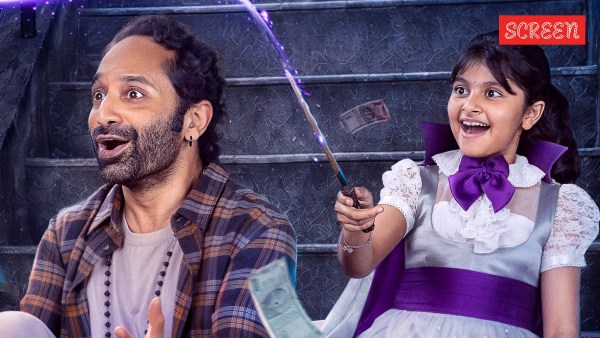 A still from the film Don’t Trouble the Trouble.
Describing his working dynamic, he said, “I hold my right hand to the director and my left hand to the writer. I go in tandem with them.” For Don’t Trouble the Trouble, writer-director Shashank Yeleti and co-writer Hamza Ali filled both roles. “For me, it was like doing a film back home. It was with my family and friends. I was as comfortable as that,” Fahadh said.
Story continues below this ad
On working across industries
Throughout Fahadh Fassil’s career, he has been navigating between Malayalam, Tamil and Telugu cinema, and he thinks each collaboration is a discovery. “When I worked with Kamal Hasaan, it was a discovery itself. The way he processes, the way he performs, the way he deals with his actors. There is so much to learn from any talent that you collaborate with. Everyone has their own technique. It’s like cooking. You may not cook the way she cooks, but your food will taste good. Every artiste will have a technique. It’s very interesting to watch it closely and discover it.”
On his character Suri
In Don’t Trouble the Trouble, Fahadh Faasil plays Suri, a street magician and con artist living in Hyderabad whose life changes when he encounters a young girl named Divya, played by Ssara Palekar. He said what attracted him to the character was the moral journey. “The character has a very interesting journey from grey to white. That journey is very interesting. In that journey, you see the magic, the fantasy, the love, everything,” he said.
Also Read: Fahadh Faasil ‘mediocre’ in Patriot? Even Mammootty, Mohanlal couldn’t save it
On his production track record
As a producer under his Fahadh Faasil and Friends banner, he has backed several of Malayalam cinema’s biggest recent hits, including Bethlehem Kudumba Unit, Premalu and Aavesham. Asked whether he anticipated the scale of their success, he was candid. “I knew Bethlehem Kudumba Unit would be a hit. But not this big. I didn’t think Aavesham would be this big. I do not have a type while selecting a script. The only thing I can judge is whether people like it or not. The rest of it is bonus,” he said.
Story continues below this ad
The actor-producer added, “I won’t start a film without a beginning, midpoint and end. These three aspects need to be in place for me to start shooting. Once you have that structuring, then you play around.”
Fahadh Fassil then offered an analogy that captures his entire philosophy of filmmaking. “Making a film is just like playing a cricket match. You don’t know if you are going to win or lose. The idea is to have fun.”
On his career journey
Fahadh Faasil, who debuted in 2002 with the Malayalam film Kaiyethum Doorath, also reflected on the path that brought him here. His first film flopped, and he left India for America, where he had a philosphy scholarship. “I did my engineering here. I was about to leave to America to pursue philosphy. I had a scholarship. I went there. The pain of losing kept bothering me. Maybe at that point I thought I was going to be in America for the rest of my life,” he said.
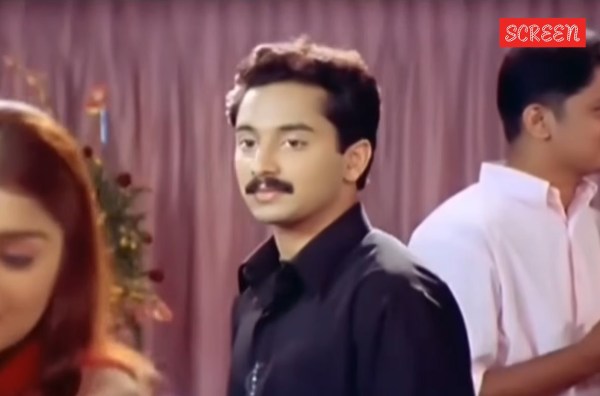 Fahadh Faasil in Kaiyethum Doorath. (Screenshot: YouTube/CentralTalkiesmovies)
Fahad did not return for six years. In that time, he discovered world cinema, read widely and met people who changed his perspective. “Those six years triggered the want to come back and do one film and maybe go back. One film became 66 films,” he said.
Story continues below this ad
Fahadh Faasil confirmed he has signed one more Telugu film with Arka Media Works which will be his next project, starting next year.
Don’t Trouble the Trouble is produced by Shobu Yarlagadda, Prasad Devineni and SS Karthikeya under Arka Media Works and Showing Business, with music by Kaala Bhairava, cinematography by Brad Francis and editing by Praveen Anthony. It releases on October 2 in Telugu, Tamil and Malayalam.
KioskNews shows a cleaned-up reading view extracted from the publisher’s page — the original always lives on their site, not ours.