Assam boy, 12, turns Rs 500 into mushroom business, earns Rs 3,000 from 12kg
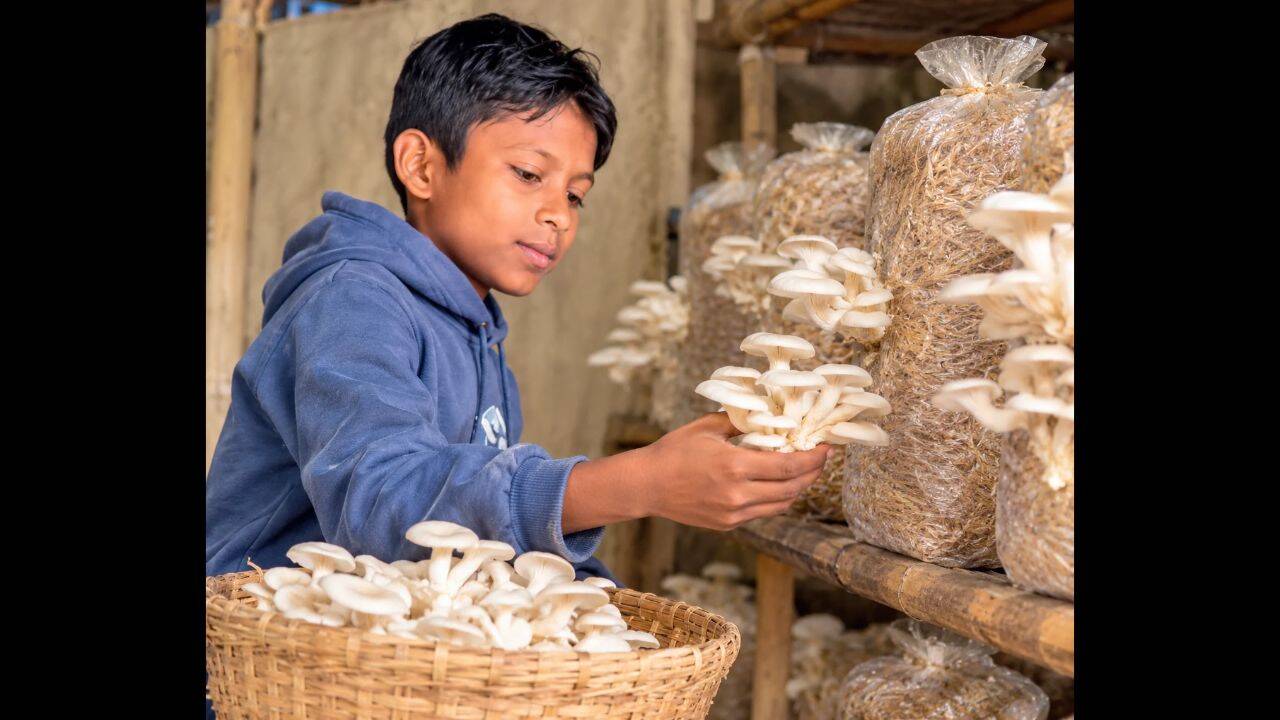
Krishna Hazarika turned a Rs 500 investment into a mushroom business (AI-generated)
While students generally attend vocational training courses as part of their regular learning experience at school, Krishna Hazarika, a Class 7 student turned one such session into an income-generating venture.
Hazarika is a student at Bogidole High School in Sivasagar, Assam. As per Akshar Foundation, which conducted the training, Krishna invested some Rs 500 in mushroom cultivation. He prepared 40 growing cylinders and harvested nearly 12 kg of mushrooms by March 2026 and sold the produce in the local market for Rs 3,000.Let’s find out more about his incredible journey
The young boy attended a series of vocational training sessions organised by Akshar Foundation between November 2025 and January 2026.
During the sessions, he learned about mushroom cultivation which gave him an opportunity to understand how the agricultural activity could become a source of livelihood.After learning the process, he decided to experiment with the skill at home and discussed it with his parents. They encouraged him to give it a try. As per the foundation's account, Krishna started with approximately Rs 500 and prepared 40 mushroom-growing cylinders.
By March 2026, his efforts had yielded close to 12 kg of mushrooms. Rather than keeping the produce for household consumption, Krishna took it to the local market and sold it for Rs 3,000.Family’s supportBehind Krishna’s success is his family support. The foundation's account mentions that Krishna belongs to a family of four living below the poverty line. His father works as a carpenter, and the household depends largely on his daily wages.

Krishna with his mother
In such circumstances, even a modest additional income can make a huge difference. Krishna's mushroom venture was therefore more than an experiment in growing food. It became an opportunity for him to contribute towards his family's income.Family support is important because starting something new often requires encouragement.Why mushroom cultivation can be a practical livelihood skillMushroom cultivation is increasingly being explored as a livelihood opportunity because it does not necessarily require large agricultural landholdings.Unlike conventional farming, certain varieties of mushrooms can be grown in relatively small spaces using agricultural residues such as paddy straw. This makes the activity accessible to people who may not own large farms or have access to extensive agricultural resources.According to the Assam government's Department of Agriculture, oyster mushroom cultivation is particularly suitable for the state's climatic conditions.
The department also notes that oyster mushrooms can be cultivated for several months of the year in Assam.For students like Krishna, learning such skills at an early age can provide an introduction to agriculture, entrepreneurship and self-employment.More about Akshar FoundationKrishna's experience also draws attention to the work of Akshar Foundation, an organisation working to introduce practical and skill-based learning into schools in Assam.
Its education model combines foundational literacy and numeracy with vocational training, digital literacy, peer learning and environmental awareness.The approach is based on the idea that education should equip children with practical abilities alongside academic knowledge. Students are introduced to activities that connect classroom subjects with everyday applications, helping them understand how different skills can be used outside school.
A small beginning
Freshly harvested Oyster mushrooms (Canva)
Krishna's story is not about a large startup or big financial backing. It happened with a school training programme, an investment of around Rs 500 and the willingness to try something new.The fact that he managed to harvest and sell mushrooms while still in Class 7 makes the achievement particularly interesting. His experience also demonstrates the importance of giving children opportunities to explore skills that can have practical applications in their communities.For Krishna, the next step could be expanding his mushroom cultivation venture with the support of his family.
KioskNews shows a cleaned-up reading view extracted from the publisher’s page — the original always lives on their site, not ours.