UK poised to miss reduced aid spending target of 0.3% of national income
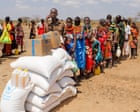
The UK is on course to miss its target of spending 0.3% of national income on international aid by an estimated £400m by the end of next year.
Calculations from the Center for Global Development (CGD) found the UK was on course for a large shortfall in promised official development assistance at the end of 2027.
The researchers said the central forecast from the Treasury’s comparison of independent experts implied UK aid would be £410m less than anticipated – at only 0.29% of national income.
However, they said it was “very plausible” that the shortfall would be £580m, at only 0.28% of national income. Even the most conservative forecast implies a £250m shortfall, according to the estimates.
Ian Mitchell, a senior fellow at the CGD and co-director of its Europe programme, described these as “material shortfalls in the spending power of UK aid”.
Making up a shortfall of even £400m would be enough to halve cuts to Africa that are likely to cost thousands of lives and mean the UK’s de facto exit from the south and east of the continent, he said.
The CGD attributed the shortfall to higher than expected inflation, which means national income will be higher than forecast at the spending review, and a 2025 policy change around the Foreign, Commonwealth and Development Office (FCDO) budget.
The researchers called on ministers to consider allocating additional funds to international aid in this week’s budget, to avoid the embarrassment and criticism from missing a target.
The 0.3% spending target for 2027 is far below the 0.7% promised in Labour’s election manifesto, having been downgraded by Keir Starmer to boost spending on defence.
Fleur Anderson, a former minister who sits on the foreign affairs select committee, said she would like to see higher spending on development aid in the budget.
She said: “I’d like to see this government going further and reversing these cuts altogether in time, but at the very least we should be hitting the reduced target that was set.
“Falling short isn’t an abstract accounting issue. It means communities not having clean water, girls pulled out of school, vaccines that don’t get delivered, peace programmes in war zones cut.
“The upcoming budget presents real opportunity for the Treasury to address this and for the government to show that its words on Britain’s place in the world are matched by action.”
after newsletter promotion
Charities have repeatedly said that the government’s deep aid cuts will hit children’s education and increase the risk of disease and death in some African countries.
The latest figures released by the FCDO in September showed that British aid cuts under Starmer’s government hit the world’s poorest countries the hardest, while higher-income countries’ share of aid increased. The data showed a 6.7% decrease in funding to the least-developed and low-income countries, amounting to cuts of £118m.
The UK’s overall official development assistance (ODA) budget in 2025 decreased to 0.44% of gross national income, compared with 0.5% in 2024, a drop of £987m.
The government has prioritised spending through multilateral agencies such as the World Bank’s development arm, the International Development Association, and the global vaccines initiative Gavi. It has also continued to fund humanitarian support.
The Conservative party and Reform UK have pledged to slash aid even further, from about £9bn a year to £1bn – a level that would leave the UK unable to cover existing contributions to the UN and World Bank.
An FCDO spokesperson said: “The publication of the FCDO multi-year ODA allocations in March 2026 set out our spending plans and priorities for the next three financial years based on GNI [gross national income] at the time of the 2025 spending review.
“Moving to a fixed budget reduces volatility and provides the necessary stability to deliver high-impact aid programmes.”
KioskNews shows a cleaned-up reading view extracted from the publisher’s page — the original always lives on their site, not ours.