How Xi Jinping’s sweeping military purge echoed at a top Chinese leaders’ meeting
At the conclusion of a four-day closed-door meeting of senior Chinese Communist Party (CCP) leaders on Thursday (October 29), it was difficult to miss the main messaging that emerged — “full and rigorous party self-governance”.
Underneath the jargon commonly spotted in official communiques was the goal that CCP general secretary and Chinese President Xi Jinping has pursued over nearly 15 years in power: ridding the Party of corruption. Of late, however, it has taken the shape of major leaders being removed across key bodies, including military ones.
The recent meeting, known as the Fifth Plenum, saw a record number of members expelled. It also saw the elevation of General Zhang Shengmin into the Politburo, which is a 24-member body of top party leaders.
In January this year, General Zhang Youxia, holding the top rank in the People’s Liberation Army (PLA), was purged from the Central Military Commission (CMC) — China’s apex military decision-making body, involved in procurement, testing and other key functions. Nearly all of the CMC’s top leadership have come under corruption investigations in recent years, and only Zhang Shengmin and Xi remain now.
And it’s not just the CMC. Suyash Desai, a Non-Resident Fellow at the Foreign Policy Research Institute in Philadelphia and an analyst of the Chinese military, told The Indian Express that within the PLA, “over 55% of its top leadership (three-star and above) has been purged” to date. The fact that the purge has affected “every section of the PLA” makes it unique in terms of its scale, scope, and nature, he added.
Major gaps
Since Xi assumed power as the general secretary of the CCP in 2012, he has described tackling corruption as a top priority. In fact, his first few years also saw senior military leaders purged, including CMC Vice Chairman Guo Boxiong, who was then the highest-ranking general to ever face a corruption charge. He is currently serving a life sentence.
Initially, some analysts in the West saw the campaign as a means for Xi to remove rivals and consolidate power, but over the years, not even his loyalists and appointees have been spared. The campaign has taken the shape of sudden removals and investigations.
Story continues below this ad
Defence has increasingly come under focus. Key posts are now vacant (see chart) in many top bodies, while others have witnessed a churn. Five of the seven CMC positions remain unfilled, and while the political head of defence has historically been part of the body, current Defence Minister Admiral Dong Jun has yet to be made a member.
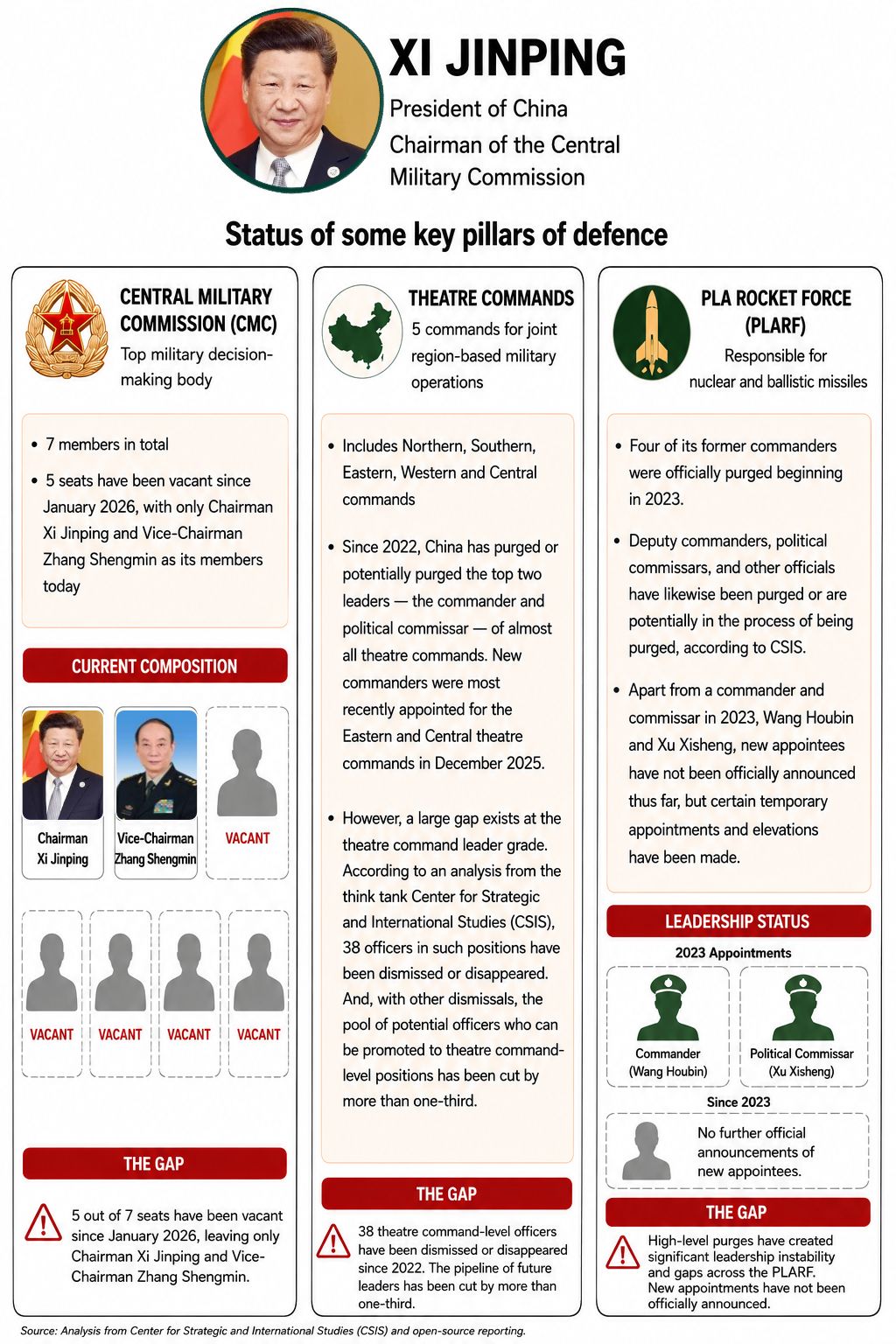 Key military institutions within China have witnessed purges of late. (Graphic generated using AI)
In May, former defence ministers Wei Fenghe and Li Shangfu were sentenced to death with a two-year reprieve (meaning the sentence would be converted to life imprisonment after that period) over graft charges.
Desai said that across the five theatre commands, almost all commanders and commissars (who handle major political responsibilities) have been purged on multiple occasions over the past three years. He added that this also includes the Eastern and Western Theatre Commands, which are responsible for Taiwan and India, respectively.
Anushka Saxena, a Staff Research Analyst at the Takshashila Institution in Bengaluru who tracks the PLA, also laid out the case of the PLA Rocket Force. Responsible for managing China’s conventional and nuclear missiles, the force saw senior leaders removed in 2023. Ex-defence ministers Wei and Li had ties with the PLARF, too.
Story continues below this ad
Saxena termed it the “pillar of China’s long-range strategic deterrent and the arm that would open a campaign against Taiwan and threaten US naval vessels”. “After former PLARF Commander Li Yuchao was pulled in 2023 and replaced by Wang Houbin, who was parachuted from the Navy, Wang himself was expelled in October 2025… the PLARF has been decapitated twice in barely two years, and no successor commander has surfaced in public since,” she told The Indian Express.
Why the removals matter
Desai said, “There are direct implications of these purges for military operations and effectiveness… For instance, the PLA’s operational textbooks divide the Taiwan contingency scenario into three parts: Joint Strike, Blockade, and Amphibious Landing Operations. The Joint Strike is the first operation led by the PLARF to clear the ground for the invading Chinese forces. However, these purges have set back the PLA’s operational effectiveness by a few years.”
Saxena added that when seen in relation to the PLA’s equipment development ecosystem and the removal of leaders at major defence State-Owned Enterprises, it is clear that layers of dishonesty run deep. “The command architecture for a joint operation has been altogether disrupted at the top. That is corrosive to the trust, continuity and rehearsed coordination on which jointness actually depends,” she said.
Apart from the military, another senior figure to have been abruptly removed was Qin Gang, the Foreign Affairs Minister who served a tenure of less than a year and was one of the youngest people ever appointed to the post. His ouster was suspected to be linked to personal reasons rather than corruption, but it again raised questions about Xi’s picks.
Story continues below this ad
With his rise, Xi at times elevated officials with links to two major factions in Chinese politics — the so-called Shaanxi and Fujian “gangs”. These are the names of the two provinces where Xi has served, the former during the Cultural Revolution and the latter as Governor.
While the CMC’s Zhang Youxia was part of the Shaanxi grouping, other purged CMC members, including He Weidong and Miao Hua, were part of the Fujian gang. Factional rivalries have previously been cited as a potential driver for the purges.
Yet another probable theory for the sudden revival in purges in the last few years is the question of Taiwan. Several US analysts have argued that Xi wants the PLA to be ready for a potential battle scenario by 2027 — the centenary year of the PLA’s founding, and when Xi seeks a record-extending fourth term as general secretary of the CPC at another major party meeting next year. Xi has also earlier stated the goal of turning the PLA into a “world-class” military by 2027.
However, Desai was of the view that these theories only made sense up to a certain point: “It is very clear now that the purges are not related to any single contingency, since all theatre commands are affected and all factions are chopped.”
Story continues below this ad
The most likely explanation for these purges, he said, was the corruption within the PLA. While Xi ordered several rounds of restructuring upon assuming power, the PLA’s power base remained intact. “And over the past two tenures before Xi, the PLA gained significant commercial autonomy, making it one of the most corrupt armed forces in the world. It reached the point where it began to impact military effectiveness,” Desai said.
It could point to a leader who, despite commanding the top of the leadership as few Chinese leaders have, remains concerned about inefficiencies and how they could affect his — and the party’s — standing in a real-world battle.
Saxena noted that while Mao Zedong’s purges were about ideology and factional loyalty, the current purges are “formally centred on corruption in procurement and modernisation, striking at the very credibility of the ‘world-class military by 2027’ project.”
She said that while political disloyalty might be a worry, paramount concerns may be related to “mediocrity, inefficiency, and graft, which is also important at a time when China is competing with the world’s biggest superpower — the US.”
Story continues below this ad
She pointed out that “A striking share of the CMC-level purge does cluster around a Taiwan-facing network,” referring to the Fujian faction. The region is also the closest to Taiwan in mainland China. Saxena said that many of the clique’s now-purged members “oversaw war planning vis-à-vis Taiwan… That so many fell together does suggest something went wrong.”
But, she cautioned, one should avoid a “siloed reading.” “It can be both a cleanup before contemplated action and a symptom of rot in the Taiwan mission, and neither is mutually exclusive. And much of the wider churn doesn’t map neatly onto just Taiwan.”
KioskNews shows a cleaned-up reading view extracted from the publisher’s page — the original always lives on their site, not ours.