‘Books are selling’: S.African author defends her use of AI after publishing 370 books in 20 months
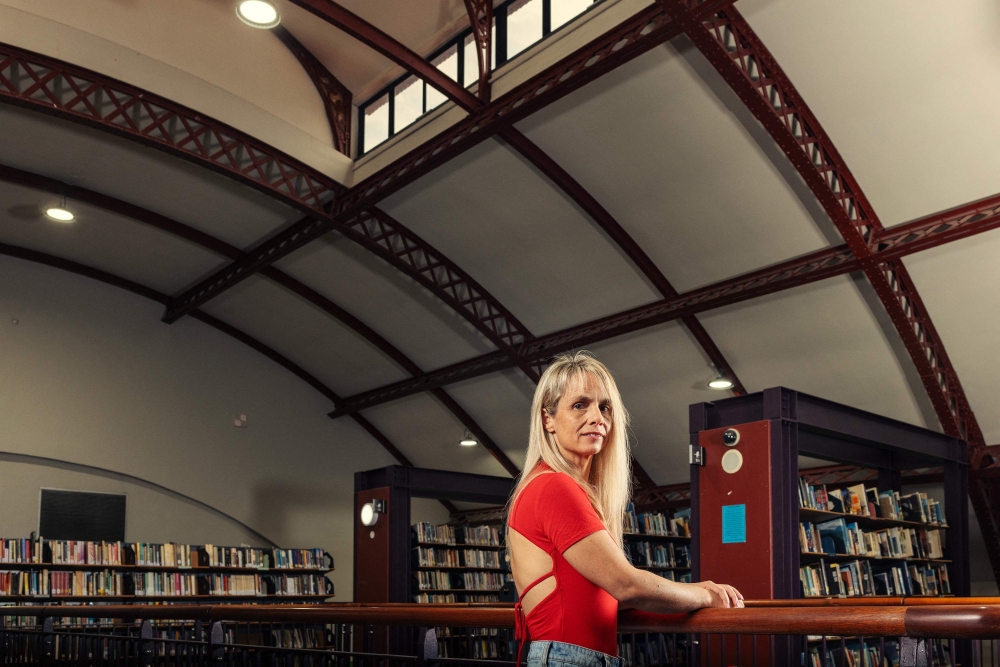

Coral Hart poses for a portrait at the Cape Town public library in Cape Town, on October 14, 2026. South African writer Coral Hart has published more than 370 books since February 2025 using artificial intelligence, a process she passionately defends despite criticism and threats. Coral Hart — a pseudonym she uses for protection — told AFP in an interview she had received ‘tens of thousands’ of hate messages and several death threats. — AFP pic
First Published: Friday, 23 Oct 2026 9:00 PM MYT
CAPE TOWN, Oct 23 — South African writer Coral Hart has published more than 370 books since February 2025 using artificial intelligence, a process she passionately defends despite criticism and threats.
“Grifter”, “villain” — insults abound on social media to describe the author who, in her forties, has become the symbol of AI’s arrival in publishing.
Coral Hart — a pseudonym she uses to protect her real name — told AFP in an interview she had received “tens of thousands” of hate messages and several death threats.
In this hostile environment, few authors using AI agree to speak publicly and show their faces.
“I chose to be the one to step up and say, these are conversations we need to start having,” Hart said.
“This is here... They’re not going to switch it off or unplug it because a bunch of authors said so.”
Before she started writing with AI around 20 months ago, Hart had been working in publishing for 14 years and written several dozen works without the technology.
It took her three months to familiarise herself with the various AI models and build a framework capable of producing a book.
Now she juggles between ChatGPT, which is “really good at dialogue, terrible at prose”; Claude, “really good story structure, terrible at sex drives”; and others like Grok, “completely unhinged” but good on “spicy scenes”.
“If you say, ChatGPT, write me a book, or, Claude, write me a book, you’re going to get a flaming dumpster fire of trash back because it doesn’t have anything (to work with),” Hart said.
The author defines the story concept, a style, details of the characters, and chapter outlines. And only then will her system generate the books.
Hart said when she started, “we could write one paragraph at a time. I usually took two or three prompts to do that.”
“I can now draft the whole book in one sequence.”
Since last year, AI models have “improved vastly”, Hart said. “The prose has improved. The syntax has improved. The sentence structure has improved.”
‘Books are selling’
The first draft of a book is generally not good, the writer said.
It is run through AI for “developmental edits” and then again “to fix any continuity issues, story issues, flat middles, character arcs that are incomplete, plot threads that have been dropped, people whose eye colour has changed.”
At the end of this process, a human proofreader reads through the text to fix any “AI tells that have slipped through” and do some rewriting. “And it’s usually ready to go.”
Although one of her novels made it into Amazon’s top 100 bestsellers, the vast majority of her 371 titles — many of them romance — are tailored to certain readers based on rigorous market research.
She has sold more than one million books, by her own estimate, in digital, print and audio formats, earning more than US$1 million (RM4.08 million) so far this year.
The South African now heads an operation that has trained several hundred people in her method and is preparing to launch software for AI authors called Authorythm.
As for her own production, she mentions her use of AI only when required by a sales platform.
“For the last 16 years, nobody’s asked me what my creative process was,” said Hart, who publishes under more than 10 other pen names.
Now, she was ready to make it public “for the right reasons”.
Regularly accused of contributing to “AI slop” — low-quality AI-generated content in text, video, music, or images — Hart points to the ultimate yardstick: “Books are selling.”
“Readers don’t read rubbish books; they return them,” she said.
The writer has followed the debate around a novel by Haitian-Canadian Thelyson Orelien that was withdrawn from the shortlist for France’s Goncourt prize after accusations that he used AI, which his publisher confirmed on Wednesday.
Critics had praised the book and sales were strong before the controversy, she said, asking: “If you need an AI label to hate something, do you hate it, or do you hate AI?” — AFP
KioskNews shows a cleaned-up reading view extracted from the publisher’s page — the original always lives on their site, not ours.