[In This Economy] Notes from Cambodia
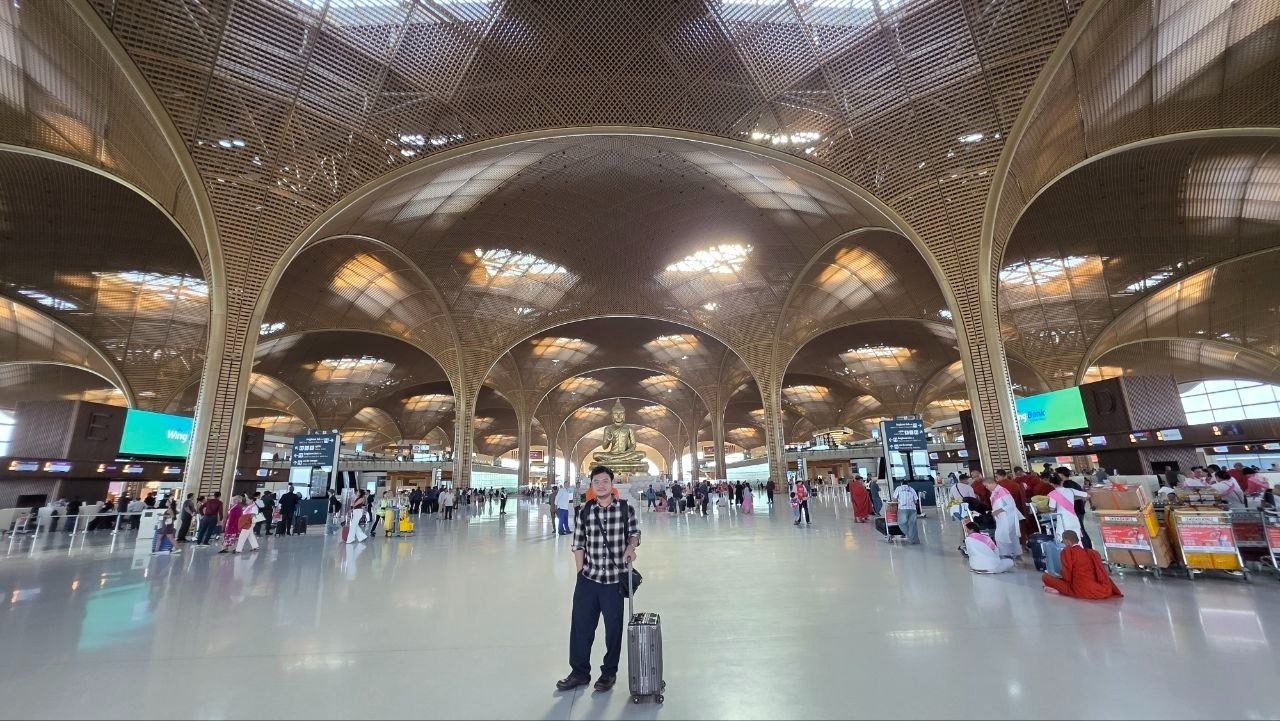
As all eyes were on Manila for the Philippines’ hosting of the ASEAN Summit, I got to explore Cambodia again for the first time in almost a decade.
My jaw positively dropped when I went through Phnom Penh’s new airport.
Techo International Airport opened in September 2025. Its terminal is huge, with a roof inspired by Cambodia’s national flower and a ceiling patterned after traditional Khmer fishing equipment.
Immediately I thought about how lamentable the Ninoy Aquino International Airport (NAIA) is by comparison.
Sure, there are questions about how Techo was built. A Chinese state-owned company built the passenger terminal, and the first phase alone cost a whopping US$2.3 billion. Critics assail how the contracts were awarded and who will end up bearing the financial risks.
At any rate, it cannot be denied that Techo is a first-class airport. If the main international gateway of a country is any indication, I’m sad to report that Cambodia beat us in this aspect.
I would even venture to say Cambodians are much more ready to receive guests for the annual ASEAN Summit than we are. (In the past few days, they actually received delegates for the Francophonie Summit, which they are hosting for the first time ever.)
Cambodia FDI
An airport, of course, signals only so much, and it can’t hide the fact that in 2026 Cambodia is in dire straits like us.
For this year, the World Bank expects Cambodia’s economy to grow by just 3.5%, down from an estimated 5.3% in 2025. Meanwhile, the International Monetary Fund (IMF) expects growth of just 3%, with inflation averaging 5.6%. Expensive energy and weaker tourism are among the reasons for the slowdown.
Sounds familiar? In my last column, I argued that the Philippines had entered stagflation territory. We’d had two quarters in a row of unusually weak growth and high inflation, even after I changed how I accounted for the pandemic in my growth benchmark.
Still, Cambodia is faring a bit better than us, and the data show that plainly.
What also stood out to me was how much foreign direct investment (FDI) Cambodia already gets. In 2025, it took in $5.1 billion or about a tenth of its gross domestic product.
Foreign investment is also spreading beyond garments to areas like electronics and renewable energy. But the IMF says Cambodia needs to attract higher-quality investment and spur more investment by Cambodian firms.
Cambodia teaches us that foreign investments are necessary but not sufficient for sustained growth. A lot of work remains after foreign money comes in.
For instance, a foreign factory can hire a lot of workers and export a lot of goods while buying its sophisticated inputs overseas and keeping its engineering work at headquarters. The gains get bigger when local suppliers can win contracts and local engineers get to solve problems they used to send back to headquarters.
That brings me back to Pax Silica, discussions of which heated up in the past couple of days in the run-up to our ASEAN hosting. Hundreds of protesters were arrested, bringing back images of how protests were stifled by the old Marcos regime.
We don’t know quite yet how much money will come into New Clark City. But it’s important to ask: What will Filipino engineers actually get to do there? Will they run the tests or develop them, too? Will Philippine firms have a shot at supplying the factory? And if we’re offering tax breaks or paying for infrastructure, what commitments are we getting in return?
Many questions linger in the air as the Pax Silica framework is set to be formalized by December, after the ASEAN Summit and the quick visit of US President Donald Trump.
Budget reforms in Cambodia
I also learned that Cambodia has spearheaded reforms in public financial management or PFM. It refers to how the government plans, spends, and accounts for public money.
This fact I picked up from the 21st International Convention of the East Asian Economic Association held in Siem Reap on November 14 and 15.
In a session on the Cambodian economy, I learned that public financial management has been the subject of a sustained reform program there since 2004. (The finance ministry’s own reform steering committee helped host the conference.)
Think about that for a moment. They’ve been at it for more than 20 years.
To be fair, the Philippines has its own PFM roadmap for 2024 to 2028. But the reforms need to level up well after 2028, in the wake of the flood control scandal of 2025 and the emerging scandal concerning the 2027 pre-election budget.
Take the multipurpose buildings, farm-to-market roads, and flood control projects that keep mushrooming in the national budget. Before any is funded, an agency should be able to tell us where it’s going, whom it will serve, and why it deserves priority.
Then when Congress adds any project, we should be able to see who asked for it and what appraisal it went through. When the money gets disbursed, people should be able to check whether the road was actually built.
Lawmakers have boasted of “reforms” like livestreamed budget deliberations and new online portals that supposedly enable ordinary Filipinos to scrutinize the budget. But in truth, many of these are perfunctory reforms that do nothing to fix the entrenched culture of patronage-driven budgeting.
Bad budgeting drags growth, and if we fail to take PFM seriously, then Cambodia might beat us here, too.
Never forget
Finally, right before my flight back to Manila, I managed to squeeze in a quick visit to S-21, now the Tuol Sleng Genocide Museum in Phnom Penh.
If you don’t have any idea about it, the Khmer Rouge took an ordinary school and turned it into a prison and torture center back in the mid-1970s. The rooms are still there, and so are the photographs and records of the people they imprisoned.
I had goosebumps the whole time. Even after I left the museum, I was still shaken.
Even in broad daylight, I was horrified by the idea that humans can do such despicable things to fellow humans. S-21 was a factory of torture and death, and visiting the museum is not for the faint-hearted.
It made me think about what we’ve done to preserve the memory of martial law under Ferdinand Marcos Sr. Sure, we’ve had a law since 2013 that calls for a memorial, museum, and library for victims of human rights violations.

Meanwhile, the University of the Philippines and the Human Rights Violations Victims’ Memorial Commission have committed to building the Freedom Memorial Museum in UP Diliman. It was supposed to have been opened in 2022, on the occasion of the 50th anniversary of the martial law declaration. But four years on, as one would expect under yet another Marcos presidency, no progress has been made.
In Phnom Penh, locals and tourists alike can visit the gruesome Tuol Sleng museum as a ghastly reminder of their past. At the end of the tour, in the central courtyard, one can pay respects to the victims of the genocide at a six-meter, non-denominational stone stupa that rises above black marble plaques. Engraved are the names of 12,272 documented S-21 prisoners.

Similarly, we need to have a stronger reckoning and memorialization of the victims of Martial Law. We have the Bantayog ng mga Bayani, sure, but it needs a lot more financial support, and the museum at UP must finally be opened after long delays.
Apart from the martial law victims, we need to seriously memorialize as well the thousands who died under the bloody war on drugs by former president Rodrigo Duterte, who will soon stand trial at the International Criminal Court.
At least 1.7 million people died under the Khmer Rouge. The UN-backed tribunal convicted just three men, including the person who ran S-21.
I just hope the families of those killed in Duterte’s drug war see justice, too. – Rappler.com
Jan Carlo “JC” Punongbayan, PhD, is an associate professor at the University of the Philippines School of Economics. His professional experience includes the Securities and Exchange Commission, the World Bank Office in Manila, the Far Eastern University Public Policy Center, and the National Economic and Development Authority. JC writes a weekly economics column for Rappler. He is also co-founder of UsapangEcon.com and co-host of Usapang Econ Podcast.
His first book, False Nostalgia: The Marcos “Golden Age” Myths and How to Debunk Them, was published by Ateneo de Manila University Press in February 2023. His second book, Twin Plagues: How Duterte and COVID-19 Wrecked the Philippine Economy, was published by Penguin Random House SEA in June 2026. Follow him on Instagram (@jcpunongbayan).
KioskNews shows a cleaned-up reading view extracted from the publisher’s page — the original always lives on their site, not ours.