One Nation’s bark is worse than its bite

Snap out of it, Shaun Carney, One Nation may have had two byelection victories but they still only hold six of the 226 seats in federal parliament (“The radical is becoming normal under Hanson. If you’re not worried, you should be”, September 17). Australians have a long history of cheering on the stirrer and the larrikin, but when push comes to shove we are a conservative lot and we don’t make the boofhead the boss. One Nation certainly has no solutions to our current cost-of-living pressures – lots of noise, no substance. Come election day, Australians will always vote for those offering solutions, not simply for a megaphone of ill-informed discontent. Barry Ffrench, Cronulla
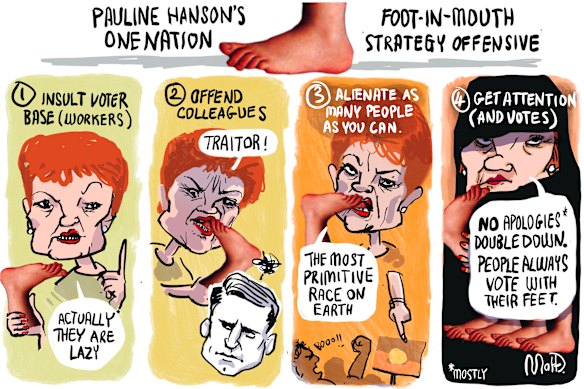
One Nation represents a political ideology that claims there is always a simple solution, and that solution has no adverse consequences. Most people see through the fairy tale and the party never gets into power. Once in a generation, however, propaganda swamps common sense and such people do get into power. A period of turmoil follows as a new generation learns the simplistic approach is bogus. They are voted out and we return to normal. I wonder if we are approaching such a generational revelation. Neville Turbit, Russell Lea
Thank you to the Herald community of letter writers. I can rely on you to lift my spirits by reaffirming that the quiet majority of folk will speak out for the marginalised and sidelined with decency and fairness. I cannot believe the mainly free ride Pauline Hanson gets in too much media due to the influence of her powerful mates. That is not how it used to be. We need to call out these subversive attacks on social cohesion wherever they occur, including on social media. The rules that apply in TV, radio and newsprint must apply to AI content and all content contributors should be compensated (Letters, September 16). Jan Kent, Farmborough Heights
Value of migrants
The migration hysteria created by One Nation and the response from Labor and the Coalition misses the point, namely the benefits of our policy over the past 250 years (“Politicians’ rethink on immigration demands sober analysis”, September 17). First, it is migration that has moved us from a minor to a middle power. Second, it has made us probably the most successful multicultural nation worldwide and one of the most peaceful. Like so many Western nations, natural population growth in Australia has stalled, but migration has kept the numbers up. Perhaps more important is the fact that without migrants, who are mainly young, ready to work and become parents, Australia’s average age would have risen sharply, making us a nation of retirees with fewer workers. The importance of migrants for our universities, one of our biggest export industries, and as backpackers to work in our fields, has been well publicised, but perhaps we should also recognise that these largely temporary migrants are mostly great ambassadors for Australia when they return to their homelands. Finally, laying aside hidden racism, it is important to acknowledge that most migrants, whatever their nation or creed, are young, determined and resourceful. They have to endure the difficulties of getting here and fitting into a new, different society. Australia needs them just as much as they need us. Andrew Caro, Greenwich
Labor can’t afford to cave in to political pressure over visa numbers as the stakes are too high (“Burke’s warning on Australia becoming a guest worker economy”, September 17). Labor is far from perfect, but more trustworthy than the other parties. One Nation is a xenophobic, divisive party and has no integrity. Pauline Hanson throws ideas and numbers into the air and calls them policies. The Coalition is on death’s door, struggling to survive, and can’t be relied on to make rational decisions. Surely, if the pre-2015 visa system worked it should at least be given another try, before making drastic decisions on the fly. Graham Lum, North Rocks
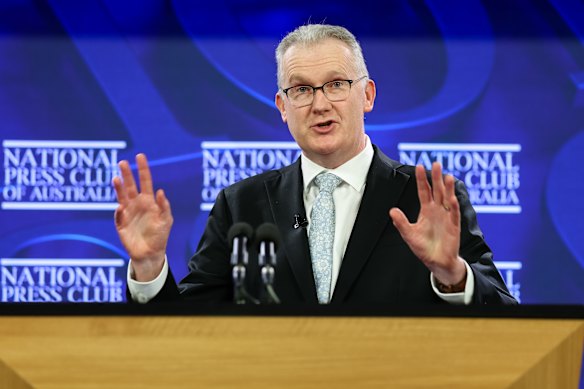
Tony Burke is quite correct in saying that without immigrants our hospitals would close. I know from personal experience that, without Filipina nurses, my stays in hospital and rehabilitation wards would have been impossible. Australia is a country of immigrants and their descendants. In my own case one grandfather was from Sweden, the other from Ireland. My mother was born in New Zealand and my wife is German. Bondi is populated by many people born outside Australia and, living in Dover Heights, the majority of my neighbours are immigrants. It is high time Hanson and Joyce examined their own ancestors and quit their criticism of migrants – they too are descended from them. Bill Widerberg, Dover Heights
While we are talking about overall visa numbers, no one seems to worry about the temporary protection visa (TPV) of about 34,000 people who have been languishing for decades, paying taxes and applying every six months for renewal for their TPV, under the continual threat of deportation. These are legitimate refugees whom the government has a responsibility to settle. Australia should rightly take 20,000 refugees on humanitarian grounds, but it should not penalise TPV holders. If they have no criminal records, the government should bite the bullet and give them permanent residency. Australians have a big heart and these hard-working, tax-paying TPV holders deserve better than being demonised. Political point scoring overlooks the fact that these are real people who suffer for years and years. We are better than that. Mukul Desai, Hunters Hill
The power to control the movement of people across our borders is a politically poisoned chalice at this time in our history. Widespread ignorance among older Australians and the mainlining of misinformation, plus the turbocharging of bigotry and hate for electoral advantage, confuses and divides a nation built on immigration. Barnaby Joyce’s unsubstantiated claim that One Nation policies are “what the people want” is irresponsible. We need cool-headed, fair-minded human experts (not algorithms) guiding the government of the day to control migration in the national interest. And that includes the interests of producers, employers, workers and communities. The goal must be the wellbeing and happiness of Australians, a unique, multicultured society that values family and is directly connected to humankind across the world. Value those ties. Frederika Steen, Chapel Hill (Qld)
Is anyone else out there becoming completely unnerved by the state of political discourse in Australia at present? The level of debate has never been lower, to my mind, and the level of ignorance has never been higher. I am reminded of an old Far Side coffee cup I used to own. On it, a cow quietly grazing looks up at the mob and says: “It is not me that’s mad; it’s them.” I am starting to feel like that old cow Bruce Ingrey, Rozelle
Keep racism out of it
Your correspondent Brian Dellit suggests that the immigration debate is being driven by racists (Letters, September 16). It’s a pity if this is the case because the main problem to be addressed is how and where to locate our increasing population. Even if immigration was nil and the population increase was because Australians were having larger families, the problem would exist. The government’s immigration target is 225,000 per annum. Based on Sydney’s population as a percentage of Australia’s, this would mean 45,000 people entering every year, the equivalent of a small suburb. Evidence suggests that developers are finding it unprofitable to build on the outskirts of Sydney, which means there will be a continual transformation of suburbs into high rise. The price of a freestanding house anywhere near the CBD will continue to rise. Is this what we want? The way to stop One Nation from gaining power is to allow the other parties to address this problem by somehow curbing high immigration without us resorting to arguments over race. Bruce Johnson, Lakewood
Yes, Andrew Bain, someone has come up with a better way to encourage productivity and reduce housing costs while managing inflation (Letters, September 16). Getting rid of capital gains concessions and negative gearing for unproductive real estate speculation encourages people to invest productively instead. And it reduces the prices and thus cost of borrowing to buy houses. And more productive investment works against consumption, thereby reducing inflation. Brenton White, Mosman
Questions for Brethren
As a survivor of the Exclusive Brethren, I was heartened to read that the parliamentary committee examining the 2025 election has agreed to subpoena the leaders of this so-called Christian church over links to far-right, pro-Coalition influencers (“Brethren and Liberals called to answer for far-right election plot”, September 17). Those who were once inside know how deftly they can twist the narrative, and that they have seemingly limitless funds when it comes to silencing any opposition. So it comes as no surprise that the Australian public have also become tired of the secrecy and deceit of this organisation. The passage of time does not dull the memories or the pain of someone who escaped the clutches of the Brethren, and I can attest that each new revelation of their questionable practices brings renewed hope of closure for traumatised families. The wheels of justice turn slowly but grind exceedingly fine, and with questions now being asked in Parliament, I know I am not alone in daring to hope the moment of accountability has finally arrived for the Exclusive Brethren/Plymouth Brethren Christian Church. Joy Nason, Mona Vale

Middle East mired
Congratulations to Kylie Moore-Gilbert for reminding us of how Iran got this way (“I’ll get death threats for saying it – but this prince is no messiah”, September 16). It reflects the sorry and disastrous history of Western intervention in the Middle East. It is also a reminder of the horrible regimes in Iran that the US, the UK and by default ourselves have supported. Iraq, Palestine and Afghanistan have also suffered in this way. The launch of the Pinochet regime in Chile in 1973 was another example. Reza Pahlavi, whom the Coalition is suggesting as an alternative leader for Iran, is the son of the former shah, a brutal autocrat. That family has no place in modern Iran. It is extremely ironic that Iran’s influential position comes in no small part from the US destruction of its one-time client, Iraq. It is also worth remembering that Osama bin Laden learnt the art of jihad when funded by Pakistani, Saudi Arabian and US money to remove the Soviets from Afghanistan. Iran is certainly not the only country that runs proxies in the region. Jock Webb, Narromine
Trump’s reckoning
Donald Trump has made deep cuts to foreign aid which have had a detrimental effect on global health. He tasked Elon Musk with aggressively cutting government spending and Robert J Kennedy Jr to make cuts to health agencies. He has enacted tax cuts that overwhelmingly benefit the ultra-wealthy and large corporations, and we now discover that the cost of going to war with Iran will cost the constantly ripped-off US taxpayers $38 billion – to say nothing of lives lost and widespread destruction. In the meantime, he and his family have amassed billions of dollars. In view of all this, how is it humanly possible that the Democrats could lose the midterm elections and thus put an end to Trump’s fraudulent mismanagement? Bernard Moylan, Bronte
Correspondent Patrick McGrath is being unfair to Premier Chris Minns when he compares him to Donald Trump for expressing dissatisfaction over the sentence for Molly Ticehurst’s killer (Letters, September 16). Trump attacks judges who either rule against him personally or against his policy agenda. I suspect Minns is just expressing a view shared by much of the Australian public – that the sentence handed to Daniel Billings was manifestly inadequate. Isabel Robinson, Alexandria
Genius motives
It’s great to read that Australia has geniuses of its own, such as Andrew Tulloch and Tristan Buckmaster (“Aussie’s $2.1b Meta salary wasn’t enough. So he left for a rival”, September 17). I don’t begrudge them joining the “brain drain” to overseas destinations, but what I want to know is will they use their superpowers for good? With all the warnings of the potential demise of humankind from the AI kingmakers, I am reminded of that saying: “When I was young, I admired smart/good-looking people (take your pick). Now that I am older, I admire kind people.” Valentina Bellio, Corrimal

Swan’s sad song
Reading Angus Dalton’s story (“Do animals grieve? Rare footage of a mother and her calf may hold the answer”, September 17) reminded me of a tragic tale I came across when researching for a book on early colonial history, as reported by one Major Antill in his journal of May 4, 1815. I think it proves conclusively that animals can indeed feel deep grief. He reported that his party shot a large male black swan, skinned it and laid it out to dry. The female of the pair kept flying overhead, very distressed and calling out plaintively and constantly. When she found the skin of her male companion, she lay down beside it, refused to move and refused all food and water. Two days later, she had died, stretched out on the remains of her mate. I doubt that anyone who had heard that story could ever shoot a bird or animal again. Christine Stewart, Willoughby
Roots of ignorance
Tree vandals like Norman Sukkar seem to have no understanding of the benefits that plants and tree foliage provide to humans (“Sydney tree vandal avoids conviction”, September17). Such people need to educated to appreciate the plant world, and they deserve to face the full force of the law. Karen Eldridge, Leichhardt
Under the radar
Your correspondent, in lamenting our AUKUS involvement, asks why there are “no subs to be seen” in the Russian and Middle East wars (Letters, September 16). Isn’t that the point of having a sub? Jeremy Brender, West Richmond (SA)
Start the day with a summary of the day’s most important and interesting stories, analysis and insights. Sign up for our Morning Edition newsletter.
KioskNews shows a cleaned-up reading view extracted from the publisher’s page — the original always lives on their site, not ours.