Artificial intelligence cracks centuries-old ciphers
Napoleon Bonaparte ordered the wartime missive written in code, creating a puzzle that went unsolved for more than 200 years — until artificial intelligence (AI) cracked it in a matter of hours.
AI is helping non-specialists unlock the secrets of historical sources, a trend described as a “turning point” in a field previously the preserve of academics and dedicated hobbyists.
One new sleuth is Carter Church, a 27-year-old AI engineer who decrypted a 19th-century letter to one of Napoleon’s generals.
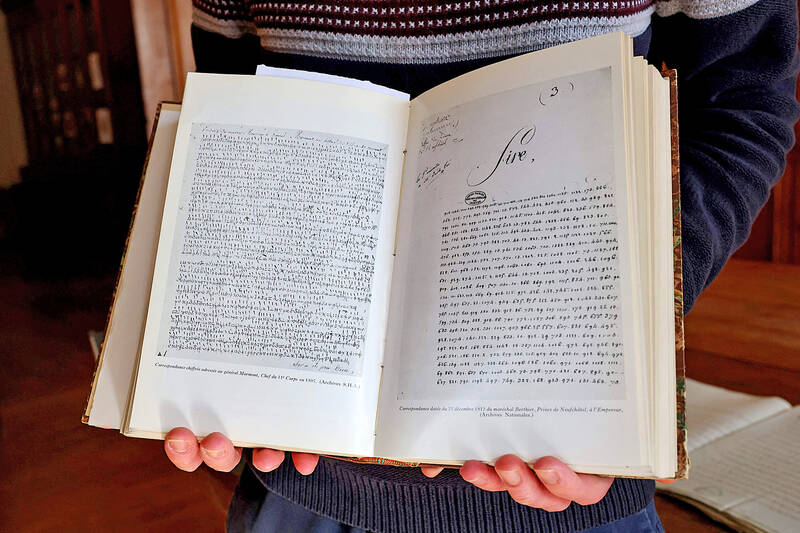
A person holds a reproduction of a wartime letter addressed to one of Napoleon’s generals written in secret code in 1809 at the Vincennes castle, outside Paris, on Thursday.
Photo: AFP
Without digital tools, the task could have taken weeks, but the latest model from OpenAI broke the cipher in six hours.
“What AI mostly brings is persistence,” Church said, adding that he felt “an unbelievable sense of satisfaction and excitement when I saw the result.”
The message from 1809 — detailing French and allied troops’ positions in two dozen lines of symbols, numbers and letters — had lain ignored in an online academic archive.
Because traditional, low-tech methods to crack ciphers are effective, but time and labor-intensive, historians “have more important problems to solve, so many ciphers like this often sit unattended,” Church said.
To find the solution, Church, who works at US cybersecurity firm SentinelOne, needed to learn “very little” about code-breaking techniques or the historical period.
He spent some evenings going over it, then consulted Japanese patent engineer Satoshi Tomokiyo, who maintains an online list of unsolved ciphers, to verify it.
“2026 will be remembered as a turning point for codebreaking of historical ciphers,” Tomokiyo wrote on his Web site Cryptiana, a go-to resource for the small, but enthusiastic global community of amateur cryptographers.
Researchers were already developing AI models to break ciphers, but the public release of state-of-the-art generalist tools has unleashed dozens of new solutions.
Although Church used OpenAI’s most powerful model, GPT-6 Astra, other people have used top offerings from US lab Anthropic instead.
Tomokiyo said that since the middle of last month, most of the ciphers on his list have been cracked using AI.
“There remain some tough problems,” which could stay an enigma for years to come, because there is less relevant data available to help AI figure them out, he said.
“I’m excited long-time problems are now solved, but on the other hand, I have mixed feelings, because AI seems to have solved these difficult problems so easily,” he said.
With technology draining the satisfaction of being first to crack a cipher, a fellow code-breaker told Tomokiyo: “I feel useless.”
AI is surpassing human abilities in pursuits from mathematics to computer programming, while threatening to alter or even eradicate many jobs. The technology is transforming the work of historians not only by decoding documents, but also by analyzing millions of medieval manuscripts or helping read ancient scrolls.
Too fragile to be unrolled without risking destruction, the Herculaneum Papyri — hundreds of papyrus scrolls carbonized in the eruption of Vesuvius in 79AD — are now being X-rayed and analyzed by AI to reveal the hidden writing inside.
Researchers in Italy announced in June the first complete virtual unrolling of a scroll, which turned out to be a treatise on ethics.
AI is also being used to build a huge, searchable collection of previously inaccessible sources on Jewish history and culture by transcribing 10 million pages of Hebrew manuscripts.
“It’s gigantic. No human being could process such a quantity” of data, said project leader Daniel Stoekl Ben Ezra, of the Ecole Pratique des Hautes Etudes in Paris.
Researchers hope the databases created using the digitized text — which he likens to a kind of “huge Facebook of the past” — could help bring to light links between people, places and ideas.
And at the French capital’s Notre Dame Cathedral, an AI system has been trained to transcribe 14,600 Latin pages from the church’s medieval archives — a task not dissimilar to code-breaking.
“These are minutes drawn up by notaries who abbreviate their decisions. The script is highly administrative, very pragmatic ... with rather technical vocabulary,” said historian Julie Claustre, who leads the e-NDP project.
With character recognition rates ranging between 88 and 94 percent, the project has revealed information about the cathedral’s daily life, its building work, its staff and the care of abandoned children.
Doing the same by hand would take “several decades,” but “it’s not just a time-saver,” Claustre said.
Automation enables “inquiries that were not previously possible; it transforms the conditions of research,” she said.
KioskNews shows a cleaned-up reading view extracted from the publisher’s page — the original always lives on their site, not ours.