Conrad Black: Mark Carney’s EU blunder
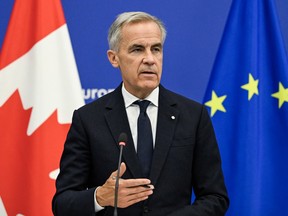
I have the painful duty of advising that I consider the basic points Prime Minister Mark Carney tried to make in his address on Sept. 27 to the European Parliament in Strasbourg profoundly mistaken. Readers should be aware that the European Parliament has no power whatsoever. The member states nominate commissioners in the different administrative fields, like cabinet ministers. The government apparatus in Brussels deluges the entire membership with decrees purporting to regulate an almost unlimited variety of activities, most of which the principal Atlantic English-speaking countries have considered unsuitable for government interference.
Sign In or Create an Account
The great achievement of the European Common Market, and then the European Economic Community was to reduce economic barriers between the Western European countries and to promote the peaceful and conciliatory settlement of differences between the constituent countries. This was done in lock-step with the North Atlantic Treaty Organization, which under unquestioned American leadership, has guaranteed the security of almost all of the member states of the evolving European Community. Eventually, President Reagan‘s plan to shelter the western world under what aspired to be a leak-proof anti-missile defence, confronted the Soviet Union, which was spending approximately half of its GDP on military matters, to contemplate the loss of it status as an equivalent nuclear deterrent power to the United States. The reform regime of President Gorbachev did not possess the will of Russian rulers from Peter the Great to Stalin and Khrushchev and even Brezhnev to suppress ethnic and political dissent in the polyglot, Soviet Union, and the whole Soviet concept became demoralized and simply disintegrated.
This inspired American strategic policy of containment of Soviet communism, as well as the heavy economic assistance of the United States and proportionately Canada, under the Marshall Plan and parallel activities revived war-ravaged Western Europe as relatively free market democracies. The relevance of this to Carney‘s address is that he advised the European Parliament that “Freedom was won thanks to the heroism of the European resistance during the war.” Freedom was in fact, won in two stages. In the first stage, the United States, the United Kingdom, and Canada, proportionately to their populations, liberated France, and Italy, the Netherlands, Belgium, Luxembourg, Denmark, and Norway, and occupied approximately three quarters of Germany. As many millions of Germans plodded westward ahead of the Soviet Red Army, the Western Allied armies ended up organizing the post-war government of nearly 80 per cent of the Germans.
The Americans, British, and Canadians with modest participation from others, resurrected liberty in Western Europe. Canada’s participation was especially remarkable as they were almost all volunteers and Canada, unlike Britain and the United States, had never been attacked or threatened by the Axis Powers. It was a courageous and unprovoked contribution to the pursuit of freedom throughout the world.
In the second phase of freedom’s triumph, the patient and comprehensive containment strategy devised and executed under American leadership throughout the Cold War emancipated the former Soviet satellite countries and several republics of the U.S.S.R. The principal benefactor in this triumph of human liberty was the United States of America, resentment of the power and influence of which, though not explicitly stated, was incandescently clear in the prime minister‘s message in Strasbourg, which renders that message incoherent, to say the least. Even in recent years, the Europeans were effectively financing the aggressive Russian war against Ukraine by buying Russian oil and gas, while beseeching the Americans to assert their influence across the ocean again and assist Ukraine in repulsing the Russians in the heart of Europe. Canada has been commendably unambiguous in its support of the Ukrainians and played a significant part in training up the Ukrainian forces in the arts and skills of self-defence.
The second serious problem with Carney‘s address is that while the central structures of European government have contributed admirably to assuring relative cooperation amongst the 27 constituent countries and massaging what would be called in Canada equalization payments, from the richer to the less developed areas of Europe, as an administration, it has not been successful. As I mentioned in this space last week, in 2008, Europe and the U.S. had approximately equal GDP’s and the United States now has 140 per cent of the GDP of the EU.
The general increase of prosperity in the world and the decline of poverty and illiteracy, as well as the spread of democracy and the free market economy, have been magnificent in the years since the end of the Second World War. This has been the third longest period of absence of extensive wars between the principal peoples or governments, after the Roman Imperial Peace from 96 to 180 AD and the Pax Britannica from 1815 to 1914. But Europe has done terrible damage to itself in economic competitiveness, largely by excessive commitment to suppression of fossil fuel use, a cause strenuously championed by Mark Carney for many years, including, quite inappropriately, from his position of governor of the Bank of England. This is the largest single element in the comparative economic decline of Europe and of Canada and is already being painfully reversed in parts of Europe. This horribly mistaken policy in much of the western world has caused $16 trillion to be spent combatting climate change without saving a single life and in a period when the world’s temperature has not moved much in 30 years. Carney hinted in Strasbourg that he wished to continue this policy.
Europe has become so enfeebled, the Chinese automobile industry has acquired about 10-12 per cent of the European auto market, and Brussels is reduced to asking China voluntarily to cap its penetration at 15 per cent, which the People’s Republic has naturally refused to do. (Carney also made a mockery of the independence of the Bank of England by turning it into a bellicose parrot of the Cameron government in the Brexit debate, scaremongering and promising the collapse of British prosperity if it departed the European Union. It is sobering for Canadians to recognize what little value he attached to the British institutions of government that have evolved fairly continuously over more than 800 years-he was happy to warn and frighten the British into abandoning all of this in favour of the unfledged and authoritarian machinery of Brussels.)
In accord with his practice of invoking famous intellectual leaders of the past with whose actual works comparatively few of his listeners would be familiar, Carney produced a lot of elaborate metaphors about the transplantation of trees between Vimy and Milliken, Ont., and imputed to Johann von Goethe a much less complicated view of national sovereignty and human liberty than he actually advocated. Goethe was a friend of Napoleon and had mixed views on the wars of alleged liberation of his time. Finally, in his complicated paean to the reticulation of the roots and branches of European and Canadian trees, the prime minister completely ignored the fact that Canada sends approximately 70 per cent of its exports to the United States and only six per cent to Europe. He ignored the fact that while President Trump has engaged in a good deal of verbal pyrotechnics, his actual tariff increases only apply to about six per cent of Canadian exports. Before escalating his war with the American president further, Mr. Carney should take careful measure of the risks of doing so: the United States is responsible for a third of Canada‘s economy, and we are responsible for three percent of the economy of the United States.
Underlying it all is Carney’s contention that “a strong economy is not an end in itself, but the means to a just society.” This is consistent with his turgid and striving book: “Values, Building a Better World for All,” which is less an economic program than a field guide for polysyllabic eagle scouts. His address in Strasbourg was less a romantic escalation of Canada‘s relations with Europe than a wistful reflection on the failure of Canada and Europe to produce a superior political ethos to that of the United States while being economically uncompetitive with it.
Until we can recover the comparatively equivalent prosperity with the United States that we enjoyed up until 10 years ago, we are in no position for our prime minister to go to the Rhine and preach Wagnerian forest murmurs to the Lorelei as he did last week.
National Post
Join the Conversation
This website uses cookies to personalize your content (including ads), and allows us to analyze our traffic. Read more about cookies here. By continuing to use our site, you agree to our Terms of Use and Privacy Policy.
KioskNews shows a cleaned-up reading view extracted from the publisher’s page — the original always lives on their site, not ours.