A real-time dashboard to watch local spikes in air pollution: Inside the country’s biggest monitoring centre
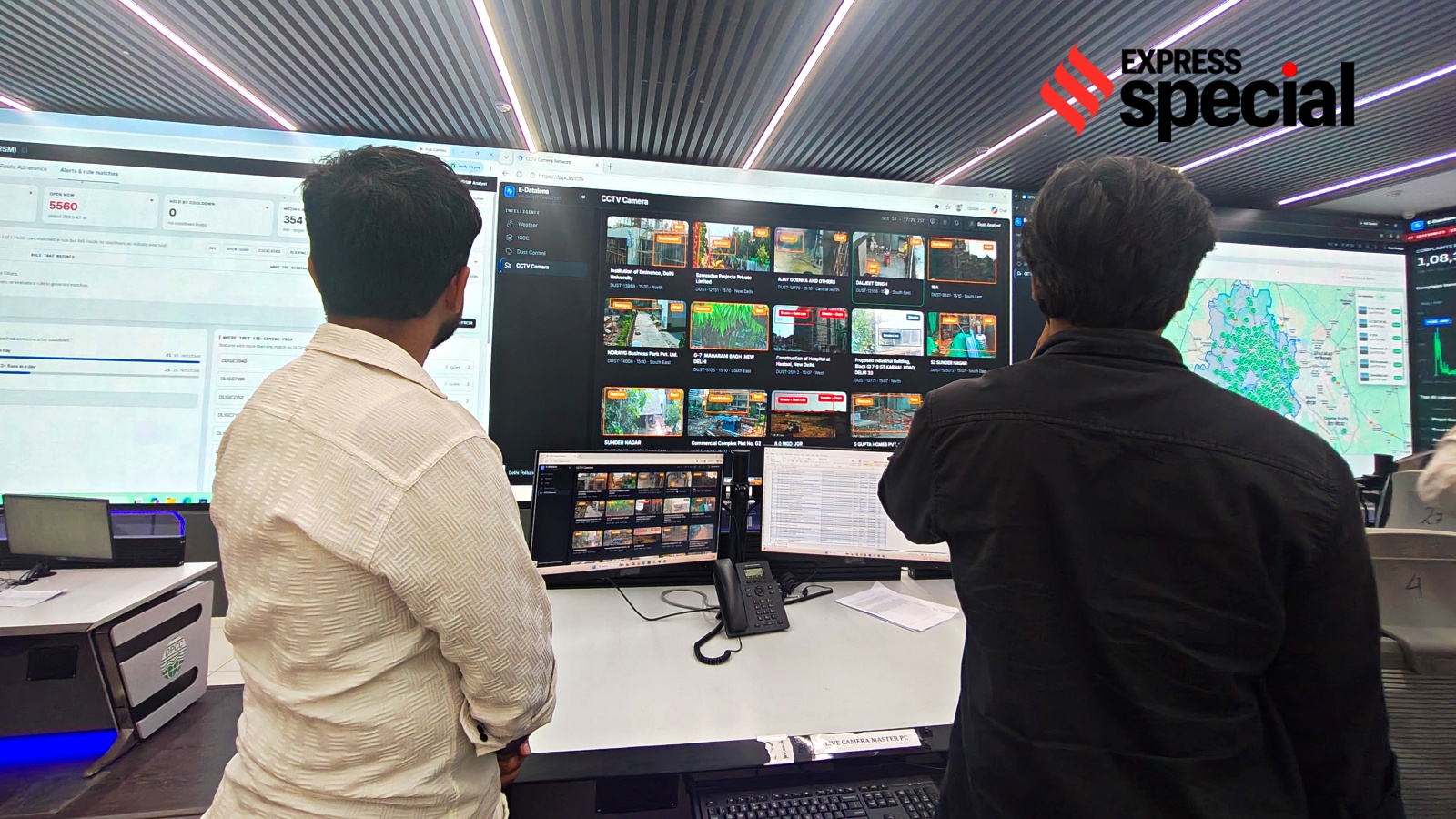
Around 5.30 pm this past Wednesday, several red lights flashed on the dashboard at the Delhi Pollution Control Committee’s (DPCC’s) new AI‑enabled Integrated Command and Control Centre (ICCC) at Shastri Park in Northeast Delhi. In Wazirpur, the Air Quality Index (AQI) had spiked 60 points in just an hour; in Narela, a monitoring station had gone offline; and a camera at a construction site had not transmitted for six hours.
Looking at a massive floor‑to‑ceiling monitor in front of him, a senior DPCC scientist said: “PM10 levels above the permissible limit at 44 [air quality] monitoring stations. PM2.5 exceeded the limit at 43 out of the 56 stations.”
The monitor showed a map of Delhi, with blipping wind vectors pointing downward, and automated warnings flashing across the screen. “Poor dispersion. Emissions inside Delhi will stay local,” said a warning.
The ICCC monitors pollution sources across Delhi in real time, the scientist said. It is the country’s largest pollution control war room, and is monitored round the clock by teams that work a general shift from 10 am to 6 pm, plus three additional shifts from 7 am to 3 pm, 3 pm to 11 pm, and 11 pm to 7 am.
Observations by the general shift form the basis for key daytime action‑taken reports and operations. The centre integrates multiple data points to assess pollution in real time using multiple sources of information, officials said.
Monitoring stations across the city record the concentration of pollutants at specific locations and times. Meteorological data help explain or predict whether atmospheric conditions favour the dispersion of pollutants or allow them to accumulate.
Historical readings help identify trends and unusual changes, while information about construction sites, industrial activity, road-sweeping operations and field inspections can help examine possible local sources, the senior DPCC scientist who is in charge of the station explained.
Story continues below this ad
Delhi Chief Minister Rekha Gupta inaugurated the centre on October 1. On Wednesday, when The Indian Express visited the control room, the AQI in the city was 148. The major takeaways from the working of the integrated monitoring centre are likely to become apparent in the coming weeks, as the winter sets in and Delhi enters its air pollution season.
At the ICCC, the senior scientist at the control room turned to look at a large white workstation underlit in neon blue. “Wind speed is less than 4 km per hour. There is poor dispersion. Wind speed has to be more than 10 kmph for good dispersion,” he said.
A younger operator sitting at the workstation confirmed that some stations were reporting a near-negligible wind speed of 1.9 kmph. As the system flagged the stagnant regional wind flow, the remarks on the dashboard said data from the India Meteorological Department (IMD) and Global Forecast System (GFS), a model run by the United States National Weather Service, would be needed to assess the transport of pollutants from Punjab and Haryana.
Almost on cue, the screens flashed red with a “critical” Priority‑1 alert. AQI at Burari crossing in North Delhi had breached the emergency threshold. “Generate the alert,” a supervisor instructed.
Story continues below this ad
Wednesday was the first day of full‑fledged operations at the control centre, and the alerts had piled up. In the ‘Ambient Air’ dashboard, a breach flagged: “PM10 jumps by more than 50 µg/m³ (micrograms per cubic metre) between two hourly readings” at the Wazirpur monitoring station. It was marked as a Priority 2 (P2) incident in the ‘Severity’ column.
The system had logged the AQI surge from 149 to 210 between 4 pm and 5 pm, and routed the report to the instrumentation cell at the Wazirpur Continuous Ambient Air Quality Monitoring Station (CAAQMS) so the source could be tracked down.
The queue flagged other issues — the Narela and Chhawla CAAQMSes had failed to transmit valid readings for three consecutive hours, and automated offline alerts had been generated and assigned to nodal officers.
The escalation queue also flickered with severe P1 triggers requiring immediate ground intervention. A “Camera Alert Missing 6 hour” had popped up because a mandatory construction‑site camera had gone dark, a “PM Sensor Alert 6 hour” was flashing because a particulate‑matter sensor had stopped transmitting data, and a P1 Audit Alert signalled that a builder’s mandatory self‑audit was overdue.
Story continues below this ad
With median acknowledgment time lagging at 57 minutes against a 30‑minute target, and with 10 major alerts having escalated past Level 1, operators in the control room raced to triage the situation before dusk fell – when lower temperatures could be expected to trap polluted air closer to the surface in an atmospheric phenomenon known as temperature‑inversion effect.
Among the technicians and data analysts at the consoles was technical trainee Shalu Yadav, a Master’s in Environmental Management from Guru Gobind Singh Indraprastha University.
“Alerts are divided into Priority 1 and Priority 2,” Yadav said. “If PM10 and PM2.5 values go above 50 µg/m³, an alert is generated. If the AQI at a monitoring station goes above 200 and stays continuously in that range, an alert goes to that station, and the cause is checked. If readings go too high somewhere, alerts go to the on‑ground enforcement teams, and we tell them, ‘Please go to this station and see what the issue is.’,” she said.
The E-Datalens Air Quality Analytics platform at the control centre was developed for DPCC by an Indian company called Datalens Technologies Pvt Ltd, along with global tech infrastructure partners such as Delta Americas, Hewlett Packard, Cisco, and NetApp, officials said.
Story continues below this ad
The platform has integrated APIs from the Central Pollution Control Board (CPCB), Indian Institute of Tropical Meteorology (IITM), IMD, Municipal Corporation of Delhi (MCD), and the Indian Agricultural Research Institute (IARI), which monitors farm fires, the project in-charge said.
The centre’s biggest challenge is “AI-layering”, the centre in-charge, who preferred not to be identified, said.
This refers to human operators having to review video feeds from construction sites and manually draw bounding boxes over specific frames to classify issues. They tag the feeds daily with labels such as “Dust High”, “Smoke Low”, “Dust + Smoke”, and “Clear”.
Every manual selection feeds the algorithm to train the AI. A senior official said roughly 10,000 frames of inputs mapped with trained tags will be required before the LLM is trained fully.
Story continues below this ad
Six modules have been developed so far — they include an hourly AQI forecast for the next 72 hours, a colour-coded record of daily air-quality categories over 30 days, and a 20-day mean AQI.
Operators can also examine individual monitoring stations and compare readings with those from nearby stations. An official said that integrating Automatic Number Plate Recognition (ANPR) cameras and monitoring of traffic congestion hotspots is planned to be added. For construction sites, AI-enabled cameras and particulate matter sensors can flag potential dust-control problems and identify interruptions in surveillance.
The centre will also track the operations of the Mechanical Road Sweeper Machines, including their location and movement, to help officials monitor their deployment and identify stretches that may require further attention.
On Wednesday, when The Indian Express visited the control centre, the Road Dust Control interface had logged that 75 out of the 79 available sweepers were running, having covered a cumulative distance of 1,774.1 km. A total 210 vehicle stoppages were recorded.
Story continues below this ad
The system has a complete operational dossier for each sweeper, including the name of the driver, the machine’s sweeping speed, and its adherence to its designated route. GPS-enabled vehicles track 78 field squad teams working in two shifts, and a complaint-handling system — which includes personnel manning social media and call centre — routes grievances to relevant authorities and monitors follow-up actions.
KioskNews shows a cleaned-up reading view extracted from the publisher’s page — the original always lives on their site, not ours.