Chinese scientists found giant ‘chimneys’ in deep water that could alter submarine warfare
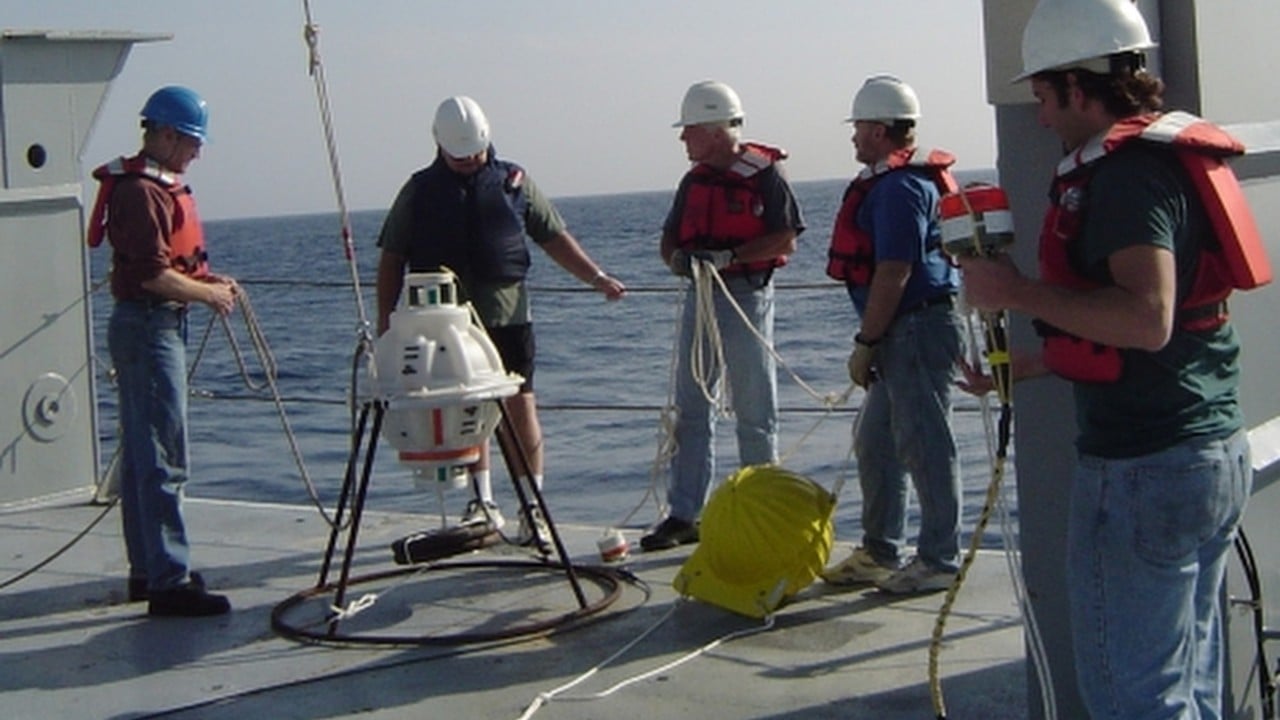
Chinese researchers have mapped how energy from surface wind surges thousands of metres into the seabed, revealing massive underwater conduits they called “inertial chimneys”.
The discovery, based on data collected by a US-funded ocean sensor array off the east coast of Japan, coupled with future long-term underwater monitoring, can provide underwater acoustic environmental support for marine detection and communication, the team said.
The scientists from the Institute of Oceanology of the Chinese Academy of Sciences published their findings in the peer‑reviewed journal Deep Sea Research Part I: Oceanographic Research Papers in October.
“The result shows that the deep sea is not a stagnant body of water,” the scientists wrote in a press release. “This work links the sea-surface wind field, the upper ocean and the deep-ocean sea floor into a continuous energy pathway.”
The study analysed two years of data collected by a grid of 46 sea floor monitoring stations spread across a 600km (323 miles) by 600km area in the Kuroshio Extension region.
These inverted echo sounders, equipped with near-bottom pressure and current sensors, were moored to the ocean bottom to record vertical acoustic travel time of a round trip from the sea floor to the surface, bottom pressure and near-bottom currents.
The array was deployed from 2004 to 2006 for the Kuroshio Extension System Study funded by the US National Science Foundation. It was deployed by researchers from the University of Rhode Island, the Woods Hole Oceanographic Institution and the University of Hawaii.
In the latest study, the Chinese scientists looked into near-inertial internal waves, which have been considered a key vehicle for wind energy to travel through thousands of metres of stratified seawater to reach the sea floor.
They are massive underwater oscillations created when surface winds blow across the sea, setting upper water layers into pendulum-like motion due to Earth’s rotation.
02:57
China trials underwater data centres to solve energy woes
Although the ocean is stratified into warm upper layers and cold deep waters that normally act as a barrier for water exchange between these layers, these internal waves act as energetic relays to transmit energy deep within the oceans.
The team found that when these waves pass through anticyclonic eddies – massive, clockwise-rotating ocean whirlpools in the northern hemisphere – the eddy’s rotation reduces Earth’s rotational constraint on the wave.
This draws the wave energy inward and propels it down into the deep sea, forming a concentrated funnel which they call an “inertial chimney”, according to the team.
The team also found that 68 per cent of bottom near-inertial wave energy stems from downward-propagating upper-ocean near-inertial waves, while the remaining 32 per cent originates from local near-bottom currents.
“The partitioning between transmitted and locally generated energy provides valuable constraints for parameterising mixing processes in numerical ocean models and for evaluating global ocean energy budget closure within climate simulations,” they wrote in the paper.
The team said temperature, salinity and sound-speed profiles obtained through long-term observations have wide applications in marine environmental forecasting and deep-sea engineering.
“As the impact of storms at the sea surface can reach the ocean floor … deep-ocean temperature and salinity structures undergo continuous change across timescales ranging from hours to seasons,” they said in a press release from the institute.
“These variations are difficult to capture through sporadic ship-based observations, pointing to the need for long-term, continuous, full-depth in situ observations,” they said, adding that underwater arrays can be linked to satellites which observe water surfaces.
They said “changes in temperature and salinity structure directly affect underwater sound propagation paths and transmission loss”.
“Integrating these data with acoustic propagation models can support assessments of sound-channel structure and propagation conditions, as well as underwater acoustic environment forecasting, helping to provide environmental support for underwater detection and communication.”
KioskNews shows a cleaned-up reading view extracted from the publisher’s page — the original always lives on their site, not ours.