FIRST READING: What SOGI actually tells teachers to do
First Reading is a Canadian politics newsletter curated by the National Post’s own Tristin Hopper. To get an early version sent directly to your inbox, sign up here.
Sign In or Create an Account
The subject of SOGI (Sexual Orientation and Gender Identity) education has become an issue in the B.C. election. B.C. Conservative Leader Lorne Doerkson has stated that if his party forms government, repealing SOGI will be a top priority.
“I firmly believe that we have to repeal SOGI,” he said.

Columnist Jesse Kline keeps you up to date with what’s happening in Israel and the effects of antisemitism on life here in Canada. Friday mornings.
By signing up you consent to receive the above newsletter from Postmedia Network Inc.
A welcome email is on its way. If you don't see it, please check your junk folder.
The next issue of Channel Israel will soon be in your inbox.
We encountered an issue signing you up. Please try again
The usual defence of SOGI is that it’s simply an “anti-bullying” curriculum, and that is indeed how it’s framed in informational pamphlets distributed to parents. But any review of B.C.’s official SOGI course materials shows that it goes way beyond merely telling students not to bully gay kids.
The SOGI 123 program, developed by the Vancouver-based ARC Foundation, is the primary purveyor of such materials, and has been a mandatory component of B.C. public school policy since 2016.
The SOGI 123 website includes 147 individual lesson plans, in both French and English, and targeted to children as young as five.
SOGI 123 also provides teachers with “scripts” of prepared talking points to respond to parents with concerns about the program.
Below, a cursory guide to what SOGI actually asks teachers to do in B.C. schools.

Instruct students as soon as possible that the “rigid gender binary” is false
You won’t find the word “man” mentioned a single time on the website for SOGI 123. And the word “woman” is mentioned just once, in a 2024 guide to SOGI-inclusive books, which mentions that the protagonist in a lesbian romance is a “young woman.”
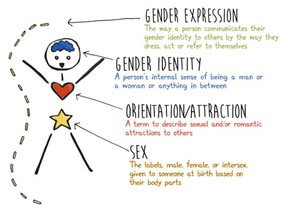
A central theme in all SOGI 123 materials is that sex is something that’s “assigned at birth,” that gender is “fluid” and that someone’s status as a man, woman or other is ultimately a self-declared identity unbounded by biology.
A 60-minute lesson entitled Gender Identity and Pronouns is intended to instruct students right from kindergarten that requesting someone’s pronouns is the only socially acceptable way to infer their gender identity.
By lesson’s end, teachers are told, “students will appreciate the gender spectrum, fluidity, and the use of gender pronouns,” and understand that gender is not held to “a rigid gender binary or with the gender they were assigned at birth.”
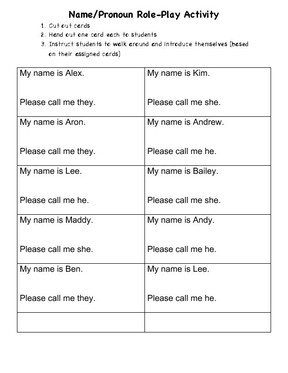
The lesson concludes with students being handed cards carrying a name and pronouns such as “my name is Aron, please call me they.” “Instruct students to walk around and introduce themselves (based on their assigned cards),” reads the teacher instructions.
Have kindergartners pick apart fairy tales for “sexism” and normalization of the “gender binary”
The unit plan Fairy Tales and Gender Roles is intended for children from kindergarten to Grade 3. The lesson plan has children reading through fairy tales such as Cinderella and Rapunzel, and being prompted to identify which parts of the story are “sexist” or otherwise supportive of the “gender binary.”
“Students call out ‘Stop!’ when they want you to cease reading. They must then identify the sexist incident before you can proceed with the story,” it reads.
The lesson plan then calls for teachers to read through King and King, a book about a gay-married monarch, and “debrief student reactions to the book.”

Tell children that changing sex is akin to a new hairstyle
This lesson plan is also targeted at the kindergarten to Grade 3 cohort.
It surrounds the children’s book Teddy, A Gentle Story, about a male teddy bear who transitions to a female teddy bear. The book’s protagonist is Errol, a “good friend” who affirms the teddy bear’s gender transition.
The lesson plan instructs teachers to frame gender transitions as a change no different than a new hairstyle or a sunburn.
“I talked about how sometimes they might see me and one day I might have a full beard. On other days, I would have no beard,” wrote the lesson’s author, adding “regardless of physical appearance, I am still the same person.”
The lesson plan then stresses that the way to be a “good friend” is to accept “non-binary understandings of gender” and affirm it in others.
“When someone shares their name, it is respectful for us to use the name they ask us to use,” it states.
Correct elementary schoolers whenever they identify an adult as a man or a woman
SOGI 123 materials are consistent in their view that there is no minimum age for discussions about gender or sexual identity.
How Young Can SOGI Go?, a 2019 article included in SOGI 123 materials, says that children can be gay or transgender as soon as they enter kindergarten, typically around age 5.
“Some students enter our Kindergarten classes already asserting their gender identity. Some students have some awareness of their own same-sex attraction,” reads the article, written by elementary schoolteacher Bryan Gidinski.
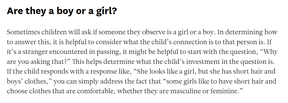
The article also stresses that children should be told from an early age that it is wrong to assume the gender of peers or even authority figures. If a child asks if someone is a boy or a girl, the appropriate response is to tell them “I’m not sure. Does it matter?” or “why are you asking that?”
Facilitate children adopting new sexual identities, and conceal the information from parents
This policy has been the most controversial flashpoint of SOGI curricula across Canada, and is already banned in Alberta. In 2024, the government of Alberta Premier Danielle Smith required school authorities to “notify parents where a student requests that teachers, principals and other school staff refer to them by a new preferred name or pronouns.”
But the standing policy of the B.C. Ministry of Education is that if a child of any age states that they want to adopt a new gender identity, the only appropriate response is to “affirm” the decision and mandate that students and school staff do so as well.
What’s more, the details of this affirmation may be concealed from the child’s parents if it is determined this is something they might find objectionable.
There’s an entire SOGI 123 unit on how to handle this process entitled Hello, My Name is Changing. School staff are to record the child’s new name and develop a strategy that will both alert other staff members to the social transition while potentially concealing it from family. “Make note of who will see what, including parents, teachers, other students, and administrative staff,” it reads.
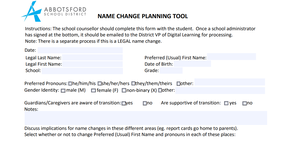
The example provided is an official Name Change Planning Tool printed by the Abbotsford School District. Included on the form is a yes/no checkbox on whether “guardians/caregivers are aware of transition,” and if they are “supportive of transition.”
This policy also comes up in the official script teachers are given to respond to parents who may have “misconceptions” about SOGI.
“Confidentiality is important for building a sense of trust and safety,” it reads. “We know that children’s wellbeing improves when they have safe adults who they can talk to.”
Bedeck schools in pride flags and calls to “action”
It is the rare B.C. school in 2026 that isn’t conspicuously draped in a year-round menagerie of pride flags, pride bunting, pride stickers, pride slogans, pride posters and even pride-themed accessories worn by staff.
The B.C. Teachers Federation maintains an online catalogue of queer paraphernalia distributed for free to BCTF members. Included is a poster reading “everyone loves a little something fruit. Queer is here,” and a sticker of the Progress Pride flag accompanied by the caption “this is a safe space for 2SLGBTQIA+ people.”

It is an explicit goal of the SOGI 123 program that school buildings should look like this, and their materials include guidelines encouraging teachers to install “rainbow displays” and even paint crosswalks and stairwells in pride colours.
What’s more, each of these displays must contain an “action” element. “A display with no action may create more harm than good,” reads a SOGI 123 guide, suggesting that rainbow displays be accompanied by a multi-point solidarity pledge that teachers must agree to before installing one.

A B.C. court has just declared that Canadians have a constitutionally protected right to deal drugs.
That may sound like hyperbole, but the Tuesday decision explicitly declares that a major drug trafficking provision in the Controlled Drugs and Substance Act “is of no force or effect” because of the judge’s view that it violates the Charter of Rights and Freedoms.
The specific provision makes it a crime to possess illicit drugs “for the purpose of trafficking.” And like most wacky Charter decisions, it was deemed unconstitutional on the grounds that it violated the Charter right to “life, liberty and the security of the person.”
B.C. is the same province where a judge ruled in 2023 that drug addicts had a Charter-protected right to shoot heroin or smoke meth on playgrounds. Again, that was premised on the idea that not allowing people to do drugs wherever they wanted violated their right to “life, liberty and the security of the person.”
But that one was only a temporary injunction. This latest decision effectively legalizes an entire category of drug trafficking. The case involves the Drug Users Liberation Front (DULF), a Vancouver activist group that essentially functioned as a soup kitchen for drugs such as cocaine or fentanyl. The argument being that DULF drugs were cleaner than the black market alternative.
The decision not only frees DULF to continue doing so, but called it a “benevolent” endeavour worthy of praise.
The National Post’s Jamie Sarkonak has a more thorough analysis, including her assertion that the decision’s author, Justice Catherine Murray, may have a bit of a bias problem.
First Reading is a Canadian politics newsletter curated by the National Post’s own Tristin Hopper. To get an early version sent directly to your inbox, sign up here.
Join the Conversation
This website uses cookies to personalize your content (including ads), and allows us to analyze our traffic. Read more about cookies here. By continuing to use our site, you agree to our Terms of Use and Privacy Policy.
KioskNews shows a cleaned-up reading view extracted from the publisher’s page — the original always lives on their site, not ours.