Donations to major parties and an ex-premier as a lobbyist: how datacentres play the political game in Australia

On 14 June 2025, Anthony Albanese stood inside an enormous sphere of glass and steel, surrounded by 40,000 plants from around the world. His mind was firmly fixed on datacentres. The prime minister was in the Seattle headquarters of Amazon Web Services. He stood alongside the company’s chief executive, Matt Garman, who outlined a $20bn plan to build datacentres in Melbourne and Sydney.
Speaking to a travelling press pack, Garman was emphatic that Australia was “incredibly important and a great market” for the world’s biggest datacentre company.
Within days of Albanese returning home, Amazon reported its largest payment to an Australian political party on record. The company’s federal disclosures show a $46,500 payment to the Labor party’s federal branch on 28 June.
This was one of 34 payments – totalling $538,000 – that Amazon made to Labor and Liberal branches over a six-year period.
While the money did not influence the government’s decision making, it continued a trend of Amazon disclosing payments shortly before or after multibillion-dollar announcements.
Payments such as this are legal. But as governments face community backlash for fast-tracking datacentres, these financial contributions are facing renewed scrutiny.
So, too, are the well-connected political operatives, from former policy advisers to at least one former premier, who have been paid to lobby governments on behalf of datacentre companies.
Transparency International Australia’s chief executive, Clancy Moore, says a cutting-edge industry is relying on old methods.
“Datacentres are the new extractive industries but [are] using the old techniques of cash for access payments and full scale lobbying to influence our political system,” Moore says.
Access to ministers
In 2024 the Albanese government announced a $2bn deal with Amazon Web Services to build three top-secret datacentres to store sensitive information gathered by intelligence agencies.
Eight days before that deal was announced, on 26 June, Amazon disclosed a $33,000 payment to Labor, according to Australian Electoral Commission filings. Less than six weeks later, another $33,000 payment was disclosed.
The payments were membership fees for the party’s fundraising vehicle, the Labor Business Forum, which facilitates access to ministers and MPs. Amazon has paid more than $200,000 in membership fees to the forum since mid-2021.
Under Australian electoral law, such membership or subscription fees to political fundraising vehicles are not technically classed as donations. Instead, they are listed as “other receipts”. But ultimately, the money goes to the same place: the party.
The proximity of these payments to major deals, while coincidental, highlights ongoing concerns about companies paying political parties for additional access to decision makers.
Amazon has also been busy attending state fundraising events.
Between mid-2021 and mid-2025, Amazon paid $38,100 to the New South Wales Labor party and $37,400 to the Liberals. During this period, the company was also pursuing several new datacentres on Sydney’s outskirts.
An Amazon spokesperson said its payments to fundraising forums were not related to public investments, including datacentre projects.
The federal government and the ALP national secretariat were contacted for comment.
Payments to NSW Liberals
In his final weeks as prime minister in 2022, Scott Morrison toured a new five-storey datacentre in Sydney’s north-west. After cutting a blue ribbon to declare the facility open, Morrison praised his hosts for keeping Australia at the “leading edge” of the digital economy.
Three days before Morrison’s 25 March speech, Macquarie Technology Group disclosed a $3,000 donation to the NSW Liberal party. This came shortly after two separate payments from the ASX-listed company to the same branch worth $15,000 in January 2022.
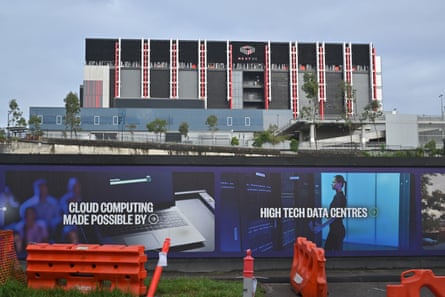
The company had been sending a steady stream of money to the NSW Liberal branch as the IC3 East datacentre was being built in the Macquarie Park innovation district. The money was also flowing as it plotted another larger adjacent datacentre, known as IC3 Super West.
Australian Electoral Commission disclosures show Macquarie made six payments to the state Liberals worth $10,700 between 12 November 2020, and 7 June 2021. NSW disclosures show the company also paid the branch $1,500 to attend a boardroom lunch with then Liberal treasurer, Dominic Perrotett, on 15 June 2021.
While there is no suggestion these payments sought to influence planning decisions or had any impact on applications, they overlap with milestones for the company.
On 15 July, Macquarie told investors about its plans for IC3 Super West, which could be fast-tracked by new rules deeming datacentre’s “state significant developments” that could be approved by a minister, rather than a local council.
Government documents show a planning application was under way by early August with a sustainability and emissions report completed on 26 October.
Three days earlier, on 23 October, the company paid $1,980 to secure a lunch meeting with Ryde’s Labor mayor, Jerome Laxale, and the then Labor leader, Chris Minns, at a Parramatta restaurant.
Laxale had no role in assessing the application, as it was before the state government. At the time, he was preparing for council elections on 4 December. In 2022, he stepped down after winning the federal seat of Bennelong.
after newsletter promotion
A spokesperson for Laxale said “all donations were reported in accordance with requirements”.
The City of Ryde has now become a strident critic of datacentres, despite having 12 existing or proposed facilities within its boundaries. It told a parliamentary inquiry in March this year that it was “deeply concerned” about a “rapid concentration” placing “significant pressure” on electricity and water supplies.
According to the AEC, Macquarie has paid $2.2m to state and federal branches of the Liberal and Labor parties since 2000.
A company spokesperson said “any suggestion that these activities influence planning outcomes is incorrect”.
“Macquarie Technology Group engages with federal, state, and local representatives from across the political spectrum through business forums, industry events and stakeholder engagement activities.
“[The group] complies with all state and federal electoral disclosure requirements and does not provide political support in exchange for planning approvals, government decisions, or policy outcomes.”
A NSW Liberal spokesperson said the party disclosed all donations in line with its obligations.
Former LNP premier hired, $20,000 donated
Datacentre companies are increasingly turning to well-connected lobbyists to further their commercial interests.
Viridis Green datacentres, which is proposing a number of small datacentres in regional areas, is among them.
The company has paid former Queensland National premier Rob Borbidge to lobby Liberal National party ministers and senior public servants on its behalf.
Lobbying records show that, in late August, Borbidge gave two of the state’s most senior planning officials a tour of a Brisbane datacentre built by the company.
This followed four meetings with public servants since March, including one arranged after discussions with a minister’s office.
Borbidge’s engagement came after Viridis made a $20,000 donation to the Queensland LNP on 20 October 2025. Sources familiar with the payment say it funded an event at the LNP party conference on the Gold Coast in November.
Viridis was contacted for comment.
‘Legitimate question to be answered’
Abigail Boyd, the upper house Greens MP leading a NSW parliamentary inquiry into datacentres, questioned why companies would pay political parties if they didn’t expect a return.
“Multi-billion dollar companies don’t make donations to major political parties for fun; they do it to acquire access, influence and good favour,” Boyd says.
The independent Australian Capital Territory senator David Pocock, a member of a federal inquiry into datacentres, says he is concerned about technology companies bankrolling election campaigns.
“We’ve seen big tech pour huge money into political donations ahead of the US midterm elections,” he says. “While at a smaller scale and in different ways, I’m concerned the same pattern is playing out here.”
The Centre for Public Integrity’s executive director, Catherine Williams, says a lack of transparency about federal lobbying activity “heightens community concern” about payments to political parties.
“There is a legitimate question to be answered about the purpose of any entity paying for party forum membership, or to attend political party/candidate events, if it is not to obtain access and influence that is beyond the reach of ordinary Australians,” Williams said.
KioskNews shows a cleaned-up reading view extracted from the publisher’s page — the original always lives on their site, not ours.