‘We’re in a brotherhood now’: the Bill Pickett rodeo – photo essay
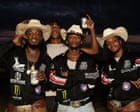
The image of the cowboy widely portrayed in westerns and popular culture has long been almost exclusively white. Yet Black cowboys hold an important place in the history of the American west. After the civil war and the abolition of slavery, many African Americans found work on ranches and on the great cattle drives westward. By the late 19th century, historians estimate about one in four cowboys were Black.
Among the Black figures who shaped this history was Bill Pickett. Born in Texas in 1870, he became one of the most celebrated Black cowboys and rodeo performers of his time, known in particular for popularising bulldogging, which would eventually give rise to modern steer wrestling.
-
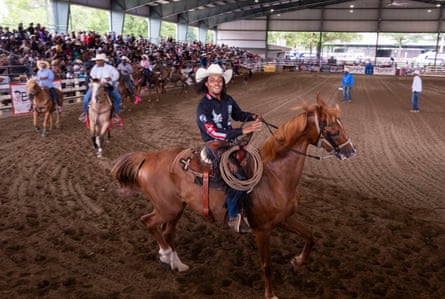
After the national anthem, Josh, a member of the Outlaws Most Wanted, rides around the arena to a pounding hip-hop track as his teammates cheer him on at the Bill Pickett invitational rodeo in Conyers, near Atlanta, Georgia, on 2 August 2026
-
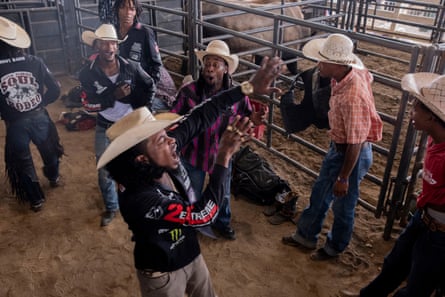
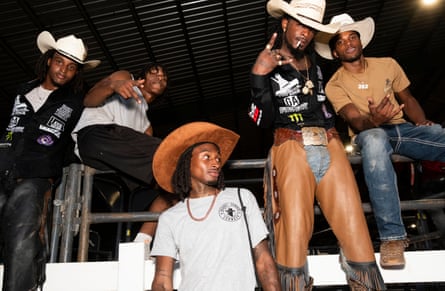
Members of the Outlaws Most Wanted joke and playfully challenge other riders, some of whom have travelled long distances to compete, backstage at the rodeo
His name was chosen by the promoter Lu Vason when he created the Bill Pickett invitational rodeo. In 1977, Vason attended Cheyenne frontier days and was struck by the absence of Black cowboys in the arena. His research led him to the Black American West Museum in Denver, where he discovered the story of Pickett and the history of African Americans in the American west. In 1984, he created a rodeo designed to give Black cowboys and cowgirls a platform and bring greater visibility to this heritage.
More than 40 years later, that mission remains at the heart of the Bill Pickett invitational rodeo. Part sporting competition, part spectacle and part space for passing on history and culture, its 2026 tour crosses the US from February to October, with stops including Memphis, Atlanta, Oakland and Los Angeles.
This year, I decided to join the tour in Atlanta.
-
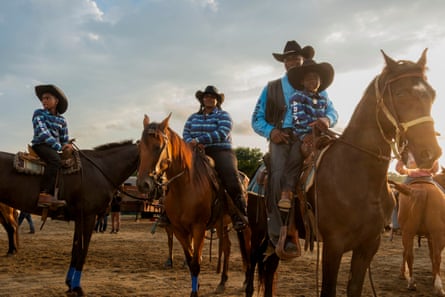
A family on horseback waits to enter the arena at therodeo, reflecting the intergenerational nature of a cowboy culture passed down through families. 1 August 2026
While there, I met for the first time a contact I had been speaking with before my trip. He runs Diamondcut Ranch, where he works with and trains horses, and around which a wider community of riders has formed. It was there that I met the Outlaws Most Wanted, a team of “bronc riders” competing at the Bill Pickett.
The organisers allowed me behind the barriers on the condition that I stayed with them. I found myself in the space just behind the arena, where the riders wait for their turn and prepare their equipment.
Music is everywhere. The riders joke around, encourage one another and build each other up. The energy and adrenaline rise as their turn approaches, until each rider has to move away from that collective excitement and focus on the few seconds waiting for him in the arena.
-
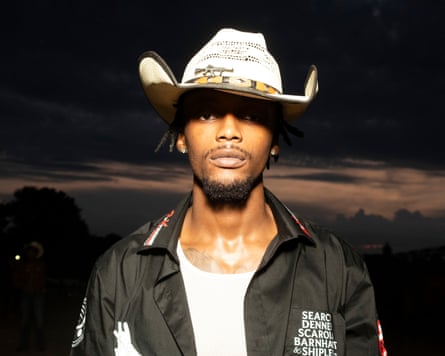
Rachied Robins, AKA Django, a member of the Outlaws Most Wanted bronc-riding team, who became my main contact and a key voice in telling the group’s story during the Bill Pickett invitational rodeo. 1/08/2026
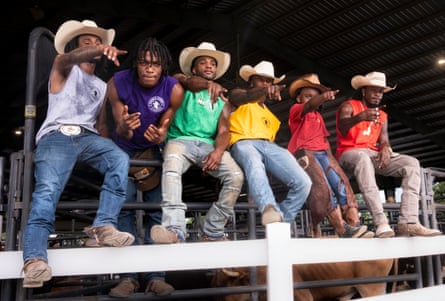
One of them, Rachied Robins, AKA Django, describes the Outlaws Most Wanted as a group of Caribbean men, some of whom have come from difficult backgrounds, brought together by their love of horses. Some, he says, found “refuge in this horse world”. Over time, their bonds grew stronger: “We’re in a brotherhood now.”
Django grew up in Kissimmee, Florida, surrounded by rodeo culture. He started out in bull riding before changing disciplines after a bull stomped on his face. He now competes in ranch bronc riding and laughingly describes himself as an “adrenaline junkie”.
But behind the adrenaline, there is also fear. Before he gets on the horse, thoughts of the danger and all the “what ifs” run through his mind. Then he has to find a way to clear his head.
-
The Outlaws Most Wanted bronc-riding team at the Bill Pickett rodeo
“You just gotta clear your mind and leave it in God’s hands.”
He has to trust his technique and make it through eight seconds. And even once the ride is over, the danger is not: Django tells me that getting off the horse can be one of the most dangerous moments.
There is also a financial side to competing. Django tells me that the Bill Pickett is not among the rodeos offering the largest purses: at the April event he competed in, he says a rider could win up to about $1,500 (£1,135), compared with as much as $10,000 at some other rodeos. But money is only part of what is at stake.
“It’s not just the money, but also your name, the respect, ranking.”
What struck me most about the Bill Pickett, however, perhaps happens beyond the competition itself.
-
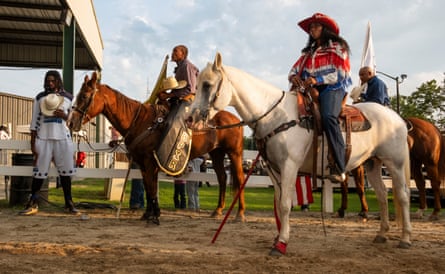
Riders wait to enter the arena in a solemn moment, hats held over their hearts, as The Star-Spangled Banner is sung a cappella at sunset before the start of the rodeo
Before the events begin, The Star-Spangled Banner is sung a cappella. Hats are placed over hearts, the riders stand still, and silence falls across the stands and the arena. I remember getting goosebumps and tears in my eyes.
Then, almost without transition, the atmosphere shifts completely and the adrenaline takes over.
All the riders enter the arena to a powerful hip-hop track. The volume rises, the horses come in, and the crowd shouts, applauds and dances. Within moments, the atmosphere moves from solemn stillness to an almost explosive energy.
That contrast captures much of what I felt at the Bill Pickett. History and memory are central to the event, but they are not frozen in the past. They coexist with hip-hop, fashion, competition and a deeply contemporary Black cowboy culture.
-
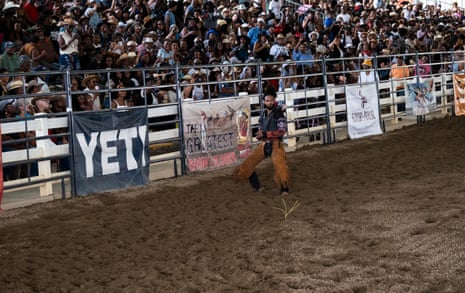
After his ride, a cowboy walks along the edge of the arena as the crowd cheers him on at the Bill Pickett
The audience is very much part of the spectacle. Western shirts, cowboy hats and boots fill the stands: people come to watch the rodeo, but also to gather, dance, show their style and celebrate a shared culture. Throughout the event, the announcers return again and again to the history of Black cowboys and the values the Bill Pickett seeks to pass on. That history is not confined to a few lines in a programme: it is an integral part of the event.
When I ask Django what the Bill Pickett means to him, he tells me that it is about more than just rodeo: “Bill Pickett means a lot to me personally. Not just because it’s a rodeo, but because it’s a platform for us minorities to come together.”
He talks about being able to show what they can do “as a group, as a unit”, but also about having a place where he can be himself and where he feels at home.
The Outlaws Most Wanted do not compete only at Black rodeos. Django tells me they compete wherever they have the opportunity and rejects the idea that these events are a form of separation. For him, they are above all about making a heritage visible: “We just want to bring out our heritage and bring out our history and show that we are part of this history, and this is part of our history.”
-
Members of the Outlaws Most Wanted bronc riding team gather behind the arena
It is also about passing something on. From trail rides to rodeos, horses create a space around which families, friendships and communities are formed. For some members of the Outlaws Most Wanted, this world has even become a refuge.
When I ask Django what he hopes the young people in the stands take away from watching him ride, he does not talk about becoming a cowboy or winning competitions. Above all, he hopes to show them that another path is possible: “Do something safe, do something legal, get out the streets, keep your mind right, don’t be another statistic.”
More than a century after Black cowboys helped shape the history of the American west while remaining largely absent from its popular image, the Bill Pickett offers a space where this heritage does not belong only to the past: it continues to be lived, passed on and reinvented.
KioskNews shows a cleaned-up reading view extracted from the publisher’s page — the original always lives on their site, not ours.